Get Full Government Meeting Transcripts, Videos, & Alerts Forever!
Get email alerts on the Small Business And Local Hiring topic
No spam. Unsubscribe anytime.
OCII reports recovery in contracting, local hiring in 2023–24; construction reached 45% small-business participation
Summary
The Office of Community Investment and Infrastructure told commissioners that contracting and local hiring rose in fiscal 2023–24, with construction spending on OCII projects achieving 45% small-business enterprise participation and local workforce hours increasing modestly compared with the prior year.
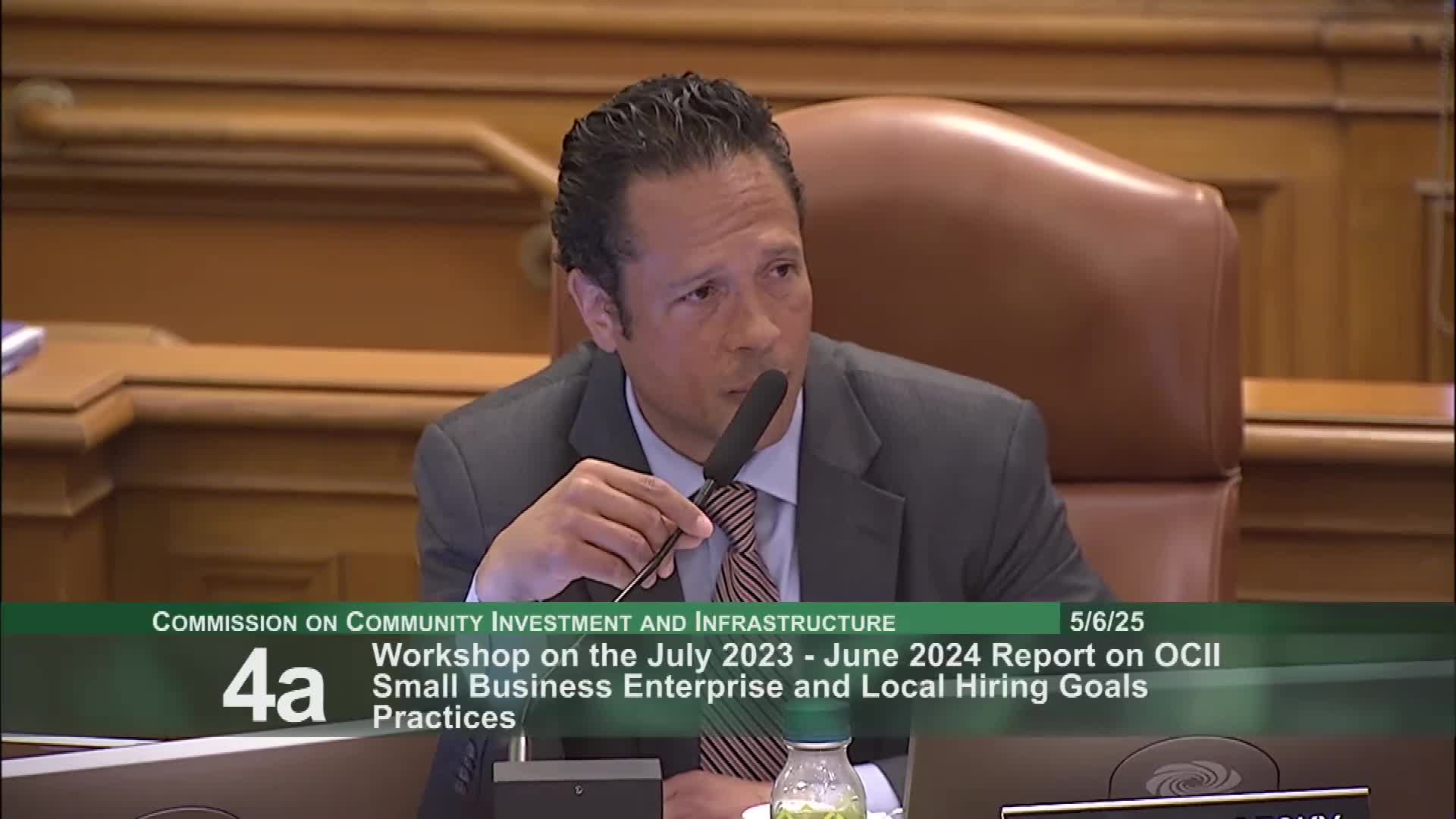
San Francisco27s Office of Community Investment and Infrastructure (OCII) presented its annual small business enterprise (SBE) and workforce status report for the 202324 fiscal year at the May 6 commission meeting, saying contracting activity has increased as the city recovers from COVID-19. Maria Pecot, OCII senior contract compliance specialist, and Julia Hernandez, contract compliance specialist, led the presentation.
OCII reported that developer- and contractor-awarded contracts within its project areas totaled about $234.1 million for the July 1, 202324through2306/30/2024 reporting period. Maria Pecot said OCII27s SBE policy "establishes a 50% SBE participation goal through documented good faith efforts," and that the program gives first consideration to firms in the project-area ZIP codes (94124, 94134 and 94107) followed by other San Francisco SBEs.
The agency said construction contracts on OCII projects achieved 45% SBE participation in 202324, representing more than $105 million credited to SBEs. Professional services contracts were credited with 29.8% SBE participation; staff noted that professional-services contracting in the year was limited and included a specialized environmental review contract of roughly $450,000. OCII also reported that around $77.2 million, or about 33% of total contract dollars, was credited to women- and minority-owned small firms during the reporting period.
On workforce, OCII reiterated its local-hiring practice that establishes a good-faith local-hiring goal of 50% of construction workforce hours on a contract-by-contract basis, giving first consideration to residents in the project-area ZIP codes and otherwise to San Francisco workers. CityBuild, the workforce-referral and compliance partner in the Office of Economic and Workforce Development, reported a recent CityBuild Academy cycle with 88 graduates and 71 hires (an 81% placement rate). OCII said CityBuild has produced 641 total local placements that include OCII project sites.
OCII also highlighted the agency27s architecture and engineering training program. In its ninth cycle completed in August 2024, OCII said seven local college students were placed in summer internships at design firms; five were later hired by architectural firms and two joined construction project-management roles. Since 2016, OCII said the program has created 86 student positions across 42 firms.
Commissioners asked about outreach and coordination. Pecot described regular pre-bid meetings, mandatory workforce kickoff meetings, weekly certified payroll monitoring and monthly compliance discussions with CityBuild, developers and contractors. OCII staff said they continue outreach via the agency website, the city procurement portal, local trade and business groups, and community advisory committees.
The presentation did not propose action; commissioners received the report and commended staff and the CityBuild partnership. OCII said it will continue monitoring participation, refining outreach, and reporting results in future updates.