Get Full Government Meeting Transcripts, Videos, & Alerts Forever!
Get email alerts on the Vision Zero Traffic Safety topic
No spam. Unsubscribe anytime.
Committee reaffirms Portland’s commitment to Vision Zero and directs task‑force planning; sends resolution to full council 5–0
Summary
The Transportation and Infrastructure Committee voted unanimously to send to full City Council a resolution reaffirming Portland’s commitment to Vision Zero and to reconvene a cross‑bureau Vision Zero task force, following broad public testimony urging increased funding, data transparency and enforcement.
The Transportation and Infrastructure Committee voted 5–0 to refer to full City Council a resolution that reaffirms Portland's commitment to Vision Zero (Vision 0) and calls for reconvening a cross‑bureau Vision Zero task force to coordinate citywide efforts to reduce traffic deaths and serious injuries.
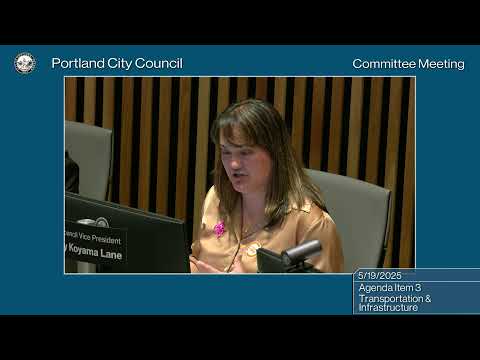
Councilor Koyama Lane, who introduced the measure, said, “No person should die or be injured from simply going about their day,” and urged renewed priority and accountability for Vision Zero work. She reviewed the program's history — saying Portland first committed to Vision Zero in June 2015 — and said data from the past decade shows a rise in traffic deaths that demands renewed action. In presenting the resolution, Koyama Lane said the principal action is reconvening a Vision Zero task force to increase cross‑bureau collaboration, accountability, reporting frequency, and community engagement.
Public testimony was extensive. Stacey Triplett, engagement director for AARP Oregon in Greater Portland, urged the committee to prioritize pedestrian safety and noted older adults and Black and Indigenous people are overrepresented in pedestrian fatality statistics. Zachary Lauritzen of Oregon Walks told the committee, “It’s not your fault,” to emphasize institutional choices that produced the current system; he urged councilors to give PBOT both funding and political cover for street‑design changes and called out specific projects such as full transit lanes on 82nd Avenue as concrete examples. Lauren McCune of Bike Bus PDX described growing demand for safe bike routes and urged pairing Vision Zero with measures to reduce vehicle miles traveled.
David Sale of Families for Safe Streets recounted the 2009 TriMet crash that killed two people and injured others; he asked the committee to use the term “crashes” rather than “accidents,” saying they are preventable. Multiple speakers called for staffed, funded accountability, more automated camera enforcement, and cross‑bureau leadership rather than placing responsibility solely with PBOT.
Council members used the committee hearing to outline budget notes and amendments tied to the Vision Zero effort. Councilor Murillo said she will propose amendments reallocating recent police funding to traffic safety infrastructure, including a proposal she described to provide $800,000 to PBOT for pedestrian safety work on Cesar Chavez Boulevard and an option to repurpose a $2 million increase in police funding for Vision Zero actions. Councilor Green outlined support for increasing the transportation network company surcharge (currently 65¢ per trip) as a revenue source — he said raising the fee to $2 could generate several million dollars for transportation and help shift travel behavior — and described budget notes to add positions to implement pro‑housing and transportation work. Councilor Koyama Lane described budget notes and two amendments to centralize Vision Zero administrative support, increase reporting frequency and data disaggregation by race/ethnicity and equity zones, and to move the city's Vision Zero lead position from PBOT to the Deputy City Administrator’s office for greater cross‑bureau visibility; she also said she will ask for funding to partially restore a shortfall for Vision Zero programs (~$500,000 request to cover an identified $300,000 gap).
Committee members and several witnesses emphasized implementation tradeoffs and the political will required to change street design, enforce speed limits, and fund safer infrastructure. Witnesses urged protecting existing safe routes (Lois Levine, Lewis & Clark College, described the Riverview Cemetery shared‑use route and asked the city to help secure a long‑term solution), engaging community members early in project design (John Jacopi, South Tabor neighborhood), and considering non‑road alternatives such as water transit (Susan Bladholm, Frog Ferry).
Councilor Murillo said she has three separate amendments and emphasized she will push to move police funding toward traffic safety. Councilor Koyama Lane said she welcomes skepticism and community oversight and emphasized transparency and quarterly reporting. Chair Clark and other councilors expressed support for the resolution and for continuing work on safety and asset management.
The committee then voted by roll call to send the resolution to full City Council with a recommendation that the resolution be adopted. Voting: Koyama Lane — Aye; Murillo — Aye; Green — Aye; Smith — Aye; Chair Clark — Aye.
Formal committee action was referral of the resolution to full council with a positive recommendation. Several councilors announced distinct budget notes and amendments that would be considered in the upcoming budget process; those proposals remain subject to committee and council budget deliberations.