Get Full Government Meeting Transcripts, Videos, & Alerts Forever!
Get email alerts on the Energy Efficiency topic
No spam. Unsubscribe anytime.
County airport manager outlines energy-audit pilot, proposes AI controls and net-zero airport steps
Summary
Gary Goddard, Los Alamos County airport manager, presented a targeted energy audit of the Municipal Building, proposed a BrainBox AI continuous-commissioning pilot and outlined measures (solar, heat pumps, automated shades) to pursue a net-zero airport, with estimated HVAC savings and possible countywide scaling.
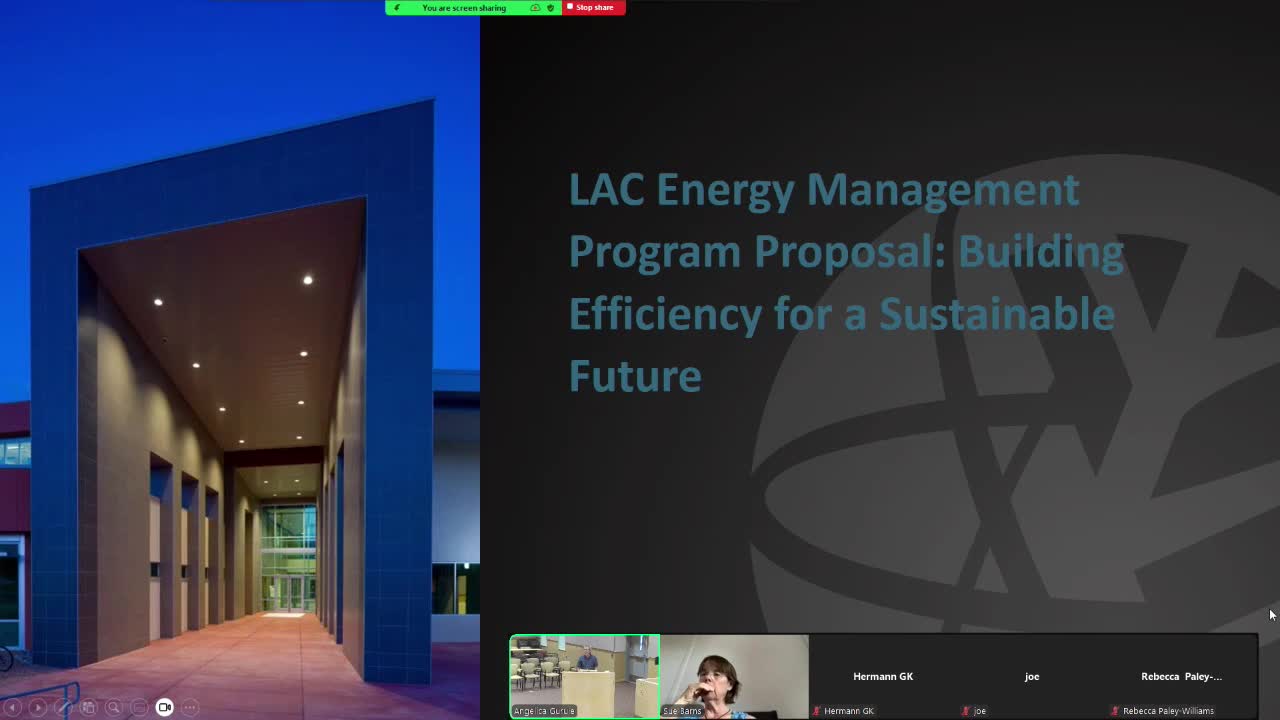
Gary Goddard, Los Alamos County airport manager, told the Environmental Sustainability Board on May 15 that a targeted energy audit of the Municipal (Muni) Building found operational problems that are common in older or long-operated commercial buildings and that the county could pilot an AI-based continuous-commissioning system to preserve energy savings.
Goddard said the audit, done with volunteer Joe Close, showed the Muni Building was using about 25% more energy than a comparable office building despite its LEED Gold designation. He described a set of routine operational failures: weekend schedules that kept equipment running unnecessarily, a disabled economizer (outdoor-air damper), a fixed supply temperature instead of a reset based on load, duct static pressures not optimized, a heating/hot-water loop running 24/7 because of broken speed controllers, and aging building-automation controllers.
The board heard that crews corrected or programmed most of those issues and that a small number of physical repairs remain as work orders. Goddard said those fixes effectively re-baselined the building to its intended design performance and that the county should track utility data over time to verify savings.
Goddard proposed a pilot of BrainBox, an AI-based optimization product now owned by Trane, to perform continuous commissioning: monitor building-automation points, identify anomalies, adjust set points (for example discharge temperatures and fan static pressure) and revert changes if performance worsens. He said BrainBox can also generate diagnostics and alerts to facilities staff and would reduce the natural entropy that causes efficiency to degrade over several years.
The presentation included a suggested pathway: complete targeted audits for a few county buildings, develop audit templates (possibly using interns under oversight), pilot BrainBox on an eligible building and evaluate whether an energy-management position could be funded from verified savings across the county’s portfolio.
On the airport specifically, Goddard described the terminal building as built in 1947 with unfilled cinder block, high ceilings and many windows; it currently uses a large share of natural gas for heating. He discussed measures already in motion — adding automated south-side shades tied to a small building-automation system, possible reuse of county landfill solar arrays, roof-mounted photovoltaic arrays on a large flat roof, and switching from gas furnaces to electric heat-pump systems where feasible. He also said he has begun offering the airport space for small community events to increase public use.
Board members asked about the math and countywide applicability. Goddard said the Muni Building audit suggested a conservative estimate of roughly 20% HVAC energy savings from scheduling and economizer fixes alone, and that savings could be higher in some buildings; he cautioned that the exact number depends on the building and that one year of normalized metered data will be needed to validate any projections. Staff reported the county has roughly 50 buildings and about 25 currently use Trane building-automation systems that are candidates for BrainBox after controller upgrades.
Members suggested partnerships and research uses — for example, involving New Mexico Tech or local pilot/tourism groups for demonstrations and grants. Goddard said the Civil Air Patrol and Experimental Aircraft Association already use airport facilities on weekends and that tourism or education uses could increase public benefit.
Board members also asked about LEED recertification. Goddard and other participants said many LEED-certified buildings lapse in operational performance without ongoing commissioning; the group agreed staff should check the Municipal Building’s LEED operational status via USGBC/LEED records.
No formal vote was taken. Board members expressed support for the pilot concept and asked staff and Goddard to return with follow-up data after re-baselining and, if possible, a one-year normalized-energy update to show measured savings.
Ending: Staff and the presenter agreed to continue with the pilot steps — completing remaining work orders, implementing monitoring and producing a follow-up report on measured energy use and any verified savings. Goddard offered to return to the board with results and further recommendations once the monitoring period yields data.