Get AI Briefings, Transcripts & Alerts on Local & National Government Meetings — Forever.
Senate hearing: Prop 36 implementation faces major funding shortfalls as counties, courts and treatment providers seek tens of millions
Summary
A June informational hearing by two California Senate committees found implementation of Proposition 36 is underway but underfunded. State and local officials described gaps across courts, probation, behavioral health and indigent defense and urged lawmakers to allocate new resources while the Second Chance Fund grant cycle is launched.
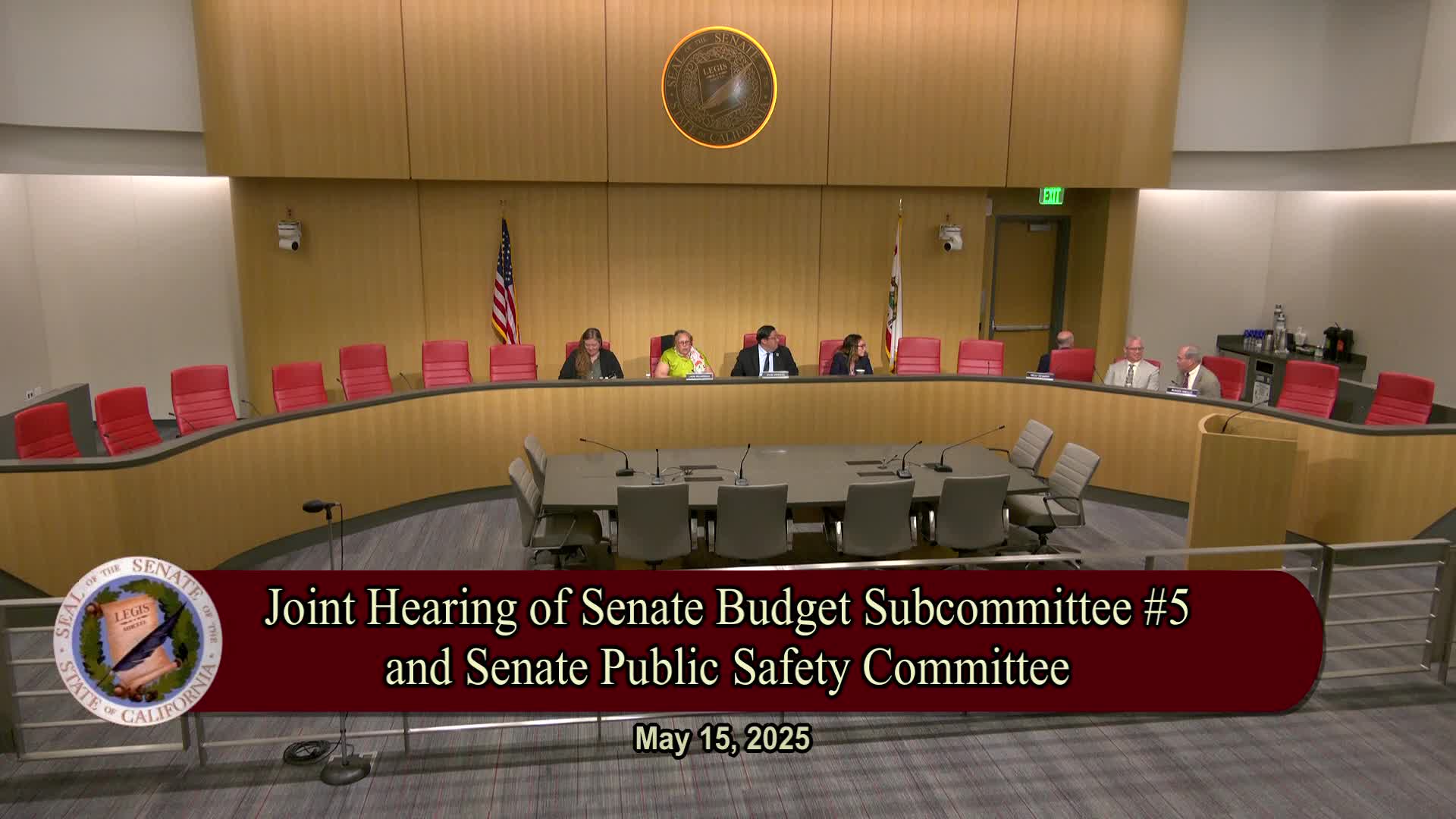
SACRAMENTO — State and local officials told a joint informational hearing of California Senate Budget Subcommittee No. 5 and the Senate Public Safety Committee that Proposition 36 implementation is underway but faces serious funding and capacity shortfalls that threaten the law’s promise of treatment over incarceration.
"As the governor announced yesterday, we have a $12,000,000,000 budget problem to solve," Sen. Susan Richardson, co-chair of the joint hearing, said in opening remarks. "We are facing potentially devastating cuts primarily in health care." Richardson urged lawmakers to weigh Prop 36 needs as they negotiate the state budget.
The hearing focused on the fiscal interaction between Prop 36 (the recent voter initiative creating a treatment-mandated felony pathway) and Proposition 47 (the 2014 measure whose prison-savings fund — often called the Second Chance Fund — supplies competitive grants). Justin Adelman, assistant program budget manager at the Department of Finance, said "the May revision includes $88,500,000 for Proposition 36," split between projected state prison costs and grant funding for treatment and diversion programs. Adelman said roughly $29,300,000 is budgeted for marginal prison costs in 2025–26 and about $49,200,000 is the Department of Finance’s estimate of the 65% share that flows to the Board of State and Community Corrections (BSCC) from Proposition 47 savings.
But multiple witnesses warned that the pool of Prop 47 savings available for grants will decline as Prop 36 increases state prison costs. Adelman and other presenters said BSCC grant availability could fall to roughly $17,400,000 by 2027–28 unless other funding sources are provided.
The Board of State and Community Corrections has moved to release a fifth grant cohort to speed funding to local agencies. "In April of this year, the board approved the release of this fifth cohort of funding with $127,000,000 made available," Aaron Maguire, executive director of the BSCC, told the committee. Maguire said the BSCC anticipates awarding grants at the board meeting in September 2025; applicants may seek up to $2,000,000 (small), $8,000,000 (large), and Los Angeles County may apply for a single $20,000,000 set‑aside.
Judicial and court officials reported steep near-term workload increases. Francine Byrne of the Judicial Council said a February court survey (responses representing 98% of the state population) showed roughly 20,000 felony filings annually that would have been misdemeanors absent Prop 36; after excluding higher-level felonies that would have required felony processing in any event, Byrne estimated about 15,000 filings that directly affect court workload. Byrne warned the difference between handling a misdemeanor and a felony is substantial and cited an earlier Judicial Council study estimating roughly $650 more operational cost per filing for felonies versus misdemeanors.
San Bernardino County Presiding Judge Lisa Rogan described large county-to-county variation in readiness. "Some counties, their participant, increased by 500%. There's no way that you could anticipate having that type of number and be readied for it without the appropriate funding and resources available," she said, urging legislators to consider unequal impacts across urban and rural counties.
The California Department of Corrections and Rehabilitation (CDCR) warned the long‑term population impacts remain uncertain. Kathy Jefferson, deputy director of CDCR’s Office of Research, said the department’s spring 2025 projections assume a gradual admissions increase beginning January 2025 and that releases to parole will be lower than initially modeled; CDCR projected a net 3.1% five‑year decline in institution population through June 30, 2029 but said Prop 36 assumptions will be updated as new data arrive.
Public safety and local officials described gaps at the county level. San Ramon Police Chief Denton Carlson (California Police Chiefs Association) and Orange County Sheriff Don Barnes said local law enforcement needs investigative capacity, evidence systems and sustained funding. Sheriff Barnes emphasized large local investments already made in jail‑based treatment and reentry supports and urged the state to view implementation as an investment in public safety rather than an expense.
Probation, indigent defense and behavioral‑health leaders made specific budget requests. Steve Jackson, president of the Chief Probation Officers of California, said probation needs to scale up for pretrial coordination, treatment linkage and supervision and requested $47,000,000. Michelle Cabrera of the California Behavioral Health Directors Association estimated counties would need to hire roughly 2,000 staff and that the state cost to expand behavioral health capacity could range from $95,000,000 to $213,000,000 annually, depending on assumptions about assessments, court work and treatment placements. The California Public Defenders Association asked for $120,000,000 over three years to fund holistic indigent‑defense teams (social workers, housing specialists and mental‑health professionals) to support diversion and treatment outcomes.
Several counties and advocates urged supplemental general‑fund support. Tarek Imboe Eastman of the Steinberg Institute, a coalition of treatment providers and county groups, and others recommended an initial allocation of roughly $105,000,000–$120,000,000 to expand treatment capacity and preserve proven Prop 47‑funded programs. Advocates also asked lawmakers to remove administrative fees that can block access to diversion and to monitor implementation with robust data.
Committee chairs requested more and regular data. Members asked the Judicial Council for updated filings through April and asked state agencies for centralized, roll‑up estimates of new costs to state and local systems (courts, jails, probation, behavioral health) to inform the budget process. The committee signaled an intent to hold another hearing in January and to consider funding changes as budget negotiations proceed.
Why it matters: Prop 36 was passed by voters as a treatment‑focused alternative to prison, but committee witnesses agreed the law’s promise depends on local treatment capacity, court infrastructure and supervision resources. Witnesses told senators that the available Prop 47 savings and current county budgets are unlikely to cover the years ahead without additional state support or alternative funding, producing a mismatch between increasing case loads and declining grant revenue.
The hearing produced no formal legislative actions. Instead, the discussion produced a list of data and budget requests the Senate staff said they will collect and use in the upcoming budget negotiations. Committee chairs asked agencies for quarterly updates and additional hearings so lawmakers can track implementation and budget impacts as Prop 36 rolls out.
Ending note: Presenters repeatedly urged the Legislature to balance short‑term needs (courts, treatment access, transportation and probation staffing) with long‑term planning, saying early investments could reduce incarceration and downstream costs over time.