Get Full Government Meeting Transcripts, Videos, & Alerts Forever!
Get email alerts on the Human Trafficking topic
No spam. Unsubscribe anytime.
Assembly approves AB 379 to expand penalties for solicitation of minors, boost survivor support
Summary
The California Assembly passed AB 379 on May 1, 2025, unanimously, creating new felony and misdemeanor offenses targeting adults who solicit minors, increasing fines for businesses that enable trafficking, and directing fines into a survivor support fund and prosecution grants.
The California State Assembly on May 1, 2025 passed Assembly Bill 379, a measure that expands criminal penalties for adults who solicit minors and increases civil and administrative enforcement against businesses that allow trafficking on their premises, by a recorded vote of 72-0.
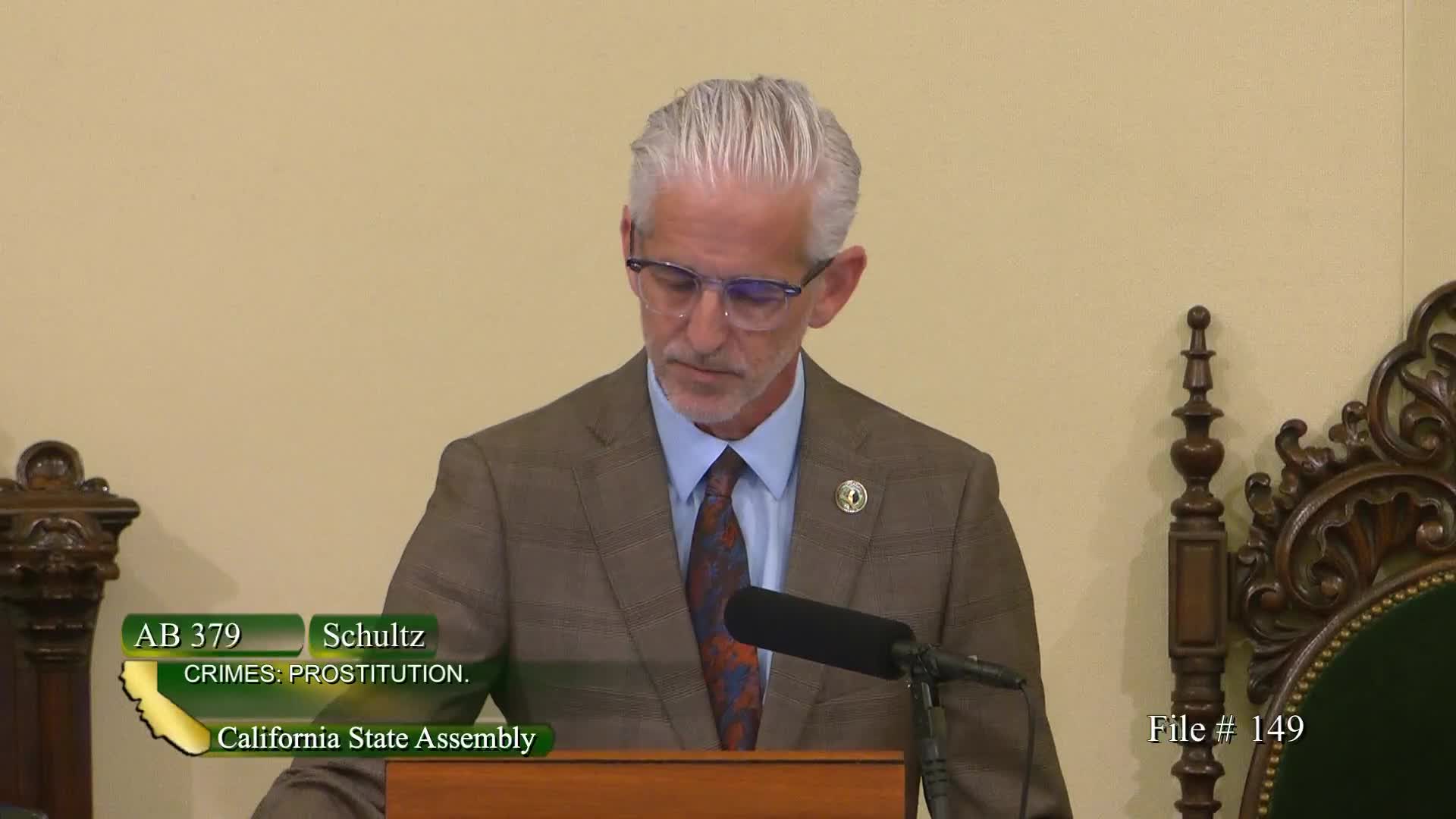
AB 379, introduced on the Assembly floor by Assemblymember Schultz, adds several enforcement tools and survivor supports to state law. The bill authorizes felony punishment for solicitation of any minor by an adult more than three years older than the minor, makes a second or subsequent solicitation violation a felony, creates a misdemeanor offense for loitering with intent to purchase commercial sex, and requires persons convicted of solicitation who receive probation to attend a mandatory education program on human trafficking and child exploitation.
The bill also expands enforcement and penalties for establishments. It authorizes the California Attorney General to enforce the state's human-trafficking notice posting requirements and to pursue civil remedies against hotels and other businesses that knowingly allow trafficking to occur in their facilities. Fines for establishments that intentionally turned a blind eye were increased in the bill from a prior range of $1,000 to $10,000 per violation to a new range the author described as $3,000 to $25,000 per violation. The bill raises the penalty range for failure to post mandatory human-trafficking notices from $500'$1,000 to $1,000'$2,000 and adds an additional $1,000 fine tied to the new loitering offense.
AB 379 creates a survivor support fund administered by the Victim Compensation Board, directing fines and fees into grants for community-based organizations that provide direct services and outreach to trafficking survivors. The bill also establishes a vertical-prosecution grant program to incentivize local district attorneys to assign prosecutors and investigators to specialized human-trafficking units.
Assemblymember Schultz, the bill's author, framed AB 379 as a comprehensive package that combines stronger penalties with new tools for prosecutors and expanded supports for survivors. "AB 379 also includes tougher penalties for businesses that are complicit in human trafficking. It includes new tools for prosecutors and enhanced supports for survivors," Schultz said on the floor.
Several members praised the bill's focus on victims and demand reduction. "There is no such thing as a child prostitute," Assemblymember Gallagher said in supporting the measure. Supporters argued the package closes gaps in existing law while funding survivor services.
At the same time, Assemblymember Sharp Collins said she would support the bill in part but voiced continuing concern about the new loitering provision, calling it vague and warning such laws have historically been applied in a discriminatory manner. "When laws are vague, they are ripe for profiling," Sharp Collins warned, citing arrest statistics from Los Angeles and urging further refinement and protections for vulnerable populations as the bill moves to the Senate.
Assemblymember Schultz and coauthors repeatedly committed on the floor to continue refining the bill as it proceeds, including addressing concerns about enforcement and disparate impacts.
The bill now moves to the Senate for consideration.