Get Full Government Meeting Transcripts, Videos, & Alerts Forever!
San Mateo commissioners, public weigh five policy pathways to electrify existing buildings
Summary
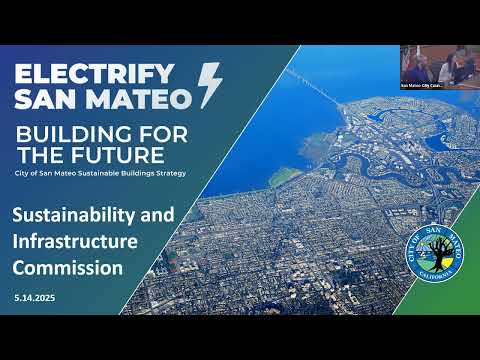
City staff and a consultant presented "Electrify San Mateo," a study of five policy pathways to phase natural gas out of buildings; commissioners and more than a dozen public commenters debated costs, equity and timing and asked staff to bring the item to City Council in June.
City of San Mateo sustainability staff and a consultant presented an update on “Electrify San Mateo” — a city-led effort to identify pathways for replacing natural‑gas appliances with electric alternatives in existing buildings — and asked the Sustainability and Infrastructure Commission for feedback on five policy approaches.
Andrea Chow, the city’s sustainability analyst, and Ryan Gardner of Rincon Consulting described the project’s goals and the five policy pathways under consideration: (1) business as usual (outreach plus continued all‑electric new‑construction reach codes); (2) reach codes for renovations (time‑of‑replacement or work‑threshold triggers such as an air‑conditioner replacement or major renovation); (3) moving faster than the Bay Area Air District’s phase‑in of low‑NOx equipment (an earlier local start date for banning new NOx‑producing space and water heaters); (4) commercial building performance standards (benchmarking and retro‑commissioning for larger nonresidential buildings); and (5) a municipal “electric‑first” policy to require or prioritize electric equipment in city facilities. "Our goal tonight is to provide more background and overview of building electrification and how the project has progressed so, thus far," Chow said.
Why it matters: staff framed electrification as a major lever for San Mateo’s Climate Action Plan. Gardner told the commission that, under current modeling, natural gas could still account for roughly 38–39% of the city’s emissions by 2030–2045 unless existing buildings are decarbonized. He said electrification reduces greenhouse gases and local air pollutants and — with available rebates and the right electric rate — can lower household bills over time.
Key technical and financial details presented: Gardner summarized the project’s outreach and modeling and gave ranges for upfront costs and incentives. Examples from the presentation and public discussion: - Heat‑pump water heaters: average installed cost shown at about $6,000; Peninsula Clean Energy (PCE) rebate…
Already have an account? Log in
Subscribe to keep reading
Unlock the rest of this article — and every article on Citizen Portal.
- Unlimited articles
- AI-powered breakdowns of topics, speakers, decisions, and budgets
- Instant alerts when your location has a new meeting
- Follow topics and more locations
- 1,000 AI Insights / month, plus AI Chat