Get Full Government Meeting Transcripts, Videos, & Alerts Forever!
Get email alerts on the Criminal Defense Ineffective Assistance topic
No spam. Unsubscribe anytime.
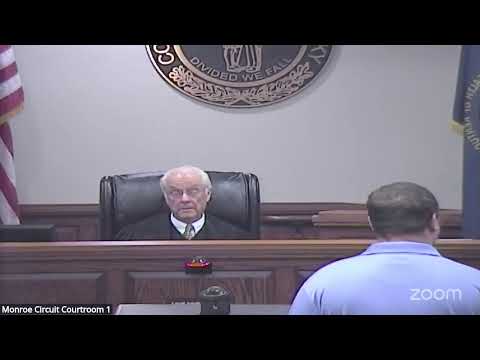
Monroe County court holds evidentiary hearing on John Smith's alibi claim; judge takes matter under advisement
Summary
An evidentiary hearing on John Smith's 11.42 motion alleging ineffective assistance of counsel was held in Monroe County Circuit Court, where the judge heard testimony from the defendant, defense investigators and a state police detective before taking the matter under advisement and ordering written briefs.
An evidentiary hearing on John Smith's 11.42 motion alleging ineffective assistance of counsel was held in Monroe County Circuit Court, where the judge heard testimony from the defendant, defense investigators and a state police detective before taking the matter under advisement and ordering written briefs.
Smith told the court he had called people from a landline at a residence he said he was at when the victim was killed and that his trial attorneys and investigators failed to pursue phone records and witness testimony that could have corroborated that alibi. "You can't be in two places at once," Smith said on the record.
The hearing focused on whether defense counsel investigated and presented a possible alibi: the court heard from investigator Jessica Shoemaker (formerly with the Department of Public Advocacy, now with Inquisitor Inc.), who testified she was assigned to interview a witness identified as Loretta (Decker) Walker, subpoenaed her and prepared notes that were later provided to the defense team. Shoemaker said she served subpoenas and attempted to secure Walker's appearance but that Walker did not appear at trial. Defense counsel Michael J. Buffkin, who was on the defense team at the time, testified he had directed investigators to seek records and statements and that subpoenas were issued; he said, however, that the records and witness testimony available then did not establish the alibi in a way he believed he could present to a jury.
The Commonwealth called former Detective Russell Decker, who authenticated an interrogation recording of Smith the morning after the killing and testified the recording was an accurate contemporaneous record of the police interview. Portions of the recording were played in court; the recording captured Smith saying he had a cell phone in his pocket the morning he was detained and discussing whether he had made or received calls the day of the offense.
Buffkin and the investigator described steps taken: subpoenas for phone records (landline and cellular) and investigative interviews. Shoemaker testified she served subpoenas and prepared a memo of her interview with Walker; she said she preserved a copy of her notes after leaving the public defender's office and emailed the memo to the then-defense counsel. Buffkin testified he would have called any witness whose testimony he determined would be helpful, and that had investigators produced records that demonstrated a reliable alibi he would have used them. He also explained limits of phone-location evidence (cell tower "triangulation" vs. landline fixed location) in establishing a precise physical location.
After hearing testimony and arguments, the judge said he needed time to consider the record and told counsel to file written submissions; the court set a 30-day period for those filings and took the motion under advisement. The judge made no immediate ruling on whether trial counsel's performance was deficient or whether any deficiency prejudiced Smith.
The hearing record reflects: defense investigators were assigned and issued subpoenas for phone records and for a witness (Loretta Walker); Walker did not appear at trial; investigators produced memoranda that were given to counsel; the Commonwealth authenticated an interrogation recording; the court has requested written briefs and will issue a written decision after review.
If the court later finds ineffective assistance that materially affected the outcome, it could order relief ranging from a new trial to other post-conviction remedies; no such relief was ordered at the hearing.
Speakers who testified or were directly referenced at the hearing included John Smith; Michael Joseph Buffkin (defense attorney, Department of Public Advocacy); Jessica Shoemaker (investigator, Inquisitor Inc., formerly Department of Public Advocacy); Josephine Guy (investigator, referenced); Detective Russell Decker (Kentucky State Police); and the presiding judge (unnamed in the record).