Get Full Government Meeting Transcripts, Videos, & Alerts Forever!
Get email alerts on the Restitution Apportionment topic
No spam. Unsubscribe anytime.
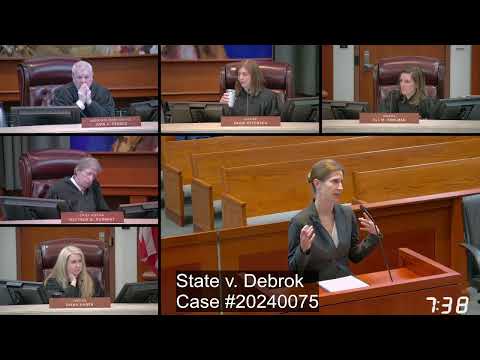
Utah Supreme Court hears arguments on whether restitution can be apportioned in State v. DeBrock
Summary
The Utah Supreme Court heard argument Oct. 26, 2025, on whether a criminal restitution order must make each defendant jointly and severally liable for a victim's entire pecuniary loss or whether courts may apportion restitution among multiple defendants under Utah's Liability Reform Act (LRA).
The Utah Supreme Court heard argument Oct. 26, 2025, on whether a criminal restitution order must make each defendant jointly and severally liable for a victim's entire pecuniary loss or whether courts may apportion restitution among multiple defendants under Utah's Liability Reform Act (LRA).
At oral argument, Natalie Scabine, representing the defendant, argued that language in the LRA governs allocation and that criminal restitution need not be joint and several. "Restitution for the entire amount of pecuniary damages that are proximately caused to each victim does not mean that the award must be joint and several," Scabine told the court, arguing the LRA provides a statutory framework for apportionment by fault and that recent statutory changes to the restitution law do not foreclose applying those civil principles.
Aaron Middleton, representing the State of Utah, urged the court to affirm the lower courts and hold that restitution orders are governed by the Crime Victims Restitution Act (CVRA) and are not subject to civil apportionment principles. "This court should affirm the district courts and hold that restitution orders are not subject to civil allocation of fault principles," Middleton said, emphasizing the statute's plain language requiring the court to order a defendant to pay "the entire amount" of damages the defendant proximately caused.
Counsel debated how to read amendments to the restitution statutes enacted since earlier cases the court relied on. Scabine argued that the LRA's definitions of "fault" and the statute's allocation mechanisms fit restitution and supply the needed procedure for dividing liability when multiple parties contributed to a victim's losses. Middleton countered that the restitution statutes now remove the prior ties to civil remedies and discretionary procedures and that the CVRA's text and purposes—fully compensating victims and addressing concerted criminal activity—weigh against applying civil comparative-fault rules.
The court also discussed practical consequences raised by counsel: whether apportionment could leave victims uncompensated if some defendants cannot pay; whether apportionment would invite attempts to shift blame onto victims; how proximate-cause and superseding-cause doctrines interact with apportionment; and whether common-law contribution or statutory mechanisms would allow a paying defendant to pursue nonpaying codefendants. Counsel cited prior Utah cases the court has considered in restitution contexts, including Ogden, Oliver, Grant and Graves, and debated how statutory changes affect those precedents.
The record in this argument included a factual point about the underlying plea: counsel stated the defendant pleaded to unauthorized possession of property and that the plea agreement appeared to contemplate splitting restitution with a codefendant. The parties agreed the case presents a question about statutory interpretation rather than disputed historical facts for the court to resolve.
After argument, the court took the case under advisement and said it would issue a written opinion. The court recessed to reconstitute and then moved to its next matter.
Background: Utah's Crime Victims Restitution Act directs courts to order a defendant to pay the "entire amount of pecuniary damages that the defendant proximately caused," language that lawyers debated at length. The Liability Reform Act provides statutory rules for apportioning fault in civil cases, including definitions of "fault" and procedures for allocating percentages of responsibility. The parties' dispute centers on whether the LRA's apportionment rules apply in criminal restitution proceedings given statutory amendments in recent years that, according to the State, severed the restitution statute's ties to civil remedies.
No decision was announced from the bench; the court will issue its written opinion resolving the statutory question.