Get Full Government Meeting Transcripts, Videos, & Alerts Forever!
Get email alerts on the Itd Ticketing And Slas topic
No spam. Unsubscribe anytime.
Audit shows wide range of ITD ticket lifecycles; commissioners press for clearer service-levels and billing
Summary
A preliminary review found ITD service tickets and work orders show lifecycles from one day to more than 1,100 days; commissioners asked ITD to present a clearer explanation of MOU, SLA, fees and ticketing at a future meeting.
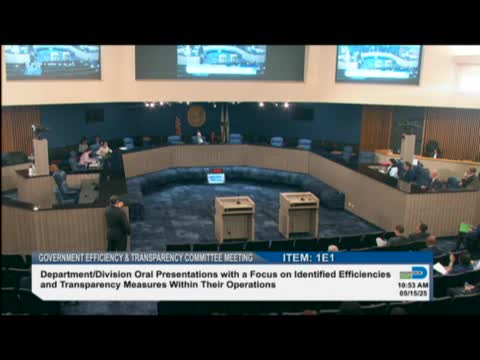
A preliminary review of Miami-Dade County IT Department (ITD) ticketing and memorandum-of-understanding practices presented at the May 15 committee meeting found a broad range of ticket lifecycles, with the minimum lifecycle recorded at one day and some incidents and work orders taking more than 1,100 days to close.
Yanko Majokudami from the commissioner’s office said the review examined the MOU background, SLAs and how service-level agreements are executed through Remedy work orders and incident tickets. Majokudami said ITD processes approximately 200 work orders and over 300,000 incident tickets; the preliminary dataset showed a minimum closure timeframe of one day and a maximum of more than 1,100 days. “The minimum that we had in our report was 1 day ... the maximum we had through the report was over 1100 days,” Majokudami said.
Margaret Brisbane, ITD director, told the committee IT consolidation began about 12 years ago and that while services are centralized, departmental staffing that holds institutional knowledge remains in place. She said ITD meets monthly with department directors to align priorities, develops road maps jointly with departments (RER was cited as an example), and is working to modernize legacy systems and deploy dashboards. Brisbane acknowledged that some tickets reflect different kinds of work—incidents resolvable in short order versus projects that require procurement, vendor implementation or cross-departmental action—and that ITD will provide additional analysis to distinguish those categories.
Commissioners pressed for clarity about how ITD bills departments (a general fee plus billable services), the relationship to enterprise funds that have restricted uses, and the effect of resource reallocations on front-line departments such as RER and WASDE. Committee staff and ITD agreed to provide a fuller presentation next month with detailed breakdowns of the MOU, service-level agreements, ticket categories and billing practices.
Ending: ITD agreed to return with a fuller briefing on MOU terms, Remedy ticket categories, SLA expectations and billing; commissioners said clearer reporting is needed to resolve timing and perceived double-billing concerns.