Get Full Government Meeting Transcripts, Videos, & Alerts Forever!
Get email alerts on the Budget topic
No spam. Unsubscribe anytime.
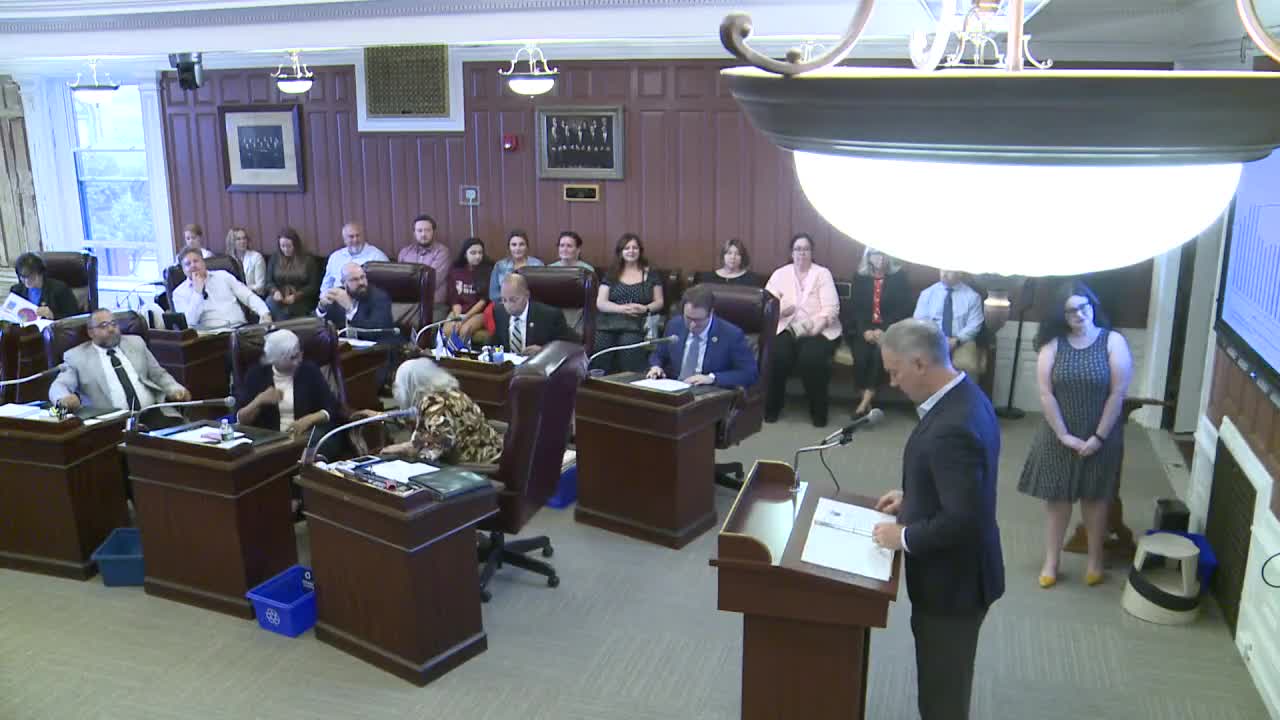
Mayor Mitchell proposes $561 million FY26 budget, cites state aid shortfall and rising pension and health costs
Summary
Mayor John Burnett Mitchell submitted the City of New Bedford's proposed fiscal year 2026 spending plan to the City Council and residents, outlining a $561,000,000 total budget and a $500,400,000 general fund while warning that state aid shortfalls, pension payments and rising employee health costs limit local options.
Mayor John Burnett Mitchell submitted the City of New Bedford's proposed fiscal year 2026 spending plan to the City Council and residents, outlining a $561,000,000 total budget and a $500,400,000 general fund while warning that state aid shortfalls, pension payments and rising employee health costs limit local options.
"I am pleased to submit tonight for your consideration the fiscal year 20 26 proposed budget for the city of New Bedford," Mitchell said, emphasizing the plan sustains services without “unduly burdening taxpayers.”
The mayor told the council that New Bedford's current local economy shows strength — the unemployment rate is roughly 5%, manufacturers and maritime businesses are expanding, the Zeiterion Performing Arts Center and the New Bedford Whaling Museum are undergoing expansions, and Vineyard Wind is supporting local hospitality — but those positives are offset by long-term fiscal constraints.
Mitchell said the city faces a persistent shortfall in unrestricted state local aid. He described the gap this year as about $14,000,000 compared with where state aid would be if it had been restored to 2008 levels and adjusted for inflation, and said the cumulative shortfall since 2008 is roughly $187,000,000. "So just think about all the things that the city could do with another $14,000,000 in the current year," he said.
The mayor identified several legally constrained and high-growth cost drivers that limit the council's flexibility: school funding determined under Chapter 70; county and vocational technical school assessments; debt service; mandated pension payments required to eliminate the system's unfunded liability by 2035; and rapidly rising employee health insurance costs. He said the retirement system is about 54.5% funded and that, in roughly a decade, the city will face a one-year pension payment approaching $71,000,000.
Mitchell forecasted employee health-care costs for FY26 at $50,400,000, or about 10.1% of the general fund. He recommended the council re-examine Sections 21–23 of the Municipal Healthcare Reform Act — a law, he said, used by nearly every other municipality in the region to create an independent mechanism for resolving disputes with unions over benefit design — arguing it can yield measurable cost savings without stripping employees of coverage.
On staffing, the mayor said department budgets include a few revenue-generating or cost-saving position proposals (for example, emergency medical technician positions and an in-house plumber) but that the proposed general fund budget would support two fewer net employees than the current year.
Mitchell also listed major infrastructure and economic projects affecting the city: reconstruction of the Route 195 viaduct (a project he placed at roughly $300,000,000), airport tower and terminal work, expanded waterfront industrial acreage (more than 70 acres added in recent years), resumed inner-city rail service to Boston, and federally mandated sewer-separation projects tied to an Environmental Protection Agency administrative order.
After the presentation the clerk read appropriation orders numbered 2 through 9, listing specific funding amounts for the general fund and several enterprise accounts. The council voted to refer items 2 through 9 to the Quasi Committee of the Whole. The referral motion was made by Councilor Pareto and seconded by Councilor Aperu; the chair called for the ayes and declared the motion adopted.
The appropriation amounts read into the record were: $460,838,400 (ordinary revenue for current municipal departments); $1,374,461 (airport receipts); $129,600 (hotel and lodging tax for arts, culture and tourism); $1,488,882 (cable access enterprise fund); $66,500 (funds to the Commission for Citizens with Disabilities, split $64,000 for purchase of services and $2,500 for supplies); $1,113,112 (downtown parking account); $35,596,711 (wastewater receipts); and $20,904,506 (water receipts).
Councilors briefly asked why budget books were not on desks at the start of the meeting; staff indicated the books were being distributed as the meeting continued. The mayor invited council questions and said department heads were prepared to explain line items in upcoming budget hearings.
The council then approved a motion to adjourn made by Councilor Oliver and seconded by Councilor Abreu. The meeting adjourned at 7:41 p.m.