Get Full Government Meeting Transcripts, Videos, & Alerts Forever!
Get email alerts on the Municipal Finance topic
No spam. Unsubscribe anytime.
Queen Creek finance staff outline $682.7 million tentative budget; 37 positions proposed, council to set tax levy June 4
Summary
Deputy Director Dan Olson presented the town’s tentative $682.7 million budget, which includes 37 proposed new positions (21 for public safety), a large capital program and continued reliance on sales tax; council consideration of the final budget and the property tax levy is scheduled in coming weeks.
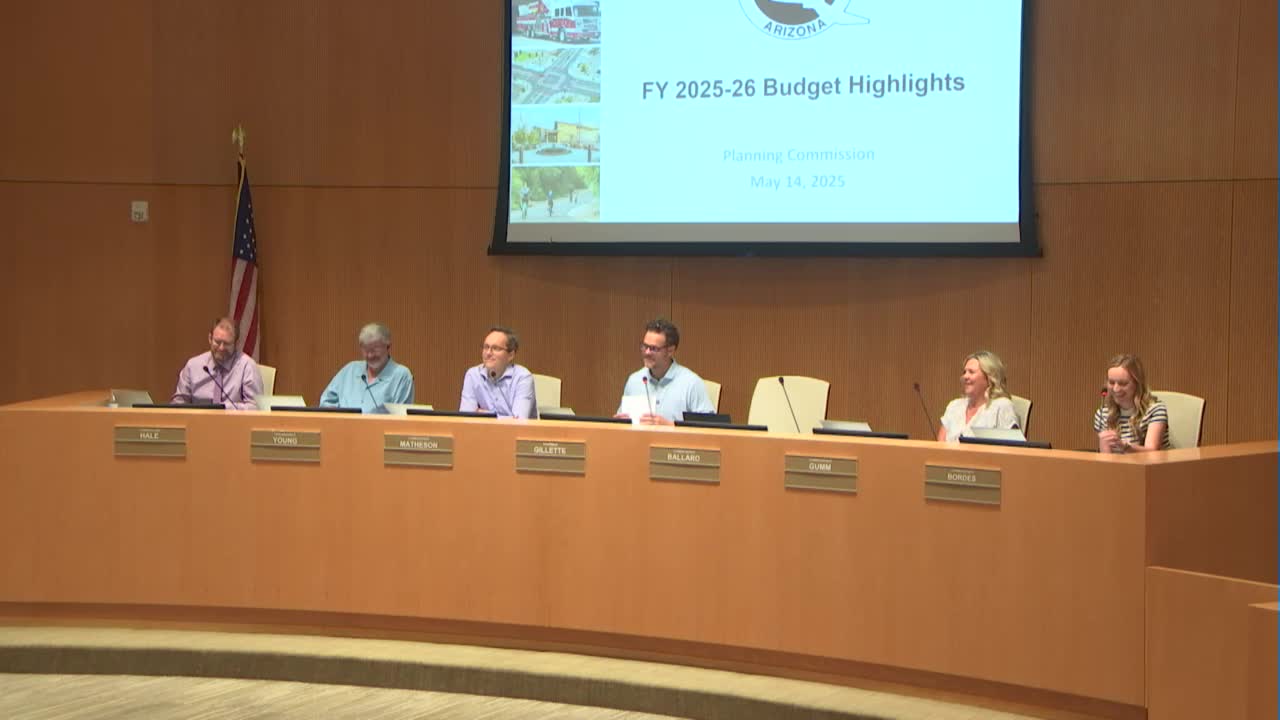
Deputy Director Dan Olson of the Town of Queen Creek’s finance department presented the town’s tentative budget to the Planning and Zoning Commission, describing how officials balance capital needs and ongoing operations and previewing several financial assumptions and policy items.
"This is taxpayer money," Olson said, emphasizing stewardship as the guiding principle in budget decisions. Olson told commissioners the tentative budget that council adopted as a tentative figure was $682,700,000. He said the town proposes adding 37 positions in the coming year, of which 21 are public‑safety related, and that the town continues to plan a large capital program and infrastructure investments.
Olson said about half of the tentative budget is devoted to capital—roads, water and sewer systems and vertical construction—and the presentation highlighted a $355 million capital bucket for the coming fiscal year. He described the town’s revenue mix and the central role of population growth and sales tax in revenue projections: retail sales tax represented the largest portion of operating revenues, construction sales tax is a material but volatile contributor, and the state shares some revenue based on population. Olson said the town expects population to pass 89,000 in the near term and used a build‑out assumption of roughly 2050 for long‑range planning.
On financing infrastructure, Olson said the town uses a combination of debt issuances, impact fees and construction sales tax to provide cash for large projects and to match costs to the beneficiaries of infrastructure over time. In response to commissioner questions, he said that while the town’s formal operating reserve policy calls for an operating reserve of at least 25% of the next year’s revenues, the presentation reported the town’s fund balance at the end of fiscal year 2024 at about 10% of total revenues (the presentation did not reconcile those two figures during the meeting). Olson noted uncertainty in multi‑year forecasting and described a departmental "I don’t know" list staff use to track items that might affect future budgets.
Olson said the council adopted a tentative budget and will consider final budget adoption next week; the council is scheduled to adopt the property‑tax levy on June 4. He also said the council had approved a 15% increase to water and wastewater rates and that staff will provide more information to residents.
Commissioners asked follow‑up questions about funding sources for build‑out, reserve policy, and the town’s infrastructure needs. Olson answered that debt (bond issuances), impact fees and construction sales tax are the primary mechanisms to fund planned infrastructure while aligning costs to beneficiaries over multi‑decade horizons.
Olson closed by urging commissioners to review the budget documents posted on the town website and to contact him with questions.