Get Full Government Meeting Transcripts, Videos, & Alerts Forever!
Get email alerts on the Wildfire topic
No spam. Unsubscribe anytime.
CAL FIRE and Nevada County OES report 2025 outlook: longer peak season, more staff and new detection tech
Summary
CAL FIRENevadaYubaPlacer unit and Nevada County Office of Emergency Services told supervisors the fire season outlook for 2025 is serious but manageable, with expanded staffing, new aircraft and AI-driven cameras; county was urged to keep promoting defensible-space and evacuation-zone tools.
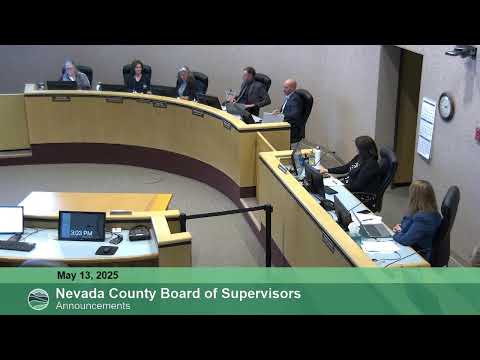
CAL FIRENevadaYubaPlacer Unit Chief Brian Estes and Deputy Chief Jim Hudson told the Nevada County Board of Supervisors on May 13 that the unit is preparing for an extended, more active wildfire season in 2025 by increasing staffing, expanding ground and aviation assets and using new detection technologies.
Estes said CAL FIRE's staffing model is shifting from a short, intense "fire season" to a longer operational period. "Moving forward, CAL FIRE is committed to a 9 month fire season," he said, defining the peak staffing window as March 15 to Dec. 15. He added that the unit aims to staff some resources year-round and expects additional hiring over the next three to four years.
The unit-level numbers presented to the board included 22 frontline engines staffed during the peak period, seven hand crews, a permanent fourth dozer added to the unit, and an increase in hand-crew capacity including a third crew at Washington Ridge Conservation Camp. Hudson said those additions give the unit more surge and backfill capacity for extended incidents.
CAL FIRE executives highlighted an ongoing emphasis on aggressive initial attack. The unit reported 427 wildland fire dispatches in the area last year and an average acreage per incident well below the five-year average; Estes noted the unit's strategy is to contain most fires at small size and said the unit has averaged containment of 95% of fires at 10 acres or less in past years.
New detection and intelligence tools were a major focus. Hudson described an expansion of the department's camera network and deployment of artificial-intelligence algorithms to speed detection. "Last year, roughly 1,700 incidents statewide were detected by AI before the first 9-1-1 call," he said, and the unit is adding cameras and pursuing partnerships with utilities to expand coverage locally.
Aviation capacity and staff-rest changes also factored into the outlook. CAL FIRE has added C-130 aircraft to the statewide fleet and is shifting toward lower work weeks (from 72 toward 56 hours) that will enable more career firefighter hires and more stable staffing of engine companies and other resources, Estes said.
On fuels-reduction and planning, the chiefs outlined ongoing projects: Montezuma fuel-break maintenance, planning for Ponderosa West, the Woodpecker Ravine and coordination at the Imigration Grama State Demonstration Forest (a multi-jurisdictional site in planning). Hudson described increased hand-crew and dozer availability and construction of targeted lines in several drainages.
Office of Emergency Services Director Alex Kiboltole briefed the board on local preparedness work that complements operational response: a countywide mailer and community survey, Firewise outreach to HOAs, collaborative tools such as a shared "Go Bag" checklist and a home-hardening interpretive sign program. OES staff also promoted ZoneHaven as a countywide evacuation-zone mapping tool and reminded residents that ZoneHaven supplements opt-in alerts (CodeRED/Nixle) but does not replace them.
Board members and the chiefs also discussed laws and regulations that affect private burning and prescribed-fire programs. Estes described Senate Bill 310 as increasing the complexity of private burning: "The Senate bill is enabling private citizens to burn on private properties in ways that are challenging for us," he said, and emphasized the need for collaboration with local burning groups and burn associations.
Several supervisors pressed for clearer public education on burn rules and for continued collaboration with local airports for aerial operations. The board unanimously voted to accept the presentation.
Why it matters: Nevada County sits in the wildland-urban interface; expanded staffing and technology can reduce the acreage and destruction of individual ignitions, but officials emphasized the continuing need for household preparedness, defensible space and public compliance with burn rules.
What's next: CAL FIRE and county OES will continue planning and will return to the board if conditions or funding requests change. Residents were urged to know their evacuation zone (ZoneHaven), create a 72-hour go-bag and follow local burn-permit rules.