Get Full Government Meeting Transcripts, Videos, & Alerts Forever!
Get email alerts on the Real Estate Licensing topic
No spam. Unsubscribe anytime.
Joint committee reviews LARA rule changes to real estate licensing, adds fair-housing hour and defines “promptly”
Summary
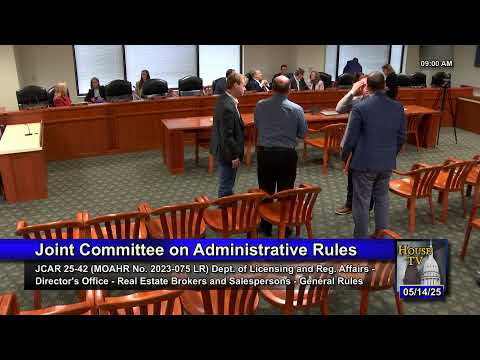
The Joint Committee on Administrative Rules heard department and industry testimony on proposed amendments to Michigan real estate licensing rules to align with Public Act 246 of 2023, add a fair-housing continuing-education hour, define “promptly” for delivery of offers and update numbering and definitions.
The Joint Committee on Administrative Rules heard testimony on proposed amendments to Michigan real estate licensing rules from the Department of Licensing and Regulatory Affairs (LARA) and industry representatives. The changes, drafted with the Michigan State Board of Real Estate Brokers and Salespersons, update continuing-education requirements to match Public Act 246 of 2023, add definitions including Arello (the Association of Real Estate License Law Officials) and clarify procedural language such as delivery timeframes and waiver processes.
Mac Jones, department specialist with LARA’s Office of Policy Legislative Affairs, told the committee the Bureau of Professional Licensing regulates roughly 700,000 licensees and that the rule package “changes the continuing education requirements to adhere to the changes that were in Public Act 246 of 2023” and adds a few definitions and organizational renumbering to meet the Michigan Office of Administrative Hearing and Rules style manual. Jones also said the rules clarify procedures when a broker dies or becomes disabled and clarify how continuing-education waivers are handled.
Brad Ward, vice president of public policy and legal affairs for Michigan Realtors, said the package is largely technical renumbering but highlighted two substantive changes. He described one change as adding “1 hour of fair housing education” to the continuing-education requirements. He also said the rules define the term “promptly” for determining when an offer to purchase must be delivered, noting that “promptly is being defined as 2 business days.” Ward told the committee that under the proposed definition the two business days do not include weekends or holidays.
Committee members asked staff and industry how the rule changes would operate in practice. Jones and other department witnesses said the state’s new licensing system staggers renewals so a licensee renews on the anniversary of their first license issuance rather than all licenses renewing on a single cycle; committee members and department witnesses confirmed that standard license cycles for these real-estate licenses are three years. On waivers of annual continuing-education requirements, a department witness said waiver requests are rare: “I only remember 1 request in the last year or 2,” and that waivers are typically granted in cases of prolonged illness that prevent completion within a licensee’s yearly requirement.
Members also questioned how continuing-education courses are approved and how the curriculum is kept current. Ward and department witnesses described an approval process in which course providers submit outlines that are compared against department checklists; the system is designed to allow adaptable course topics when market conditions change. The Michigan Realtors association said it provides on-demand and in-person options, and Ward described work with local boards in the Upper Peninsula, naming the Eastern Upper Peninsula Board of Realtors in Sault Ste. Marie and the Upper Peninsula Board of Realtors in Marquette as local providers that organize periodic in-person continuing-education offerings.
Several lawmakers asked about recent national developments affecting buyer-agency agreements. Ward explained the industry is operating under requirements that emerged from a federal settlement involving the National Association of Realtors: agents who wish to obtain the protections of that settlement must have a written agreement with buyers. Ward said that written agreement can range from a multi‑month buyer’s agency agreement to a single‑day showing agreement, but “it just has to have a written agreement, laying out the duties of that buyer’s agent,” and that requirement comes from the federal settlement rather than state statute. He said the industry expects forthcoming state legislation to adjust Michigan’s agency disclosure forms and address related duties.
No public opposition to the rule package was reported to the committee’s record from the March public hearing, and committee members did not take a committee vote at the session. Department and industry witnesses answered members’ questions and offered to provide additional department-level detail on related topics such as remonumentation fees and college vocational pathways for pre‑licensure education.
The committee’s discussion focused on clarity and compliance: aligning rules to statute, making delivery timelines explicit and ensuring continuing-education processes are accessible across Michigan’s regions, including the Upper Peninsula. The rule package will remain available for further committee consideration and any subsequent formal action or vote will be recorded in the committee’s minutes.