Get Full Government Meeting Transcripts, Videos, & Alerts Forever!
Get email alerts on the City Budget topic
No spam. Unsubscribe anytime.
Sacramento unveils $1.6 billion FY‑26 proposed budget; $62.2 million gap closed with one‑time moves and program reductions
Summary
City staff presented a balanced fiscal year 2025–26 proposal that closes a $62.2 million funding gap largely through one‑time reallocations, vacancy savings and fee adjustments. Council members and community speakers pressed for clearer community engagement, protections for youth programs and alternatives to sweeping police vacancies.
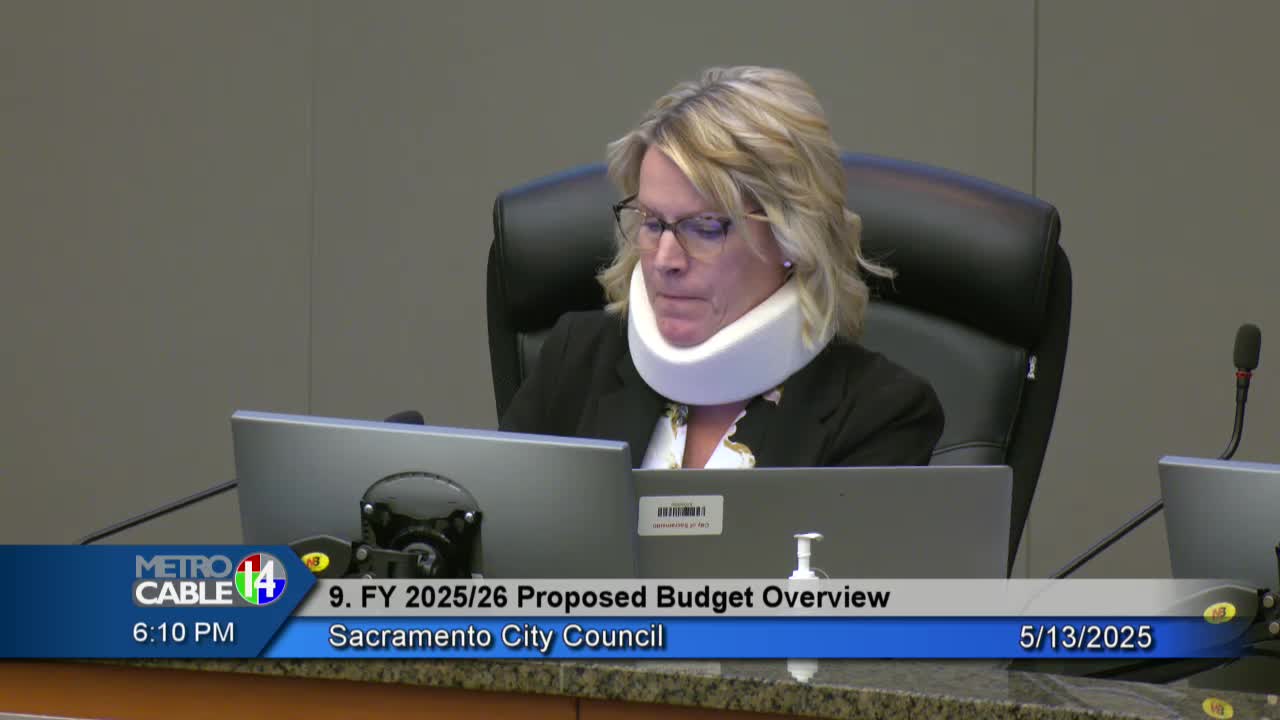
The Sacramento City Council on Tuesday received a detailed overview of the city manager’s proposed fiscal year 2025–26 budget, a $1.6 billion all‑funds plan that staff said closes a $62,200,000 funding gap using a mix of one‑time funds, revenue adjustments and targeted service reductions.
In a presentation to the council, Marthala Santizo, budget manager, said the “fiscal year 26 proposed budget totals 1,600,000,000.0 for all funds and 847,000,000 for the general fund.” Pete Coleto, the city’s finance director, told the council staff had closed the gap presented in February: “we closed that $62,200,000 funding gap.”
Why it matters: The proposal keeps core services running while relying on a substantial amount of one‑time solutions and vacancy savings that create continuing budget pressure in later years. Staff warned the plan improves the near‑term picture but does not eliminate a recurring structural deficit that will reappear in fiscal 2027 unless new revenues or deeper ongoing cuts are adopted.
Most important facts - Total proposed budget: $1.6 billion (all funds); general fund $847 million (Marthala Santizo). - Gap closed: $62.2 million; roughly half of the solutions are one‑time (Pete Coleto). - Ongoing reductions/strategies include vacancy eliminations, fee adjustments and program realignments; staff said about 486.3 FTEs were proposed across all strategies and the proposal currently impacts roughly 7 filled positions to be eliminated among those items noted as filled (Marthala Santizo, Pete Coleto). - Public safety: “The proposed budget for public safety Departments includes strategies totaling 15,300,000.0” (Mario Lara, assistant city manager for public safety). Staff said many public‑safety reductions are designed to preserve sworn staffing while shifting some civilian duties and using one‑time funds for certain functions. - Municipal services: “The municipal service basket includes just under $12,000,000 of savings,” including parking rate and enforcement changes (Ryan Moore, assistant city manager for municipal services).
What staff proposed and the tradeoffs City staff presented a package of department and citywide actions: aligning revenue estimates to current trends (building fees, parking, EMS reimbursements), reallocating completed project balances and other one‑time funds (including $3.5 million from unallocated ARPA) and deleting a mix of vacant and a small number of filled positions. Staff said roughly half the proposed strategies are one‑time, which improves the current year but ramps a shortfall back into future budgets.
Pete Coleto described the mix used to balance the proposal: revenue adjustments, vacancy savings, project reallocations and limited program reductions. Marthala Santizo said departments were required to submit reduction strategies equal to 15% of their general fund budgets and that 160 proposals were evaluated for service impacts and legal constraints.
Public safety and homelessness Assistant City Manager Mario Lara summarized public safety strategies and emphasized attempts to protect core emergency response while acknowledging reductions to hiring pipelines and civilian support roles. He said the departments would continue to pursue external grants and that “remaining sworn staff will need to handle functions previously performed by intra level civilian personnel, which may lead to increasing officer workload, call volume and reduced response times.”
Council and public concern about vacancies Several council members and speakers pressed staff about the use of vacancy savings and the scale of current unfilled positions in the police department. Keyon Bliss said council records show more than 190 police vacancies and argued some existing police programs or contracts could be reexamined to fund parks and youth programs. Police leadership told the council that cutting vacancy usage further would significantly worsen 9‑1‑1 call answer times and response capacity and could mean some victim services or proactive units could no longer be staffed.
Youth programs, parks and skate park testimony Speakers and some council members urged protecting youth and parks funding. Several youth‑serving organizations and skate park advocates said reductions to staffing at the 20th & B skate park would remove supervised public hours and limit year‑round access for skaters who depend on the covered facility. Sean Latour Harkine of Project Lifelong said that cutting the staff position that keeps the park open would remove “the only public space for thousands of skateboarders... for over a hundred days of the year” during rain or heat.
Community engagement and deferred maintenance Community members and some council members asked for more robust outreach during the budget process. Alyssa Lee (Strong Sac Town) said, “we need a better community engagement process when it comes to our budget.” Several speakers and council members highlighted the city’s long list of unfunded capital and maintenance needs—staff cited roughly $1.8 billion in unfunded capital and deferred maintenance—and asked the council to consider how to address recurring liabilities rather than relying on one‑time fixes.
Next steps and deadlines Staff outlined the budget hearing schedule and next milestones: council deliberations continue in the coming weeks, with a formal public hearing on vacancies required by state law and final budget adoption scheduled for June 10. Staff told council the proposed budget assumes no HAP (state homelessness assistance) funding for fiscal 2027 and cautioned about the multi‑year outlook: absent new ongoing revenue, staff projects a near‑$60 million deficit in FY‑27.
Ending Councilmembers gave general direction and raised a series of follow‑up items — deeper review of vacancy lists, options to protect youth programs (including potential Measure L funding), phased or mitigated fee adjustments for vulnerable users, and fast‑tracking any business operations tax modernization work for voter consideration. Staff said they will return with additional detail for council direction at subsequent hearings.