Get Full Government Meeting Transcripts, Videos, & Alerts Forever!
Get email alerts on the Homelessness topic
No spam. Unsubscribe anytime.
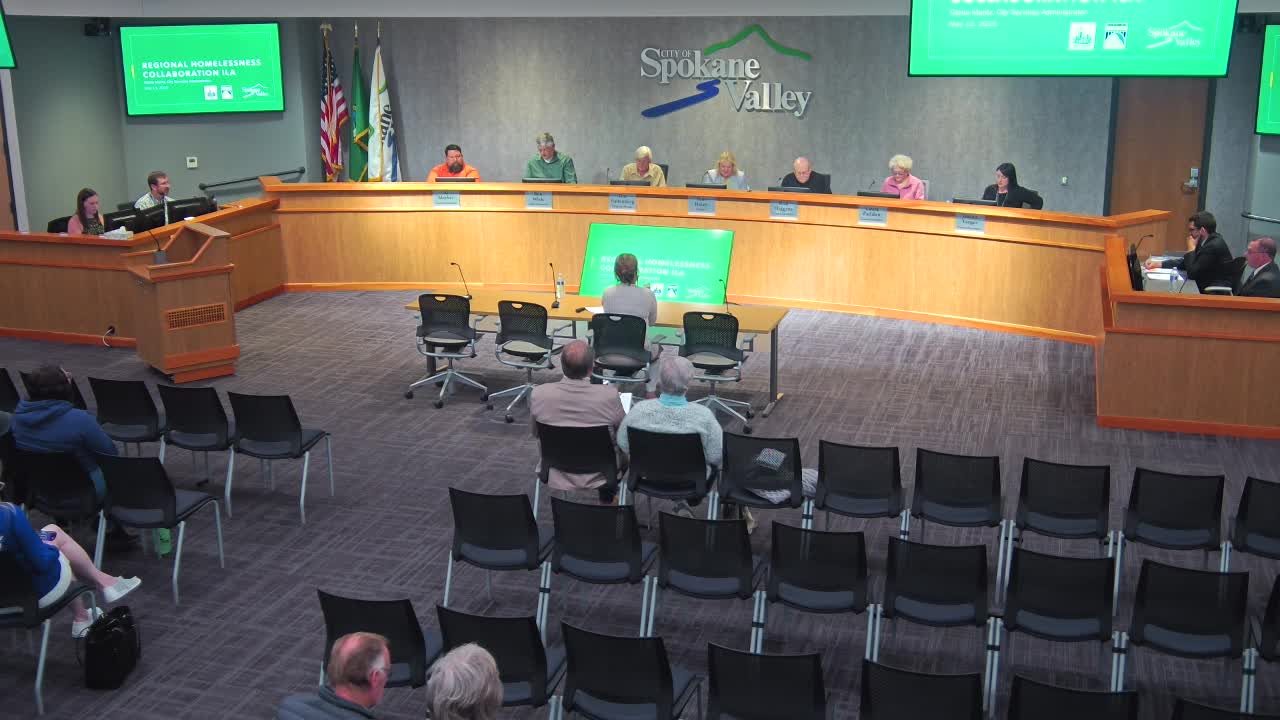
Spokane Valley council approves interlocal agreement for regional homeless coordination, 6‑1
Summary
Council approved an interlocal agreement to coordinate homelessness funding and planning with Spokane County and the City of Spokane; vote was 6‑1. The agreement requires local plans consistent with state Department of Commerce objectives and establishes joint responsibilities for coordinated RFPs, data reporting and provider evaluation.
The Spokane Valley City Council voted 6‑1 May 13 to approve an interlocal agreement designed to improve coordination on homelessness between the city, Spokane County and the City of Spokane.
Gloria Mance, city services administrator, told the council the agreement aims to coordinate the three jurisdictions on funding and program decisions and to streamline the request‑for‑proposal process for homelessness providers. The agreement’s recitals cite the Continuum of Care five‑year plan and state Department of Commerce objectives; Mance said Spokane Valley must adopt a local plan by the end of 2025 that is consistent with those objectives if it wants to administer document‑recording fee revenues tied to homelessness.
The agreement’s core provisions (Section 4 in the ILA) establish joint responsibilities: sharing information when jurisdictions issue RFPs; developing a model RFP to reduce duplication; creating minimum qualifications for providers and consistent contract language; evaluating provider performance; and establishing shared data reporting and performance metrics. The ILA also notes a goal of creating a mechanism so private philanthropic funds can leverage government dollars.
Councilmember Al Merkel raised concerns about the ILA’s second stated objective — to “prioritize those with the greatest barrier to housing stability and the greatest risk of harm” — saying he worried the approach would “burn the most money and help the fewest people” and that the city should emphasize prevention. Mance and City Manager John Holman said the Department of Commerce sets those objectives and that if Spokane Valley chooses to continue administering recording‑fee funds it must adopt a plan consistent with them; council retains discretion within its local plan about how to prioritize interventions.
Councilmember Merkel was the lone vote against the agreement; the council recorded the motion as passing 6‑1. Council members who spoke in favor said the ILA increases efficiency, reduces duplication of effort between jurisdictions and would allow Spokane Valley to remain at the table for regional funding decisions.
Why this matters: the ILA is the mechanism for coordinating limited homelessness resources and future RFP awards among the three jurisdictions; it will shape how Spokane Valley applies recording fees and other locally administered resources for homelessness programs. The city will bring a local plan back to council later in 2025 that must align with the state objectives in the ILA.