Pelham superintendent outlines $140 million bond package, budget and office purchase ahead of May 20 vote
Loading...
Summary
Superintendent Cheryl Champ told a small public meeting that the Pelham Union Free School District will present seven items on the May 20 ballot including the annual budget, a proposed purchase of a house at 29 Franklin Place for district offices, four separate bond propositions split to give voters more choice, and three uncontested board seats.
Superintendent Cheryl Champ told a small public meeting that the Pelham Union Free School District will present seven items on the May 20 ballot including the annual budget, a proposed purchase of a house at 29 Franklin Place for district offices, four separate bond propositions split to give voters more choice, and three uncontested board seats.
Champ said the district's total appropriations for the coming year are $96,290,000, a $2.7 million (2.9 percent) increase from the prior year. She said personnel costs make up roughly 76 percent of the budget and the district has built a 2 percent contingency into the proposal. The proposed tax levy increase is 3.48 percent and Champ described the proposal as tax-cap compliant.
Champ said the proposed capital request was split into four propositions because the board recognized the overall ask — described during the presentation as about $140 million in projects — was large and wanted to give voters “more say” by allowing them to approve parts individually. She emphasized that Proposition 1, the core infrastructure package, must pass for any of the other propositions to move forward.
Champ said the district's facilities review identified a number of aging systems and building needs across campuses: 30-year-old boilers approaching end-of-life, water intrusion and masonry issues, leaking roofs and windows. She cited a recent shutdown of the middle school for a day after an HVAC/roof-related leak and said many major projects require about two years of lead time for design and approvals.
On the ballot and key cost items: Champ described the five ballot categories voters will see on May 20 as (1) the school budget, (2) the purchase of a house at 29 Franklin Place, (3–6) the four bond propositions split by project type, and (7) the school board election. She said the house purchase request is for a $1,450,000 purchase price plus up to $400,000 for renovations and state-required work to secure a certificate of occupancy for offices, and that the district intends to use undesignated fund balance for that acquisition rather than borrow from voters.
Champ outlined the four bond propositions and approximate costs provided in the presentation: Proposition 1 (core infrastructure; a scenario shown in the materials corresponded to about $56 million of work), Proposition 2 (Siwonoy school infrastructure, air conditioning and ADA upgrades — listed as roughly $42.6 million), Proposition 3 (high school student center/cafeteria and two floors of new science labs — listed as roughly $40.4 million) and Proposition 4 (geothermal heating at two schools — listed as roughly $4.5 million). The district cited an estimated total in the presentation of about $140 million across the propositions.
Champ explained the financing rationale: two existing debt obligations are scheduled to end in coming years (the Colonial-related debt is expected to drop off around 2026–27 and the middle-school debt a few years later). The district plans to repurpose that debt service capacity so that some borrowing can occur without increasing taxes immediately; she said that mechanism gives the district the ability to borrow roughly $10 million when the Colonial debt drops off and about $55 million when the middle-school debt drops off, producing roughly $65 million of tax-neutral borrowing capacity. Champ also said the district's state building-aid ratio for eligible projects has risen from about 43 percent during the 2018 bond to about 49 percent today, which affects the net cost of eligible work.
Champ presented model tax-impact scenarios for an “average assessed home” from the handout and demonstration calculator the district will post on its website. Using the presentation's scenarios and language, she said one scenario (in which only the infrastructure Proposition 1 passes) would produce no new taxes because it fits within the district's tax-neutral borrowing window. Other scenarios shown in the materials estimated sample annual impacts: roughly $481 per year for an average home if infrastructure plus the Siwonoy project passed (labeled in the presentation as about $96 million of work); about $1,233 per year in one broader scenario described in the materials (displayed in the slides as “a little over $100 a month”); and an illustrative scenario where all propositions passed that added “about $64 on top” of the prior figure, bringing the presentation's combined figure to “almost 1,300” per year for the sample average home (the presentation gave these figures as annual amounts tied to the district's modeled average assessed value; the district also said taxes would not start immediately — construction would likely begin in summer 2027 and taxes would likely show up in the budget around 2029).
Champ described programmatic goals tied to the projects: converting old steam systems to hydronic heating (which she said is required to pair effectively with new air conditioning), adding air conditioning at Prospect Hill and Siwonoy elementary schools to comply with a state rule she described as “a new law requiring that we can't put classrooms and have instruction in any classroom that's 88 degrees or hotter,” and expanding Siwonoy to add an eight-classroom addition and a cafeteria underneath the existing gym so the building can meet ADA access requirements and lose fewer classrooms to elevator/ADA circulation. She said that Siwonoy's split-level layout would require two elevators to bring all parts of the building to grade and that the ADA plan would displace four full-size classrooms, which the proposed expansion would restore plus provide three additional rooms for flexibility.
On the high school work Champ said the plan would create a student center/cafeteria space on the ground floor of a new addition and provide two floors of new science labs above (eight new science labs total). She said the high school expansion was intended both to add capacity and to modernize aging science facilities.
Champ said the district plans to stage projects to reduce community disruption, and that not all campuses would be under construction simultaneously. She suggested as one sequencing option that the district might start with the high school project and take additional time to plan the Siwonoy project because of neighbor sensitivities and playground/yard impacts. She also said most renovation work would occur in summer breaks, while some expansion or staged interior work could be done during school years with safety protocols.
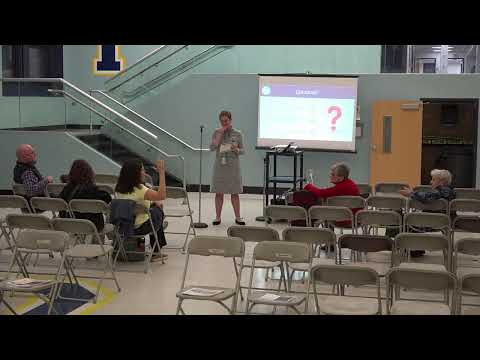
Residents at the meeting pressed the district for historical bond detail and tax impact clarity. One attendee, identified in the transcript as Jill, said, “here I'm here to be a proponent of the bond load and it's important.” Another attendee asked for a listing of past bonds and what the proceeds were used for from 1990 to 2025; Champ said she would provide contact names and that records could be requested via Freedom of Information law if needed. A resident questioned the cumulative tax burden on long-time homeowners; Champ said the district will add a tax-calculator tool to its website and that hard-copy handouts with tax-impact examples were available at the meeting.
Champ closed the presentation by describing voting logistics: polls will be open May 20 from 7 a.m. to 9 p.m.; early and absentee voting will be available; and the district will publish the tax-calculator on its website and provide contact names for requests for historical bond documentation.
Discussion vs. decisions: the session was informational and included public Q&A; no formal board vote occurred at the meeting. The superintendent said the district intends to use undesignated fund balance to cover the proposed $1,450,000 purchase and up to $400,000 in renovations for the 29 Franklin Place house if voters authorize it, and that any work beyond what voters authorize would not be undertaken without additional approval. The superintendent repeatedly said she did not want to “misspeak” on historical bond figures and offered to provide names and records for attendees seeking more detail.
Next steps identified by district staff in the session: finalize and post the tax-calculator on the district website before the end of the week, assemble stakeholder groups to refine design details if propositions pass, and meet with construction teams after the May 20 vote to finalize sequencing and schedules.
Residents who requested records were told whom to contact, and the district offered to provide a point of contact for follow-up questions after the session.