Get Full Government Meeting Transcripts, Videos, & Alerts Forever!
Get email alerts on the School District Budget topic
No spam. Unsubscribe anytime.
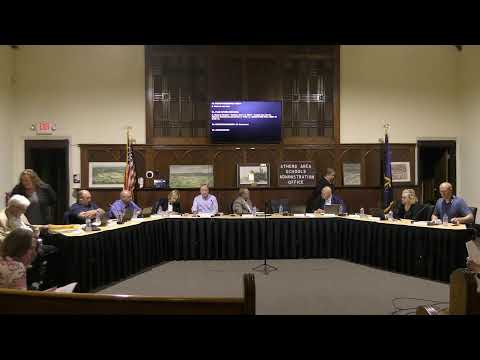
Athens Area School District board reviews preliminary budget showing $2.755 million shortfall; places budget on display
Summary
Superintendent and business manager told the board the district started with an approximately $4.3 million deficit and reduced it to about $2.755 million through staff attrition, spending adjustments and a proposed millage increase; the board voted to place the preliminary budget on public display and to raise millage to the Act 1 index.
The Athens Area School District board on May (preliminary meeting) reviewed a proposed preliminary budget that district leaders said started with an estimated $4.3 million deficit and, after adjustments, showed a remaining shortfall of about $2,755,000; the board voted to place that preliminary budget on public display ahead of a final vote in June.
Superintendent Dr. Sage said the district “started with a deficit of approximately $4,300,000” and that leaders have been working to reduce that gap. “We have to actually make some hard decisions,” Dr. Sage told the board during the presentation, emphasizing use of one-time federal relief and the need for ongoing savings.
The presentation, led by Dr. Sage with business manager Doreen Secor assisting, traced the gap to four main drivers: the use and exhaustion of one-time ESSER relief funds, modest local tax increases during the pandemic period, rising salary and benefit costs and a sharp increase in cyber charter tuition payments. Secor reviewed figures that the district used about $8.4 million in ESSER and related one-time federal relief over recent years and that health-care, special-education and contractual salary increases were major ongoing expenditure pressures.
Why it matters
District leaders said the exhaustion of one-time federal funds, growth in cyber charter costs and only modest tax increases during and after the pandemic have left the district dependent on fund balances unless recurring revenues are raised or expenditures reduced. Dr. Sage said the district has reorganized staff through attrition and identified other savings but still faces a multi-million-dollar shortfall.
Key numbers and proposals
- Initial deficit identified when budget work began: approximately $4,300,000. - Adjusted shortfall presented as the preliminary figure to be addressed: $2,755,000. - Proposed tax increase to the Act 1 index (5.8%), described in the presentation as 3.14 mills, expected to generate an estimated $876,829. - Fund balance estimates stated in the presentation: an estimated general fund balance of $7,900,000 at the upcoming June measurement and a projected balance of $4,850,000 by June 30 of the later projection year.
Dr. Sage noted the district had increased millage modestly in prior years and that the board’s proposed rise to the Act 1 index this year is aimed at narrowing recurring shortfalls. Board members asked several technical questions about fund balances and the district’s flexibility to use assigned reserves; Doreen Secor explained that portions of the balance are assigned for specific purposes and therefore not all available to cover operating deficits.
On cyber charter costs, Dr. Sage and Secor said the district’s payments have grown materially from prior years; Dr. Sage said, “cyber charter schools are not free, and they have a definite impact on rural schools and their budgets.” Board members and the administration discussed the role of state-level changes and potential relief but made no policy commitments beyond the local budget actions.
Board action and next steps
After the budget presentation and discussion, the board voted to place the preliminary budget on public display, as required by the Pennsylvania Department of Education’s (PDE) process, and scheduled final adoption for the June meeting. The vote to display the preliminary budget carried with the following recorded votes: Christine Middlecamp (yes), Mr. Johnson (yes), Mr. Jones (yes), Mrs. Minnick (yes), Mr. Owen (yes), Mrs. Smart (yes), Mr. Tarasnowski (yes), Mrs. Cooper (yes), Mr. Frisbie (yes).
The administration told the board it would continue to refine revenue estimates and examine additional expenditure reductions and that the final budget could change prior to the June 17 final vote. Dr. Sage and Secor said they would present updated figures and that some changes might improve the outlook but that the district is still planning for a multi-million-dollar gap.
Votes at a glance (other board actions taken at the meeting)
- Employee settlement (employee #1460): board approved a settlement agreement authorizing payment of $8,750; vote recorded as unanimous (all board members present voted yes). This was handled under the solicitor’s recommendation. - Election of treasurer: the board re-elected Mrs. Smart as treasurer for a one-year term; motion carried unanimously. - Personnel approvals: the board approved a slate of personnel actions including resignations, support and professional hires, summer student employment and athletic contracts; the personnel package passed on a recorded roll-call vote. - Contracts and agreements: the board approved multiple renewals and service agreements (Bradford-Title Head Start sponsorship, Bayada Nursing contracts, occupational therapy services and others). One item—the ESS subcontract—was tabled to June at the administration’s request.
What the board did not decide
The board voted only to place the preliminary budget on display; it did not adopt a final budget at this meeting. The final vote is scheduled for the June meeting after the required 30-day public display period.
Background and context
Dr. Sage and Secor described three structural pressures that contributed to the deficit: (1) the end of one-time federal relief (ESSER); (2) steady increases in salary and benefits (the administration referenced contractually driven salary steps and an 8.2% health-insurance increase cited in the materials); and (3) a significant rise in cyber charter tuition payments compared with earlier years. The administration said they reduced non-staff spending and reorganized through attrition (five teaching positions noted) to lower the projected increases in the operating budget.
The board will reconvene June 17 for final budget adoption. The administration said it will supply updated fund-balance and revenue information and expects to continue looking for savings and state-level adjustments that could alter the final numbers.