Get Full Government Meeting Transcripts, Videos, & Alerts Forever!
Get email alerts on the Vacant Properties topic
No spam. Unsubscribe anytime.
County committee considers stronger rules, higher fees for vacant properties; substitute adds gated-entry requirement for large sites
Summary
New Castle County’s Administrative Finance Committee discussed a substitute to Ordinance 25-046 that would raise registration fees for vacant properties, add monthly inspection fees and require restricted vehicular access for large vacant commercial structures; no final vote was recorded in the transcript.
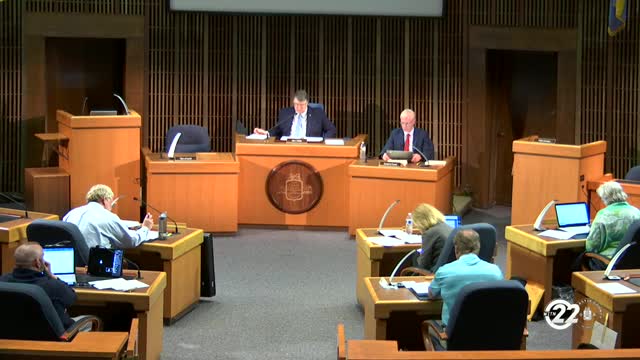
The New Castle County Administrative Finance Committee on May 13 discussed a substitute to Ordinance 25-046 that would increase fees and inspections for vacant properties and add a requirement that large vacant commercial structures restrict vehicular access.
The substitute, discussed by Land Use General Manager David (Dave) Culver, would raise first-year registration fees, add a $100 monthly inspection charge and require that “all vacant commercial structures over 100,000 square feet shall restrict vehicular access to the site,” while preserving fire-department access under Delaware State Fire Prevention Regulation 705, General Safety Chapter 5, Section 2.6. Culver said the change was prompted by recurring public-safety incidents at some large vacant sites, including car racing and gatherings.
Committee members said the fee increases and new enforcement tools are intended to discourage long-term vacancy, improve public safety and spur rehabilitation or reuse. Councilman John Cartier, chairing the meeting, and several council members pressed staff on implementation details and appealed to the need to circulate the substitute to all council members because it was released shortly before the meeting.
Council members asked for details on timelines and appeals. Councilman Smiley said he was initially concerned about unequally applied enforcement but accepted staff assurances there is an existing appeal process. Councilman Koneko asked why the substitute requires a structural inspection after five consecutive years of vacancy; Culver said the five-year threshold was selected because fees escalate at that point and because prolonged vacancy is associated with greater deterioration. Culver said property owners must pay for any required design-professional inspections; if owners fail to comply, staff would pursue warrants to inspect.
Council members also questioned whether five years was too long; Culver said the department could consider three years if council preferred. Council members and staff discussed the fiscal impact and staffing needs; Culver said increased inspections and the new monthly fee would support additional code inspection capacity and that the draft fiscal note estimates higher revenue to offset inspection costs.
A public commenter, Rob Bullock of the Route 9/913 Community Alliance, asked whether the ordinance would force owners to sell; Culver replied that the ordinance requires registration and enforcement (including cleanup and possible sheriff’s sale for unresolved liens) but does not force sale simply because a property is vacant. Culver said the department will provide council with the policy details on when an owner’s property would be pursued for sheriff’s sale and the costs that could trigger that process.
The substitute also adds placard/notice language for structures deemed unsafe so first responders can see a visible warning when arriving at a call. Council members cited recurring vacant-site problems, including the long-vacant theater and other properties, and urged timely enforcement and police notification of high-risk sites.
No final committee vote on the substitute is recorded in the transcript. Committee members agreed the substitute needed to be distributed to all council members in advance and that rules-suspension language might be required to take final action that evening. Councilman Cartier said he would work with counsel to ensure the substitute and fiscal note were available to members before any vote.
If adopted, the substitute would modify New Castle County Code Chapter 7 (Property Maintenance Code) Article 2 (Registration and fees for vacant premises) and add the restricted-access requirement for large vacant commercial structures. The county’s land-use department will return implementation details and the sheriff-sale policy to council.
Council members suggested possible edits before final action, including lowering the required continuous-vacancy period for a mandatory design-professional inspection from five years to a shorter interval and specifying a deadline for submission of any required inspection reports. Culver said staff could incorporate those clarifications if council requests them.
Council and staff agreed to continue work on the substitute and circulate the final language and fiscal note to committee members before any vote.
Ending: The committee did not record a final vote on the substitute in the transcript; sponsors and staff said they would circulate the substitute and fiscal note to council and return with clarifications and any requested edits before final action.