Get Full Government Meeting Transcripts, Videos, & Alerts Forever!
Get email alerts on the Municipal Governance topic
No spam. Unsubscribe anytime.
Lynnwood council debates tightening residency rules for elected officials; no vote taken
Summary
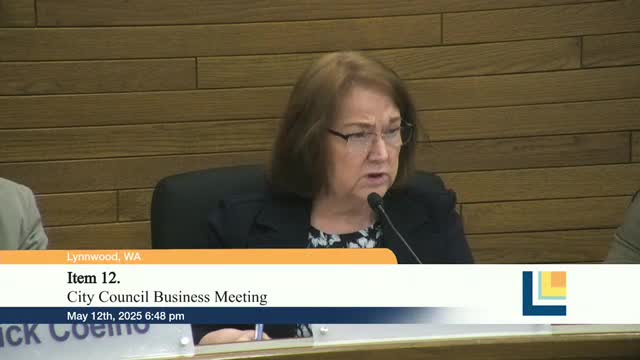
Lynnwood City Council members debated proposed amendments to LMC 2.04.060 on May 12, 2025, but took no vote; the measure would define “reside” and “live in” and create a document-based verification process for candidates and seated officials.
Lynnwood City Council members debated proposed amendments to Lynnwood Municipal Code (LMC) 2.04.060 on Monday, May 12, 2025, after Councilmember Decker introduced language intended to define “resident” and “live in” and to set a written proof process for verifying whether someone meets residency requirements for city office.
The change under consideration would require written proof of residency and would specify time windows and timelines for submission and review. Supporters said the amendment is intended to close ambiguity about who is eligible to hold elective office in Lynnwood; critics and staff warned it could create legal and administrative complications.
Councilmember Decker said the existing language is unclear and urged clearer definitions: “I would challenge any member of this council to tell me how they would define the 2 terms the 2 terms, resident or live in.” He said the change is meant to prevent situations in which an elected official could keep serving while living outside the city, “playing snowbird in Arizona.”
City Attorney Lisa told the council that staff had reviewed implementation risks tied to public records requests. Lisa said documents submitted to the city as proof could trigger the Public Records Act (PRA), which would require staff to follow PRA timelines and redaction rules: “If a public workers request is made by a citizen that wants proof of residency, for example, the affidavit, the document evidencing residency, if for some reason that comes through the city as a public records request, we must honor that as a public work records request.” She warned that records with residential addresses are often redacted under PRA rules and that redaction could make a PRA-produced document “useless” as proof unless staff provide an attestation.
Luke, identified in the meeting as the city clerk, described practical processing issues: distinguishing regular requests from PRA requests, meeting statutory time limits, and the risk of missing PRA deadlines if a residency request arrives in the PRA workflow.
Several council members raised related concerns and alternatives. Councilmember Escamilla and others questioned whether the proposed ordinance would actually prevent the conduct Decker described, pointing out that people could still misstate hardship or move without reporting it. Councilmember Coelho asked whether the proposal should include a glossary or clearer definitions of terms. Councilmember Hurst noted that F-1 disclosure forms file each year already ask for an address and suggested reliance on existing disclosures for some verification purposes.
Multiple members proposed lower-burden alternatives. The mayor suggested a recurring signed affidavit from councilmembers attesting to residency every 90 days; Escamilla and others said an affidavit or regular reporting could shift the onus to the officeholder without creating a heavy new records-processing workflow for staff. Councilmember Lutweiler suggested embedding any recurring affidavit into existing reporting or quarterly updates to reduce separate administrative work.
Councilmembers and staff also reviewed outside processes that can be used to challenge residency: voter-registration challenges at the auditor’s office, recall petitions, or lawsuits in superior court. Lisa said a superior-court challenge is a possible remedy but noted litigation timelines and costs, and that courts (and county processes) are the standard venues to resolve disputes.
No ordinance vote was taken. Several members suggested revision and simplification rather than the broad, detailed draft before the council; Councilmember Decker said he would revise the ordinance and bring it back for further consideration. The city did not adopt any new rule or change LMC 2.04.060 on May 12.
The council’s discussion included these process and policy takeaways: the existing code language is ambiguous; implementing a document-based verification system raises PRA and redaction questions; the auditor’s office provides an existing venue for some challenges; and a recurring affidavit or clarified council rules could be lower-cost options. Decker indicated he will return with a revised draft that narrows definitions and addresses implementation concerns.
The item was a discussion only and no formal action was recorded on the ordinance at the meeting.
Ending note: Councilmembers asked staff and the rules task force to examine simplified options and to return a narrower proposal for future discussion.