Get Full Government Meeting Transcripts, Videos, & Alerts Forever!
Get email alerts on the Municipal Budget topic
No spam. Unsubscribe anytime.
Lewiston City reviews FY2026 personnel costs, internal service fund rate requests and rising insurance costs
Summary
Lewiston City officials used a May 12 special budget work session to present early estimates for the fiscal year 2026 budget, focusing on personnel costs, internal service fund rate requests for fleet and information systems and security (ISS), the status of the workers' compensation fund, and rising insurance premiums.
Lewiston City officials used a May 12 special budget work session to present early estimates for the fiscal year 2026 budget, focusing on personnel costs, internal service fund rate requests for fleet and information systems and security (ISS), the status of the workers' compensation fund, and rising insurance premiums.
Amy Gordon, city treasurer and finance director, told the council the presentations were an initial look and that staff are “continuously working on the budget between now and up until we present that final work session with counsel at the June.” Gordon said payroll totals were still being calculated and that staff expect to return in June with firmer figures and a recommendation on property-tax funding options.
The work session matters because decisions about personnel costs, internal service rates and insurance premiums affect department operating budgets, utility and internal charges to other funds, and — ultimately — the property-tax and fee decisions the council must make in June.
Personnel and benefits Nikki Provence, human resources director, presented data on the city’s workforce and personnel-cost drivers. Provence said “personnel do make up a large portion of the budget,” and noted the city currently counts 329 employees (full- and part-time, excluding seasonal employees). Provence reported an uptick in turnover in 2024 and said 80 employees are at maximum pay step across the represented and nonrepresented groups.
Staff said the budget team is planning for a cost-of-living adjustment (COLA) of up to 2.5 percent for FY2026. Provence summarized existing contract language for represented employees as providing a minimum 1 percent and maximum 2.5 percent COLA. Gordon and Provence both described ongoing uncertainty about health-insurance renewal terms; finance has temporarily budgeted a 2 percent placeholder for benefit-cost changes while staff continue negotiations and await final renewal figures.
Internal service funds: fleet, ISS and workers' compensation Gordon and staff reviewed three internal service funds that charge city departments for centralized services: fleet services, information systems and security (ISS), and workers' compensation.
Fleet services requested a 6 percent increase in operating rates for FY2026 while leaving annual capital replacement rates flat. Staff reported the fleet operating budget is roughly $1.1–1.2 million and that about 60 percent of operating costs are personnel. Gordon explained that the fleet fund has funded large capital purchases in recent years (including a $1.6 million ladder truck ordered in FY2024) and that staff plan additional contributions (about $460,000 across this year and next) to rebuild reserves to avoid a near-zero reserve position in future years.
Robin Braun, fleet services manager, said the city keeps specialty maintenance in-house because “we can have a very quick turnaround to get those things taken care of,” citing specialized equipment such as Vactor trucks and mowers that outside shops may not prioritize.
ISS requested a 6 percent increase on both operating and (in some presentations) capital rate components. Staff described software as ISS’s largest nonlabor expense and said recent changes to the city purchasing policy require all software purchases to be vetted by ISS for security and data-ownership terms. Gordon identified the largest software packages in current use, including the Munis cloud enterprise resource planning system and NeoGov for recruitment and personnel tracking; Dustin Spooner, information systems director, said centralized oversight has reduced unmanaged or duplicate licenses.
Workers' compensation is self-funded. Provence described two recent “high claims” (one general employee, one public-safety employee) that reduced the fund’s reserves and said an actuary recommended a target reserve of $1.6 million; staff and the risk manager, Jean Harrington, prefer a larger cushion of roughly $2.5 million. Staff reported planned contributions of $205,000 in the current and next budget years to restore reserves, and the city is maintaining a workers' compensation premium level of about $550,000 for now. Provence noted stop-loss thresholds cited by staff: roughly $500,000 for general employees and $750,000 for public-safety employees. The council was told incident rates have fallen and claims this fiscal year have been relatively low, which staff expect will help reserves recover.
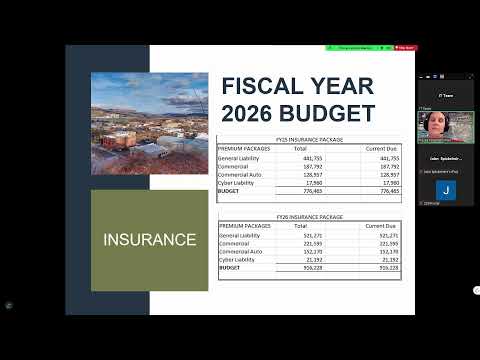
Insurance and broader budget timing Gordon and staff warned the council that property, liability and other insurance premiums have risen notably; staff said the city saw an 18 percent increase in the FY2025 premium and that initial broker conversations suggested a similar increase in the coming renewal. Staff are reviewing policy-structure options, including higher deductibles or other design changes, to limit premium increases.
Next steps and council direction Gordon reminded the council that payroll recalculations remain in progress and that staff will return in June with updated payroll impacts, capital-program details (including enterprise fund capital), and options to fund the FY2026 budget. Councilors asked for additional material on foregone tax authority and alternatives; Gordon said foregone-tax decisions require a council resolution and typically a public hearing and that she will provide preparatory information ahead of the deeper June work session.
Ending No formal votes were recorded at the work session. Staff listed the topics they will bring back in June: final payroll calculations and recommended funding options, a capital-project work session covering enterprise and transportation projects, and additional reserve or actuarial analysis for workers' compensation if the council requests it. Councilors also were encouraged to review the supplemental binders provided by finance before the next session.