Get Full Government Meeting Transcripts, Videos, & Alerts Forever!
Get email alerts on the Behavioral Health Services topic
No spam. Unsubscribe anytime.
Prince George's County outlines crisis continuum and says youth inpatient beds remain lacking
Summary
County health officials and partners described expansions in crisis services — including the Dyer Care Center, mobile crisis teams and 988 integration — but parents and speakers said there are currently no inpatient psychiatric beds for children in the county.
Prince George's County health officials and community partners on Monday detailed recent investments in the county's behavioral health system while acknowledging a continuing shortage of inpatient beds for children and adolescents.
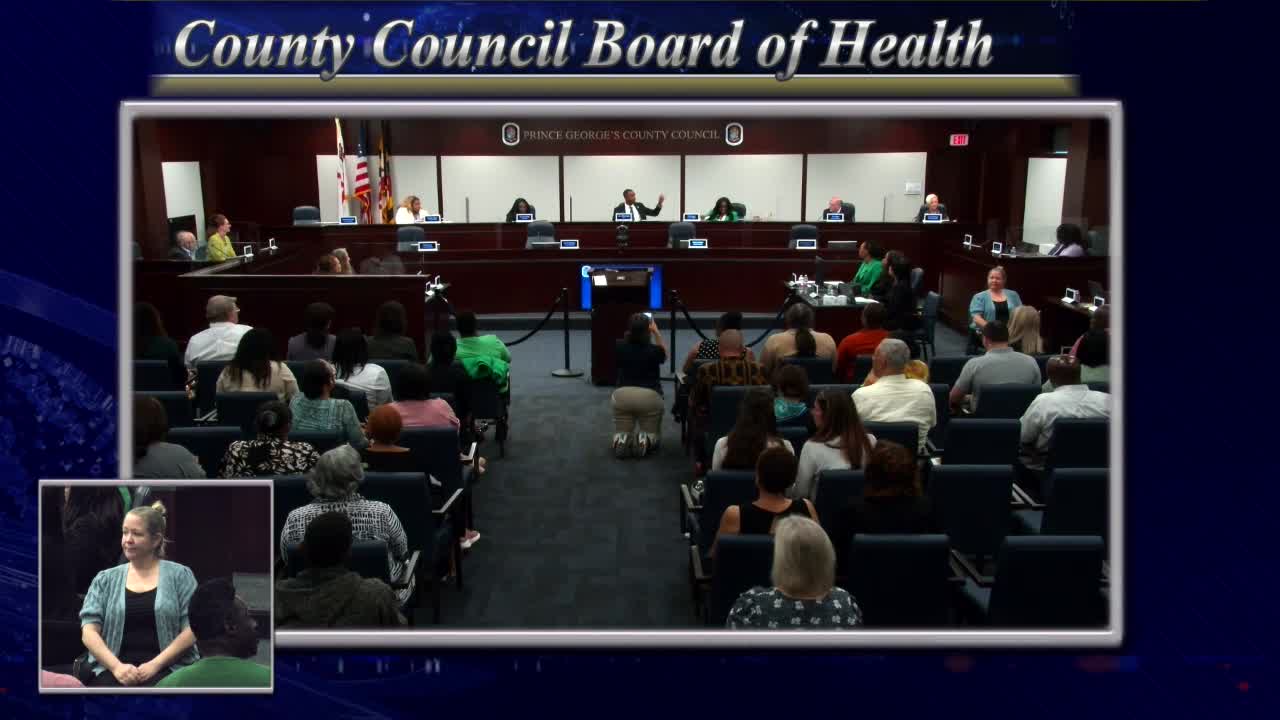
At a public hearing of the County Council sitting as the Board of Health on May 12, 2025, presenters reviewed the county's crisis continuum — 988 call services, mobile crisis response teams and the Dyer Care Center, a 16‑chair crisis stabilization facility — and described increases in licensed providers and program beds. County health officer Dr. Matthew Levy said the county now lists 237 licensed public behavioral health providers and 615 licensed programs and noted residential program capacity and other recent additions.
The presentations outlined why the county is investing in a crisis continuum: 988 can resolve many lower‑level needs by phone, mobile crisis teams provide scene‑based evaluation and short‑term care plans, and short‑stay stabilization centers such as the Dyer Care Center provide alternatives to emergency departments for adults. Margaret Fowler, executive director of TLC Maryland, described the county's “someone to call, someone to come to you, somewhere to go” crisis model and said the Dyer Care Center, which opened in September, is staffed 24/7 and accepts voluntary and involuntary guests for up to 23‑hour stabilization.
The county described concrete capacity numbers: 347 residential rehabilitation beds countywide, an increase in behavioral health residential/crisis providers from 134 to 225 in the most recent fiscal year, and 75 substance use treatment beds added this year by Pyramid Health. Mobile crisis services were described as eight two‑person teams covering 24 hours; response times have averaged about 45 minutes (with up to 60 minutes allowed).
But several parents and advocates urged faster action on services for children. A parent who identified herself as Danielle LaClear said the county lacks inpatient beds for children with serious psychiatric needs. "There are 0 inpatient mental health beds for children in this county," she said, describing episodes in which her daughter waited in emergency departments and was moved across county lines for placement. Imani Booker Lewis, who said she represents the local behavioral health authority, replied that the LBHA and partners are “close to getting to that point” of establishing crisis stabilization or inpatient beds for youth and that discussions with hospital and community partners are ongoing.
Presenters also described related programs and funding. The county has run a diversion pilot to route nonviolent behavioral health calls from 911 toward 988 and mobile crisis responders; Hyattsville and other municipalities have begun naloxone and fentanyl‑test‑strip distribution programs; and the county issued a request for information (RFI) that identified 12 potential partners to provide follow‑up care to people leaving crisis within 72 hours. County staff said the Health Services Cost Review Commission provided a behavioral health catalyst grant of more than $25,000,000 to support infrastructure built in collaboration with MedStar Southern Maryland Hospital, University of Maryland Capital Region and Adventist Healthcare Fort Washington. The school system has a separate $25,000,000 behavioral health grant for services in schools, presenters said.
The hearing included several community outreach items: the county hosted a “GOAT Behavioral Health Expo” for ages 16–24 that drew more than 500 attendees and involved more than 40 partners, and the health department said it is training peers and building curricula for young adults. Officials emphasized 988 as a first step for residents seeking help and encouraged use of the Local Behavioral Health Authority (LBHA) phone and resources for referrals.
The council did not take formal legislative action at the hearing; the meeting concluded with public comment and an adjournment vote.
Community members and council members said they welcome the new crisis infrastructure but urged the county to accelerate plans for youth inpatient and residential capacity so families need not send children out of county for extended care.