Get Full Government Meeting Transcripts, Videos, & Alerts Forever!
Get email alerts on the Land Use topic
No spam. Unsubscribe anytime.
Taylor planning commission backs special-use permit requirement for most large multifamily, mixed-use and RV projects with sunset tied to state bill
Summary
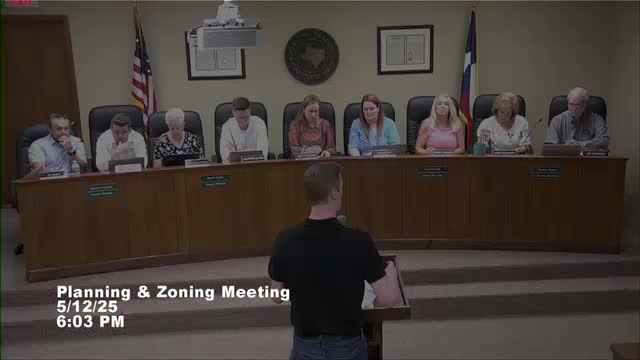
After an hour of public comment, the Taylor Planning and Zoning Commission voted to recommend that city council require special-use permits for large multifamily, mixed-use buildings containing multifamily units and recreational vehicle parks — but removed small apartments and added an automatic expiration if state HB1585 changes the law.
The Taylor Planning and Zoning Commission voted to recommend that the City Council require special-use permits (SUPs) for large multifamily developments, mixed-use projects that include multifamily units, and recreational vehicle parks, while excluding live/work units, duplexes, triplexes and quadplexes from the requirement. The commission’s recommendation includes a condition that the local SUP requirement automatically expire on the effective date of pending state legislation (House Bill 1585) that would restrict out-of-jurisdiction Housing Finance Corporations (HFCs).
Commission Chair Amy Everhart opened the public hearing and asked staff to present the proposal. Scott Dunlop of the city’s planning staff said the ordinance amendment responds to a City Council directive and to a January council resolution (Resolution 2025-O2) aimed at preventing tax-exempt entities from acquiring multifamily property and removing it from the tax rolls. Dunlop said the SUP would not change what uses are allowed in zoning districts; rather it would add a discretionary permit step before construction permits are issued so the city can require financial disclosures and evaluate whether a project would be tax-exempt and therefore shift service costs to other taxpayers. “This does not add or remove any use or sale or lease. All it does is add an additional permit requirement if you want to build multifamily, mixed use with multifamily, or an RV park,” Dunlop said during his presentation (transcript excerpt).
Why it matters: Commissioners and many speakers said the change is intended to protect the city’s tax base from projects financed through alternative, tax-exempt structures (such as some Housing Finance Corporation arrangements) that could leave the city providing services without corresponding property-tax revenue. Opponents — including developers and property owners — argued the SUP would add time and cost to projects, chill investment, and potentially infringe property rights. Several speakers urged narrower language targeting only developments that use alternative financing or only very large projects, and multiple commenters asked for a sunset clause if the state acts.
Public comments and staff clarifications: More than a half-dozen residents and developers addressed the commission. Justin Irving, a member of the public, warned the SUP could raise the cost of development and harm the city’s reputation with investors, calling for a time-limited (sundown) approach. Developer Prakash Patel said the city should limit any additional permitting to projects using PFC/HFC tax-exempt financing rather than applying an SUP to all multifamily. Property owner Chisholm Pierce, who described spending more than a year and money on an RV-park application, asked that projects already underway be grandfathered or otherwise protected. Marie Bloomer and Lisa Drummond said they supported stronger targeting or a sunset, and asked why the city was acting while state legislation was pending.
Staff answers: Dunlop told the commission the resolution passed by council in January is a policy directive and the SUP is the implementing ordinance; a resolution alone does not create enforceable permitting requirements. He said projects already vested through platting or other steps would be reviewed case-by-case to determine whether the new SUP requirement would apply. Dunlop also clarified that the LDC building-type definitions separate small apartments, large apartments, live/work, duplex/triplex/quadplex and that live/work and duplex–quadplex building types are not subject to the proposed SUP. He said notice of SUP requests would follow the city’s 200-foot zoning notice rule and that applications would be heard first by the Planning and Zoning Commission and then by City Council.
Amendment, conditions and vote: Commissioner Newman moved that the commission recommend approval to council, with a condition that the ordinance be of no further force and effect on the effective date of state amendments (the commission referenced HB1585 as the pending state measure). Commissioner Buzan seconded. Commissioners later amended the recommendation to remove small apartments from the SUP requirement (so the SUP would apply to large apartments, mixed-use with multifamily, and RV parks). The amended motion carried on a voice vote.
What the ordinance would change: The proposed ordinance text amends multiple Land Development Code sections (staff cited changes to section 4.3, 5.2A, 5.221 and 5.222) to change small and large apartment building types and RV parks from permitted to SUP-required in specified place types (for example, P4/P5 districts). Dunlop explained the city’s building-type approach: small multifamily is a detached building with multiple dwellings on a single lot; large multifamily is block-scale multifamily; mixed-use with multifamily typically has commercial ground floors and residences above; and RV parks are regulated separately in Chapter 16 of the municipal code.
Limits, process and next steps: Dunlop said the Planning and Zoning Commission’s recommendation will go to council for introduction and public hearing at the City Council meeting on May 22; if the council approves introduction, the ordinance would go to a final reading (and would become effective) on June 12. He noted the county canvass for a runoff was expected to be June 17, which could affect council membership between introduction and final reading. Commissioners and members of the public suggested the city could revisit or eliminate the SUP as part of an upcoming broader Land Development Code revision; staff noted the city has an active RFP for a consultant to revise the comprehensive plan and LDC.
Ending: The Planning and Zoning Commission forwarded the amended proposal — SUPs required only for large apartments, mixed-use containing multifamily and RV parks, with an automatic expiration tied to the state’s action on HB1585 — to the City Council with a recommendation to approve.