Get Full Government Meeting Transcripts, Videos, & Alerts Forever!
Get email alerts on the Community Reinvestment Area topic
No spam. Unsubscribe anytime.
Council approves ordinance to expand CRA boundaries citywide and standardize incentives
Summary
Delaware City Council on May 12 approved an ordinance to expand the citywide Community Reinvestment Area (CRA) to align with corporate limits, standardize tax-abatement terms and add mixed-income incentives aimed at encouraging multifamily and redevelopment projects.
Delaware City Council on May 12 approved an ordinance to expand the citywide Community Reinvestment Area, set standard limits for tax-abatement agreements and add incentives aimed at encouraging mixed-income housing and redevelopment.
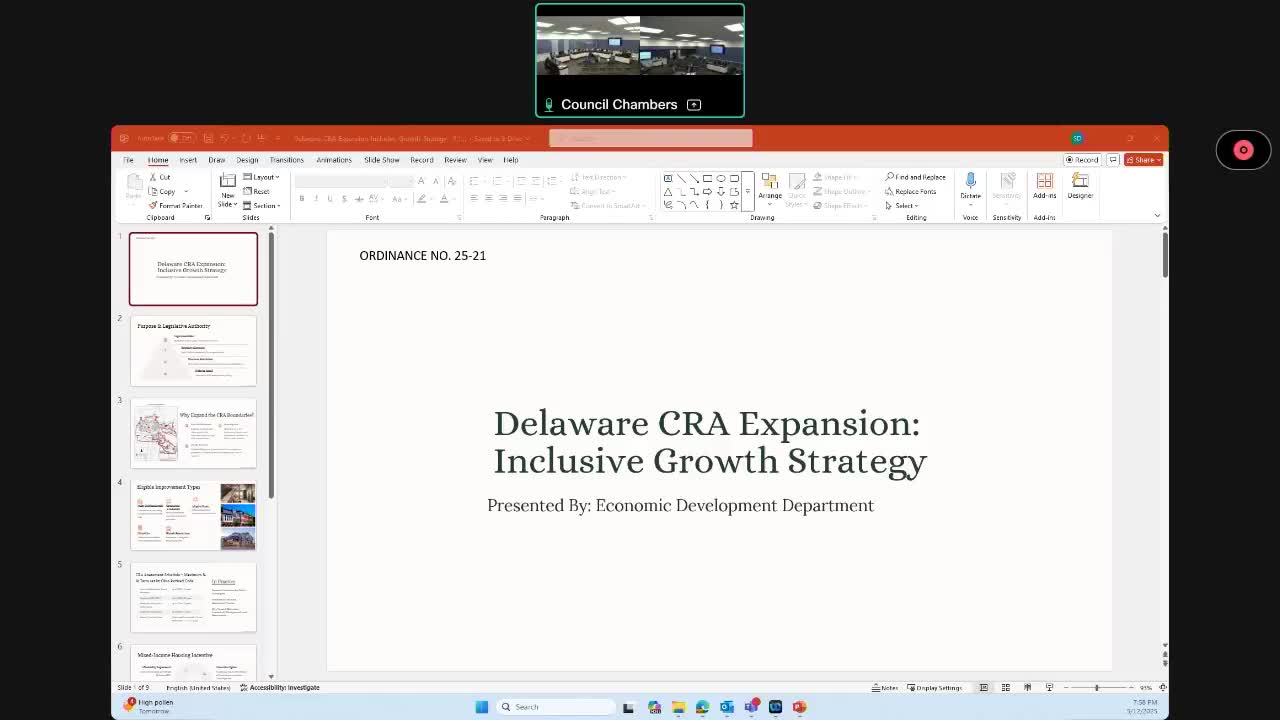
City planning staff presented the fourth reading of Ordinance 20521, which would expand CRA boundaries to the citys corporate limits and codify the types of eligible improvements and typical abatement terms. "We're experiencing and have experienced for the last 20 years robust growth," City staff member Nick Langford told council, arguing the tool would help address a local housing gap.
The ordinance lays out eligible project types including multi-unit residential, commercial/industrial, adaptive reuse, mixed-use and historic preservation. It sets a standard abatement of 70% for 10 years and adds a "mixed-income housing" incentive: developers who dedicate at least 20% of units at 60% area median income (AMI) would qualify for enhanced consideration; optional qualification at up to 80% AMI requires additional financial documentation and bank-reviewed pro forma statements.
Langford described an "enhanced CRA incentive" path for projects with documented financial need or significant public benefit, such as large land set-asides for parks or costly brownfield remediation. "Once again, they'd have to submit documentation, a bank reviewed pro forma, their sources and uses," Langford said, noting the city would work with third-party reviewers to stress-test proposals.
The ordinance also tightens oversight and enforcement language, giving the city the ability to revoke incentives if agreements are not honored, for example if lower-income units are segregated or promised public amenities are withheld. Councilmember remarks supported the measure as a tool to encourage attainable housing: "This brings us closer to what we've been discussing for a couple years now about incentivizing attainable housing," Vice Mayor Schaefer said.
Council approved the ordinance on a recorded roll call after a public presentation and staff Q&A. The ordinance references authority in state law: it implements Ohio Revised Code sections 3735.65 through 3735.7, which govern Community Reinvestment Areas.
If adopted, the city will publish the ordinance for two weeks in a local newspaper and report the change to the Ohio Department of Development before making the expanded CRA operational.
The council vote was unanimous. Mayor Carolyn K. Riggle and councilmembers voted in favor; no recorded dissents were made during the roll call.
The ordinance replaces prior CRA language; existing CRA agreements remain in force under their original terms unless amended by separate action. Staff said standardized terms should simplify tracking and enforcement going forward, though individual developers would still be required to execute project-specific CRA agreements.