Get Full Government Meeting Transcripts, Videos, & Alerts Forever!
Get email alerts on the City Budget topic
No spam. Unsubscribe anytime.
Santa Rosa third-quarter review forecasts roughly $13.3 million deficit; sales tax shortfall singled out
Summary
City finance staff told the Long Term Financial Policy and Audit Subcommittee on April 22 that weaker-than-expected sales tax receipts and rising public-safety personnel costs will leave the fiscal 2024–25 general fund with a projected shortfall of about $3.7 million in revenue and an overall deficit near $13.3 million.
On April 22, the Santa Rosa City Long Term Financial Policy and Audit Subcommittee heard the fiscal year 2024–25 third-quarter general fund review and year-end forecast from city finance staff. The presentation projected the city would fall short of its adopted revenue budget by about $3.7 million and finish the fiscal year with a deficit roughly $13.3 million.
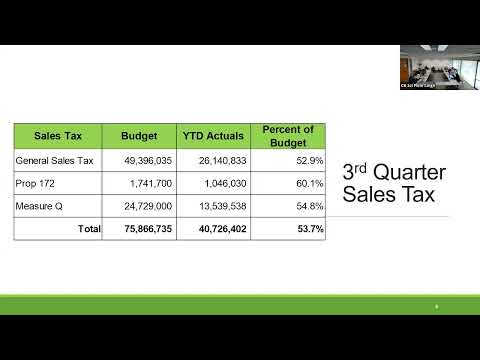
Veronica, a finance staff member who presented the review, said the shortfall is driven mainly by weaker sales-tax receipts and higher-than-expected salary and overtime costs in public safety. “We are not going to hit our revenue budget this year,” Veronica said. “We’re gonna come in short by about $3,700,000.” The city’s sales-tax consultant projects year-end sales-tax receipts of $68,480,000, about $7.4 million below the adopted budget, the presentation said.
The presentation walked the committee through year-to-date revenue and expenditure detail as of March 30. Property-tax receipts were at 56.4% of budget (two installments have been received and a large installment historically posts in April). Overall sales taxes were at 53.7% of budget versus an approximate 58.3% target given the city’s two-month reporting lag. Utility users tax was at 67.6% of budget; intergovernmental revenue was at 83.2% (timing related to Roseland annexation payments); licenses and permits trailed at about 65% of budget (affected by outsourced plan reviews); and miscellaneous revenues included one-time receipts such as opioid funds and strike-team reimbursements for the fire department.
On the expenditure side, the city expects to overspend salary costs by about $1.2 million, driven primarily by police and fire salary and benefit lines and higher overtime related to vacancies and injuries, Veronica said. Benefits were projected to be within a narrow range around budget (the presentation estimated a possible $350,000 underspend on a roughly $68 million benefits budget, but noted that could move in either direction). Operating expenditures historically tend to be fully spent, and the city’s midyear budget reductions eliminated much of the unspent appropriations cushion staff previously used to absorb overruns.
Taken together — revenue coming in lower than budgeted and expenditures likely to exceed budget — staff projected the fiscal 2024–25 general fund would close the year with a deficit near $13.3 million on a roughly $217 million budget. Finance staff noted that council actions in January reduced the adopted budget and that staff will recommend more conservative sales-tax assumptions for fiscal 2025–26 and beyond.
Committee members asked about regional sales-tax trends and the conservatism of future forecasts. Veronica said the sales-tax declines reflected a statewide pattern, though Santa Rosa has sometimes outperformed surrounding areas. Member Matt Nuellos asked whether Santa Rosa is an outlier; Veronica replied that statewide trends are similar to the local pattern. Member Caroline and Member Greg both thanked staff for the detailed breakdown and noted the tightness of current estimates.
Public commenter Janice praised recent commission and council meetings and asked unrelated questions about county office moves and tax allocation; staff offered to follow up outside the meeting.
The subcommittee did not take any formal budget action at the meeting; the presentation was informational and meant to inform the upcoming study session and the 2026–27 budget development process.
Ending: Staff said they will reflect the weaker sales-tax outlook in next year’s projections and bring additional budget recommendations to council via the study-session and formal budget process.