Get Full Government Meeting Transcripts, Videos, & Alerts Forever!
Get email alerts on the Land Use topic
No spam. Unsubscribe anytime.
Prince George's County committee weighs repeal of police facility adequacy tied to subdivision approvals
Summary
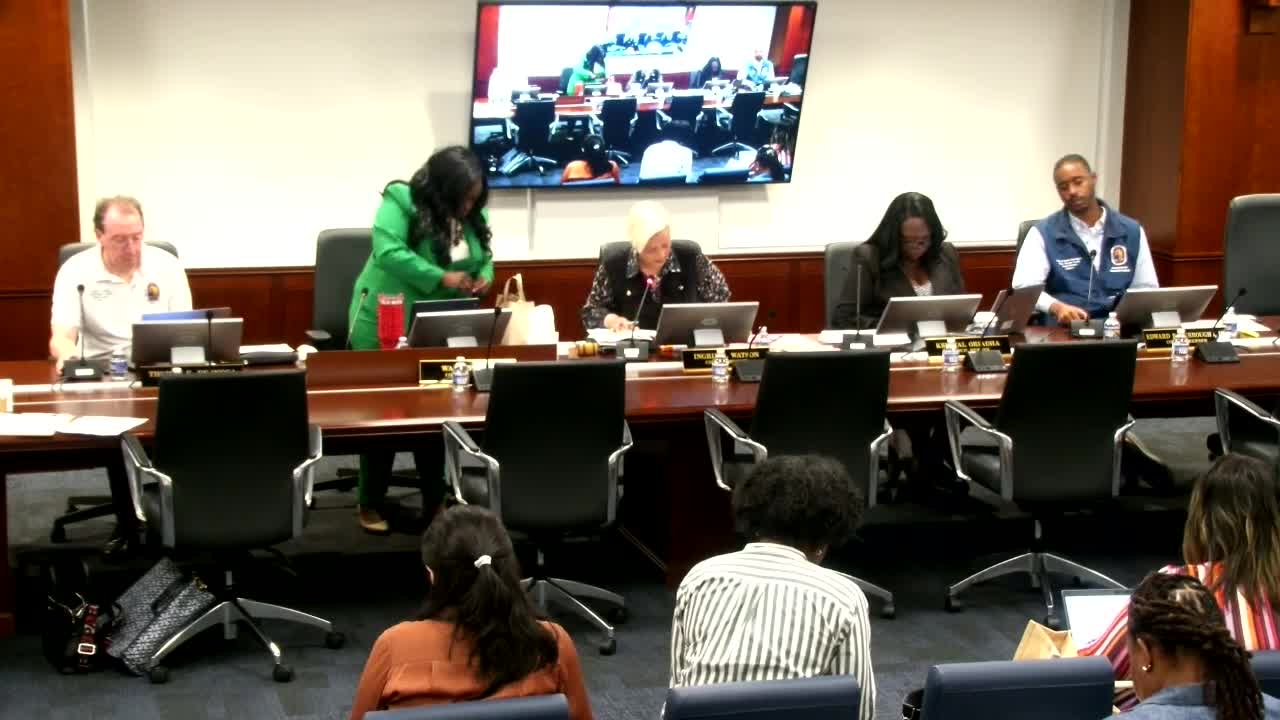
The Prince George's County Government Operations and Fiscal Policy Committee on May 12 considered CB 29-2025, which would remove police facility adequacy and police response-time standards from the county's subdivision regulations.
The Prince George's County Government Operations and Fiscal Policy Committee on May 12 considered CB 29-2025, which would remove police facility adequacy and police response-time standards from the county's subdivision regulations. The committee heard more than an hour of testimony from county staff, police and private-sector developers about the bill's effect on development, public safety and mitigation revenue.
The bill sponsor and county policy staff said the current law has become unworkable. Shaylyn Miller, policy analyst for CB 29, summarized the proposed changes: the legislation would remove police response-time indicators from the level-of-service standards that apply to residential subdivision approvals, remove requirements that the police chief submit equipment and response-time statements, and repeal the mitigation guidelines that require applicants to fund or participate in construction of police facilities on a pro rata basis.
Why it matters: Developers told the committee recent police response-time data have pushed large swaths of the county into moratoriums or into mitigation, blocking subdivisions or imposing high mitigation fees. Those outcomes have immediate fiscal and housing consequences, they said, while county staff and police argued data quality and measurement methods make the standard unreliable.
Developers, affordable-housing advocates and attorneys said the latest data update is being applied at subdivision review in ways they describe as sudden and retroactive. Thomas Haller, representing impacted clients, said projects that spent months and hundreds of thousands of dollars on planning were suddenly told they could not proceed or must pay mitigation, and he proposed two amendments: voiding mitigation agreements not yet paid and making the bill effective on adoption as an emergency measure.
Several builders and development representatives gave specific examples. Judd Ellum, management director at Standard Communities, said retroactive application of updated response times produced mitigation assessments equal to about $6,100 per unit on two projects he cited, totaling roughly $3 million. Patrick Donahue, regional vice president of land for NVR Inc., said one project (High Landing) could face a $7.8 million mitigation fee and that the moratorium risks halting projects that would generate substantial school and public-safety fees and road improvements.
Attorneys and consultant testimony questioned the dispatch- and recording-based method used to calculate response times. Matthew Tedesco, an attorney, summarized decades of review and litigation efforts and said, "the test is broken. It doesn't work." He told the committee that the response-time thresholds and the county's method of calculating them are out of alignment with dispatch priorities and with how other large jurisdictions measure response.
County planning staff and the county executive's liaison said the planning department has been applying the most recent annual police data it receives. Lakeisha Hall, planning director, told the committee the department issues adequacy letters based on the police data it receives and notifies applicants when updates arrive; she said there should not be wholesale retroactive revocations of previously issued certificates but acknowledged applicants have reported surprise when new numbers are applied as projects reach subdivision review.
Assistant Deputy Chief Jordan Swanger of the Prince George's County Police Department told the committee that response-time data are produced annually from the department and transmitted to planning; he said some of the variability arises from how dispatchers record timestamp values and that not all calls capture automated vehicle-location (AVL) or consistent timestamps. In response to a question about data accuracy, Swanger said roughly a third of records lack consistently populated timestamps because the system relies on manual dispatcher entry rather than automated GPS timestamps.
Committee members probed both policy and procedural fixes. Several members noted a Plan 2035 task force is reviewing infrastructure measures and public-safety testing. After discussion the committee voted to hold CB 29-2025 for further work and clarification; the motion to hold carried on a recorded vote.
What happens next: Committee staff and the bill sponsor indicated they will continue interagency work, including clarifying how police response times are calculated, whether alternative measures or mitigation approaches should be used, and the status of projects that received earlier determinations. The bill will return to committee after staff and sponsors report back.