Get Full Government Meeting Transcripts, Videos, & Alerts Forever!
Get email alerts on the Hhs Policy Agenda topic
No spam. Unsubscribe anytime.
HHS Secretary Robert F. Kennedy Jr. and agency chiefs outline health priorities, vow actions on food dyes, vapes and chronic disease
Summary
In an on-camera session at the Hubert H. Humphrey Building, HHS Secretary Robert F. Kennedy Jr. and leaders from FDA, CMS and NIH described an administration agenda focused on chronic disease, new food labeling and dye rules, stronger enforcement at the border against vaping devices, and changes to research and approval processes.
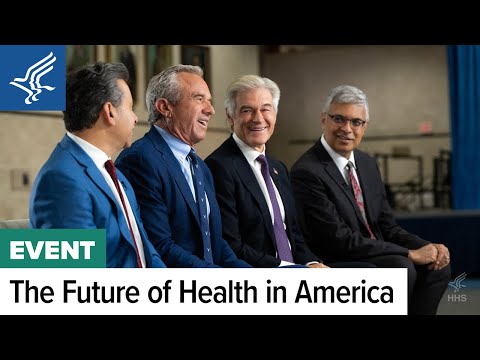
U.S. Department of Health and Human Services Secretary Robert F. Kennedy Jr. and three agency leaders outlined a broad agenda for changing federal public-health policy during an on-camera interview at the Hubert H. Humphrey Building.
Kennedy said the administration will prioritize reducing chronic disease and restructuring incentives across health care, citing plans to publish a MAHA Commission report “next week” that he said will identify causal factors such as “too much sugar, too much starch, ultra processed foods.” He said the administration has ordered the removal of nine petroleum-based synthetic food dyes over the next two years, with the two “worst” dyes to be removed within two months.
The announcement accompanied comments from Dr. Marty McCary, identified in the session as commissioner of the Food and Drug Administration, Dr. Mehmet Oz, identified as administrator for the Centers for Medicare and Medicaid Services, and Dr. Jay Bhattacharya, identified as director of the National Institutes of Health. Each described priorities for their agencies while supporting Kennedy’s framing that the U.S. health system contains “perverse incentives” that favor treatment over prevention.
“We want to focus the agency on cures and meaningful treatments,” Dr. McCary said of the FDA. He said the agency would emphasize new treatments in the pipeline and cited concerns about youth vaping devices he said are “designed to get kids addicted” and said the administration will stop such devices from entering the country and “confiscate them.”
Dr. Oz said CMS plans to increase payments to Medicaid while also seeking more efficient spending to address chronic illness, which he said accounts for roughly 70% of CMS-related expenditures across Medicare, Medicaid, the exchanges and CHIP. Oz described a newly created “war room” to combat fraud and organized criminal schemes that he said target entitlement programs. He provided figures he characterized as improper payments in fiscal 2024, citing about $54 billion in Medicare and $31 billion in Medicaid improper payments.
Dr. Bhattacharya criticized what he described as failures of past public-health leadership and endorsed an executive order the administration issued to limit what he called risky laboratory research (gain-of-function). He said the U.S. must set an example globally and said the administration will emphasize “gold standard” peer-reviewed, placebo-controlled studies for new medical technologies.
Kennedy and the agency leaders also described several administrative directions rather than completed rulemaking: - Kennedy said the administration has ordered removal or labeling of specified synthetic food dyes, with a two-year phase-out and two dyes targeted within two months. Kennedy said labeling will help consumers identify “food-like substances” with “lab created chemicals.” - McCary said FDA will increase enforcement at U.S. ports to stop certain vaping devices and will confiscate shipments rather than returning them to other ports. - Bhattacharya and McCary described initiatives to reduce animal testing in research and to align Medicare payment so that, when FDA approves a breakthrough device, Medicare will provide coverage sooner without duplicative review. - Oz described a war room and enforcement focus on fraud, and said CMS will seek to increase Medicaid payments while trying to improve value of spending.
The interview also touched on personnel and public-health messaging. Kennedy said a surgeon general nominee previously scheduled for a Senate hearing was withdrawn and that another public-health advocate, Casey Means, will play a role in communicating the administration’s vision. Kennedy and Bhattacharya repeatedly emphasized removing taboos in scientific discussion and preserving what they described as free speech in science.
On measles outbreaks, officials said CDC and HHS response teams were active in 22 states and that most U.S. cases were concentrated in Texas and New Mexico. Kennedy noted the outbreak has affected some unvaccinated Mennonite communities and urged vaccination while also saying people with religious objections “should be treated with compassion.”
The leaders also commented on broader administration priorities, including a planned MAHA Commission report that Kennedy said will deliver preliminary findings within months and “definitive answers within a year.” They said the administration will press pharmaceutical companies to limit television advertising and called for greater transparency and more rigorous, peer-reviewed trials for new drugs and technologies.
Statements in the interview were framed as administration intentions and policy directions; the group described actions already ordered (for example, dye phase-outs and border enforcement steps) but did not present published rules, finalized regulations or enacted legislation during the session.
The officials named a variety of outcomes they aim to pursue and provided timelines for some items, but several promises—such as major regulatory or statutory changes to advertising and broad shifts in Medicare payment policy—would require formal rulemaking, statutory changes, or agency processes that were not completed during the interview.