Get Full Government Meeting Transcripts, Videos, & Alerts Forever!
Get email alerts on the Government Oversight topic
No spam. Unsubscribe anytime.
Office of the Procurador del Ciudadano asks legislature for $503,000 and a technology upgrade
Summary
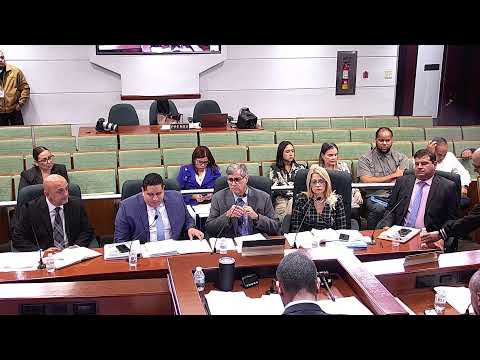
Edwin García Feliciano, Procurador del Ciudadano (ombudsman), told the House Finance Committee on May 9 that his office needs a $220,000 capital upgrade and new staff to handle legally created specialized ombudsman functions and rising casework.
Edwin García Feliciano, Procurador del Ciudadano (Ombudsman), asked the Puerto Rico House Finance Committee on May 9 to fund a technology replacement and additional staff to carry out newly created specialized advocacy units and to maintain casework capacity.
García Feliciano told the panel his office handled roughly 26,000 citizen contacts in the last fiscal year and currently employs about 60 people with an operating budget “de cerca de 3.3 millones de dólares.” He said the office’s case‑management software dates back two decades and has been unreliable; the office asked for a nonrecurring capital investment of $220,000 to replace it. “El sistema mecanizado que utilizamos para atender los reclamos ... data de hace 20 años,” García Feliciano said.
The Procurador also asked for 13 additional positions to staff a set of newly authorized specialized ombudsman units that the legislature has created in recent sessions: a small‑business ombudsman, a transport ombudsman, a data‑banks ombudsman, and representation of customer interests on several public boards (electric power and aqueducts authorities). The salary and benefit cost for those 13 positions was presented as roughly $396,000; combined with other operating needs the office requested $503,000 in non‑payroll funds in the budget under review.
Why it matters: The Procurador’s office acts as an intermediary between citizens and many agencies of the executive branch. García Feliciano said the office’s interventions not only resolve individual complaints but also generate broader institutional recommendations — for example, compiling the island’s most complete lists of school closures, shelter status and tire‑management research.
Details provided in testimony - Caseload and cost per complaint: The office described serving about 26,000 citizen contacts last year and estimated the average cost to process a complaint at about $140 from intake to resolution. - Technology request: $220,000 nonrecurring CAPEX to replace an aging case‑management system; current license costs are reported at about $55,000 annually. - Staffing request: 13 positions to staff several specialized ombuds units; estimated cost about $396,000. García Feliciano noted the office previously had as many as 140 employees in a different era but now operates at roughly 60, and indicated a long‑run staffing ceiling around 90.
Committee response and follow‑up Members pressed for details on the technology solution, asked whether the requested positions are permanent or one‑time, and sought clarity on which new statutory duties produced the staffing need. García Feliciano tied the staffing ask to specific laws that created new specialized ombudsman functions (small business, transport, data banks, etc.) and said those statutory mandates arrived without dedicated operating allocations.
The Finance Committee asked the Procurador to provide an itemized payroll impact and to confirm whether the technology request can be delivered as CAPEX to avoid recurring licensing charges. The committee also discussed the office’s remit and whether additional investigators should be added in future budgets; García Feliciano said the office currently has 17 investigators and expects to request additional investigative positions in the next budget cycle to reach roughly 30 investigators.
Provenance: García Feliciano’s entire presentation and the committee’s questions appear in the hearing transcript; key figures and direct quotes were taken from his testimony to the Finance Committee on May 9.