
Senate committee hears bill to let reproductive and gender‑affirming care providers use fictitious addresses
Get AI-powered insights, summaries, and transcripts
Subscribe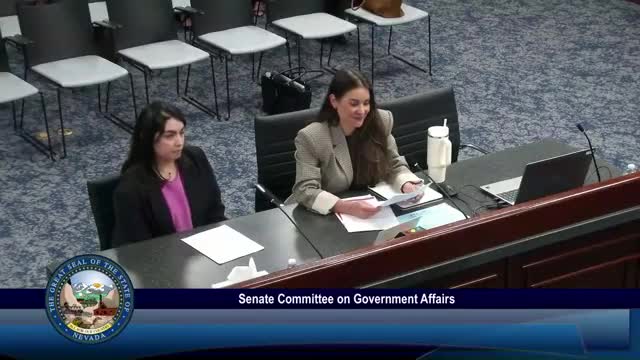
Summary
AB 235, a bill to allow certain reproductive‑health and gender‑affirming care providers to request that county and state records use a fictitious home address, was presented Wednesday to the Nevada Senate Committee on Government Affairs.
AB 235, a bill to allow certain reproductive‑health and gender‑affirming care providers to request that county and state records use a fictitious home address, was presented Wednesday to the Nevada Senate Committee on Government Affairs.
Assemblymember Erica Roth, the bill sponsor, said the measure is narrowly aimed at protecting providers from doxxing, threats and harassment. "Our health care workers should not be put in this position where their lives or well‑being are in danger simply for doing their jobs," Roth said in committee testimony.
Roth and witnesses from Planned Parenthood Votes Nevada described incidents they said illustrate the risk facing providers, including the release of personal contact information for staff and reports of threatening calls and materials left at staff homes. Alexis Solis, interim executive director of Planned Parenthood Votes Nevada, told the committee the bill would extend current law that allows certain public officials to seek confidentiality to reproductive and gender‑affirming care providers: "These providers and their support staff ... deserve to be protected in their homes," Solis said.
The bill would add reproductive‑health and gender‑affirming care providers to lists in existing Nevada statutes (testimony cited NRS 217.462, NRS 247.54 and NRS 481.091) that allow specified persons to petition a court to keep a home address confidential, and would add a DMV alternate‑address mechanism for identification.
Opponents including Nevada Right to Life and the Nevada Republican Party urged the panel to either make the protections available to all viewpoints or to reject the bill. Melissa Clement of Nevada Right to Life said harassment and doxxing happen to organizations on both sides of the abortion debate and asked the sponsor to consider a broader approach. Joshua Skaggs of the Nevada Republican Party expressed concern that the bill could create a protected class for one set of providers and asked why similar protections would not extend to staff at crisis pregnancy centers and pro‑life activists.
Committee members pressed the sponsor on how many providers would qualify and how narrowly the bill would be applied. Roth said she did not have an exact statewide headcount but that the measure was meant to be narrow and to cover providers who deliver reproductive and gender‑affirming care, noting that abortion is one service among many provided by those clinics. Legal counsel told the committee that Nevada law already includes a process allowing persons not specifically listed to seek confidentiality from the court if they can show justification; the new bill would make reproductive and gender‑affirming providers an enumerated category.
Several health‑care professional groups testified in support, including the American College of Obstetricians and Gynecologists (Nevada section) and the Nevada Advanced Practice Nurses Association, saying confidentiality could help recruit providers. Domestic‑violence advocates and the Nevada Women's Lobby also urged passage.
The committee did not take a final vote on AB 235 during the hearing. Sponsors and witnesses said they could provide follow‑up information about how many providers would be eligible and examples of threats reported in Nevada.
Ending: The bill remains in committee. Supporters told senators they see AB 235 as a narrowly tailored safety measure; opponents asked either that protections be available to a wider set of people or that the committee rely on existing confidentiality mechanisms. The sponsor said she would provide additional numbers and that legal counsel had confirmed courts can already grant confidentiality to persons not enumerated in statute if they demonstrate need.