Get Full Government Meeting Transcripts, Videos, & Alerts Forever!
Get email alerts on the Wildfire Fuel Management topic
No spam. Unsubscribe anytime.
Council authorizes interim fuel‑management work at George Washington Park; CEQA memo cites limited exemptions
Summary
The council unanimously approved interim wildfire fuel‑management activities at George Washington Park, authorizing limited removal and chipping of downed wood and other targeted work after a pre‑activity biological survey and with conditions to protect nesting birds and sensitive habitat.
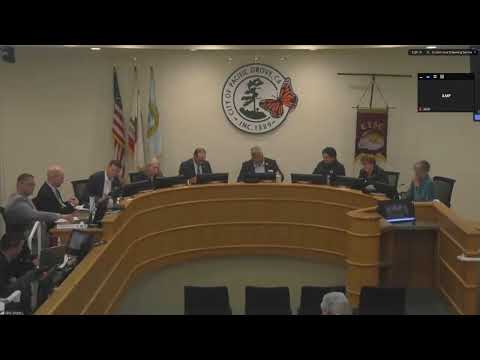
The Pacific Grove City Council on May 7 authorized interim fuel‑management activities in George Washington Park to reduce wildfire risk, unanimously approving a staff‑recommended approach that limits work to specified zones, requires pre‑activity biological surveys and stipulates techniques to minimize ecological harm.
Public Works staff described four target areas in the park where heavy accumulations of downed wood and tree debris pose a fire hazard. The city retained Denise Duffy & Associates to prepare a pre‑activity biological resources survey and a CEQA memorandum that recommends statutory and categorical exemptions for the limited interim work. City attorneys and staff advised council the work as described could proceed under CEQA exemptions but that biological protections must be observed.
The council’s authorization directs staff to: conduct a biological (nesting bird) survey no more than 10 days before field work; limit access to established trails where possible; use small rubber‑track loaders and portable chippers to remove and process downed wood; and follow the consultant’s mitigation measures. Councilmembers added a narrow amendment instructing that chips created from a specific small pile (site 1) be blown back into the park rather than spread on the public trail surface.
Public comment included support for immediate fuel reduction steps but urged staff to consider a larger‑scale fuel‑reduction effort using emergency provisions in state guidance. Speakers also raised practical concerns about chipping poison‑oak‑entwined debris and the potential for spreading urushiol; several residents recommended chips from poison‑oak material not be placed on trails and suggested off‑trail disposal or alternate handling.
Staff said the plan anticipates minimizing handling of poison oak and will retain significant portions of poison oak where feasible. For piles that cannot be chipped safely on‑site, Public Works said crews will remove large elements for off‑site disposal. The council approved the interim plan 7–0 and directed staff to host a public walk‑through of the work areas on May 13.
Why it matters: George Washington Park is a city‑owned 20‑acre site that includes both recreation areas and natural habitat. The interim work is intended to reduce near‑term wildfire risk while protecting habitat; the action also establishes a process and timeline for follow‑up planning and public engagement.
Implementation details: The city will perform a pre‑activity biological survey and only proceed if no active nesting or other protected resources are found within work zones. Public Works will primarily use trail‑based access, small rubber‑track loaders, and a portable chipper. For material contaminated by poison oak or too large for the chipper, crews will remove and haul it away.
Quotes
“We do have the consultants who are the experts and we will do that pre‑work,” Deputy City Manager Daniel Goh said, describing the survey and equipment the city will use.
Resident Kevin Hanley, who spoke during public comment, encouraged the council to consider broader fuel‑reduction options available under the governor’s emergency proclamation but said the interim steps were a reasonable start.
Ending
The council approved the interim fuel‑management authorization unanimously. Staff will proceed with the consultant‑recommended pre‑activity surveys, a May 13 public walk‑through, and limited trail‑based removal and chipping under the mitigation measures in the CEQA memorandum.