Get Full Government Meeting Transcripts, Videos, & Alerts Forever!
Get email alerts on the Council Compensation topic
No spam. Unsubscribe anytime.
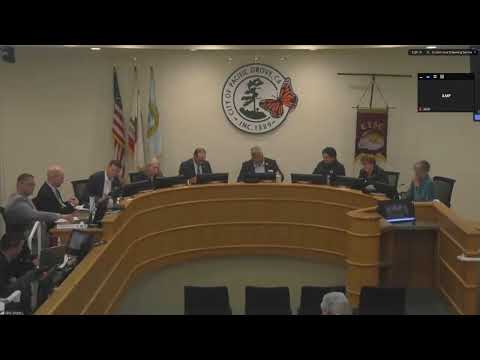
Pacific Grove council introduces ordinance to raise mayor and council pay; health benefits tabled
Summary
After weeks of public comment and debate, the Pacific Grove City Council voted to introduce an ordinance that raises monthly pay for the mayor and council members while removing a proposed health-benefit provision for later consideration.
Pacific Grove City Council voted on May 7 to introduce an ordinance increasing compensation for the mayor and council members and to remove a separate proposal to provide city-paid medical benefits for council members for later consideration.
The action came after more than an hour of public comment during which dozens of residents urged the council either to reject the pay increase or to send the matter to a public ballot. Opponents cited the city’s constrained budget and competing capital needs; supporters said modest pay helps broaden who can serve in local office.
City Attorney presented the legal background and the limits set by state law, including recent changes enacted by Senate Bill 329 and related Government Code provisions. The ordinance the council considered applied the state‑authorized formula — roughly a 5% per year adjustment measured since the last local raise — resulting in new monthly pay levels the city attorney said would be close to $966 for council members and $1,610 for the mayor if the council applied the state model.
Mayor Nick Smith moved the council adopt a version of the ordinance that excluded the section creating medical benefits for council members; the motion to remove the medical-benefit section passed 6–1. The council then voted 5–2 to introduce and hold the first reading of the amended ordinance (compensation only) and to publish the ordinance title as required by city rules.
The city attorney told the council any adopted ordinance would take effect 30 days after the second reading unless the council specified a different effective date; because the council chose to introduce and hold the first reading on May 7, the technical steps for adoption will continue to the next meeting for the required second reading and final adoption process.
During the debate, several council members said the increase was intended to “catch up” after more than two decades without an adjustment and to reduce financial barriers for would‑be candidates, especially after the city’s impending switch to district elections. Others said compensation should not include medical coverage for a part‑time, elected role and argued that such a change either be delayed until after the city’s budget process or placed on the ballot for voter approval.
The council did not adopt the medical‑benefits proposal and separately voted to defer further consideration of any health‑benefit change until after completion of the city’s upcoming budget process. That later decision passed 6–1.
What changed: The ordinance that the council introduced on May 7 modifies local pay to align with the state formula authorized in SB 329, but it does not include the proposed medical‑benefits provision. The medical‑benefits question will return to the council for further study after the budget cycle; council members also discussed but did not adopt a referral to place the measure on a public ballot.
Why it matters: The change reverses a 26‑year period during which local elected pay went unchanged, potentially lowering the financial barrier for residents who otherwise could not afford to serve. At the same time, many residents and some council members warned the city should address immediate infrastructure and service needs before adding recurring compensation costs and questioned whether taxpayer‑funded health benefits are appropriate for part‑time elected officials.
Quotes
“I am supportive of the proposed ordinance as written in the errata,” Mayor Nick Smith said during deliberations, citing the long period since the last pay change and the city’s cost‑of‑living pressures.
Councilmember WalkingStick urged a public vote instead, saying, “If the contract is to be changed, it must be done by the public,” and recommended referring the proposal to the next general election.
Votes at a glance
- Motion to remove medical benefits from the proposed ordinance: passed 6–1 (council vote summary recorded by roll call). - Motion to introduce and hold first reading of the amended ordinance (compensation only): passed 5–2 (council vote summary recorded by roll call). - Motion to defer further consideration of medical benefits until after the budget process: passed 6–1.
Next steps: The council introduced the ordinance and waived further reading at the meeting; the ordinance requires a second reading and a formal adoption vote (and the 30‑day effective period after adoption) before changes take effect. The medical‑benefits proposal will return for additional analysis and budgetary review following the city’s two‑year budget process.
Ending
The compensation ordinance will return for a formal second reading at a later meeting. The council’s split vote and the robust public response make clear this topic remains politically charged in Pacific Grove: compensation increases moved forward, while medical benefits will be reconsidered only after further fiscal review.