Get Full Government Meeting Transcripts, Videos, & Alerts Forever!
Get email alerts on the Student Voice topic
No spam. Unsubscribe anytime.
Howard County student council highlights growth in student engagement, urges more state advocacy
Summary
The Howard County Association of Student Councils (HCaS) presented its annual report, citing expanded participation across middle and high schools, policy engagement on state bills, 13-candidate SMOB election and plans to increase middle school outreach and state-level advocacy.
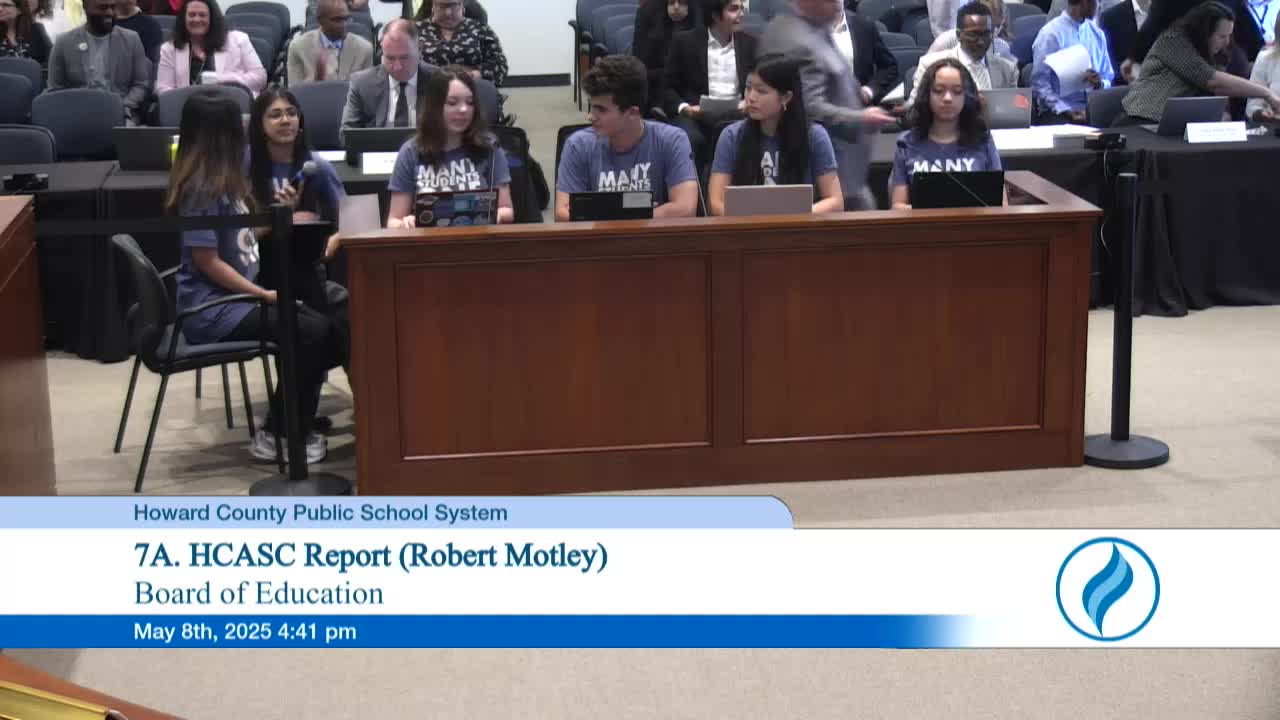
Student leaders from the Howard County Association of Student Councils presented the organization's annual report to the Board, outlining membership, programming and legislative engagement.
Gavin Falcone, acting president, and other officer-team members reported that HCaS this year represented all 13 high schools and 16 of 20 middle schools, totaling about 150 high school members and 63 middle school students across committees and appointed staff. They said the organization held nine general assemblies and multiple panels, including mental health, STEM and legislative affairs.
HCaS said it took positions on state-level bills including HB 52 (Your School, Your Voice Act), HB 72 (Civic Excellence Program), HB 197 (Restorative Practice Schools), HB 782 (study on detecting deadly weapons) and SB 429 (Excellence in Maryland Public Schools Act), supporting some measures and opposing others. The student group also supported full funding for the Maryland Blueprint.
HCaS members described successful activities: a student leadership symposium, statewide convention participation, and a county SMOB election that produced two finalists who campaigned across schools prior to the countywide vote. Officials reported plans to expand middle school representation and to organize an Annapolis advocacy day to connect students with state legislators.
Board members praised the student leaders' work and asked about transportation barriers for student participation, the process for shaping legislative stances, and communication channels for broadening engagement. Students said they planned more in-school outreach, morning-announcement promotion, and hybrid options to increase access; they described a multistep process for legislative stances involving committee review, internal votes, and consultation with SGA presidents.
Board members suggested leveraging morning announcements and curriculum connections and offered administrative support for student outreach and state-advocacy opportunities.