Get Full Government Meeting Transcripts, Videos, & Alerts Forever!
Get email alerts on the Criminal Sentencing topic
No spam. Unsubscribe anytime.
Michigan Supreme Court Hears Challenge to 25-Point OV19 Score After Meth Found During Booking
Summary
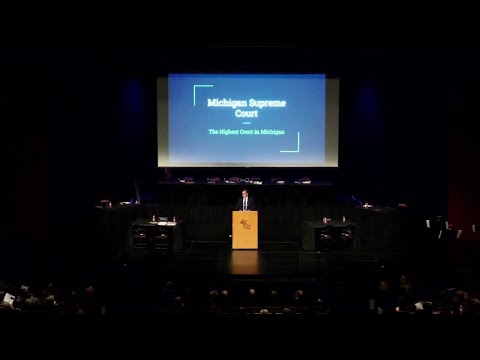
The Michigan Supreme Court onstage at Lowell High School heard oral argument in People v. Curtis Allen Morris, a case asking whether a trial court properly assessed 25 points for offense variable 19 (OV19) when methamphetamine was found in the defendant’s belongings during a 2022 jail booking.
The Michigan Supreme Court onstage at Lowell High School heard oral argument in People v. Curtis Allen Morris, a case asking whether a trial court properly assessed 25 points for offense variable 19 (OV19) when methamphetamine was found in the defendant’s belongings during a 2022 jail booking.
Liza Moore, an attorney with the court, briefed the audience that police first encountered the defendant in June 2021 during a traffic stop and that, during a separate January 2022 arrest and booking, methamphetamine “fell out of his pocket,” prompting additional charges. Moore said the trial court sentenced the defendant in August 2022 to “38 to 120 months” after scoring 25 points for OV19; the Court of Appeals affirmed in an unpublished opinion and the Supreme Court granted argument to decide whether those 25 points were properly assessed.
The question before the justices focused on two connected legal issues: whether the scoring element “by his or her conduct” requires voluntary or purposeful action by the defendant, and whether the booking area where the substance was discovered is the kind of penal-institution space OV19 contemplates.
Appellate counsel Charles Covello argued for the defendant that “a reasonable and common-sense understanding of conduct is that it is some kind of voluntary action,” and therefore scoring OV19 based on items found while a person was involuntarily in custody would improperly expand the variable. Covello told the court the defendant had been arrested, handcuffed and placed in a police vehicle before the booking discovery, and urged the justices to read the statute narrowly to avoid penalizing an individual for circumstances created by the arrest process.
Branch County Prosecutor Zachary Sempien said the sentencing scheme was working as the legislature intended to capture post-offense conduct that affects a facility’s security. Sempien argued OV19 is meant to reflect post-offense behavior and said methamphetamine is particularly dangerous in custody because of its association with violent or erratic conduct: “Methamphetamine is one of the most dangerous drugs that we have on the streets currently,” he told the court. He also told students during the program’s debrief that a typical quantity in the case was about 0.33 grams.
Justices probed both sides. Several asked whether the booking area should be treated the same as the housing units of a jail, whether a drug that “falls out of a pocket” during processing should count as threatening conduct, and how OV19 compares to other offense variables that assign 25 points (for example, conduct that supports terrorism). The justices also discussed factual permutations that could alter the analysis—whether a defendant deliberately discarded contraband, whether trustees or staff could later access the booking area, and how disclosure to staff in intake would affect the security analysis.
During a post-argument debrief for students, court staff explained options the justices have next: deny leave and let the lower-court decision stand, reverse, affirm, or issue a published opinion clarifying the law. As Dan Brubaker, the court’s chief commissioner, told the audience, “If they decide to do something simple, that decision could come out in a matter of weeks. If they decide to do an opinion, it could be months.”
The court took the case under advisement and the justices submitted the case for decision; no ruling was announced from the bench.
The outcome could affect how trial courts nationwide apply OV19 in Michigan sentencing practice, particularly in cases where contraband is discovered during booking rather than after a defendant has been admitted to general population.