Get Full Government Meeting Transcripts, Videos, & Alerts Forever!
Get email alerts on the Policy Reviews Child Abuse Behavior Enrollment topic
No spam. Unsubscribe anytime.
Board reviews draft updates to child-abuse reporting, student behavior interventions and enrollment policies
Summary
Calvert County Public Schools staff presented proposed updates to policy 14-60 (child abuse reporting), policy 32-15 (student behavior interventions) and policy 37-10 (enrollment). Board members asked for added language on volunteer training, restorative approaches and clarifications for homeschool credit evaluations.
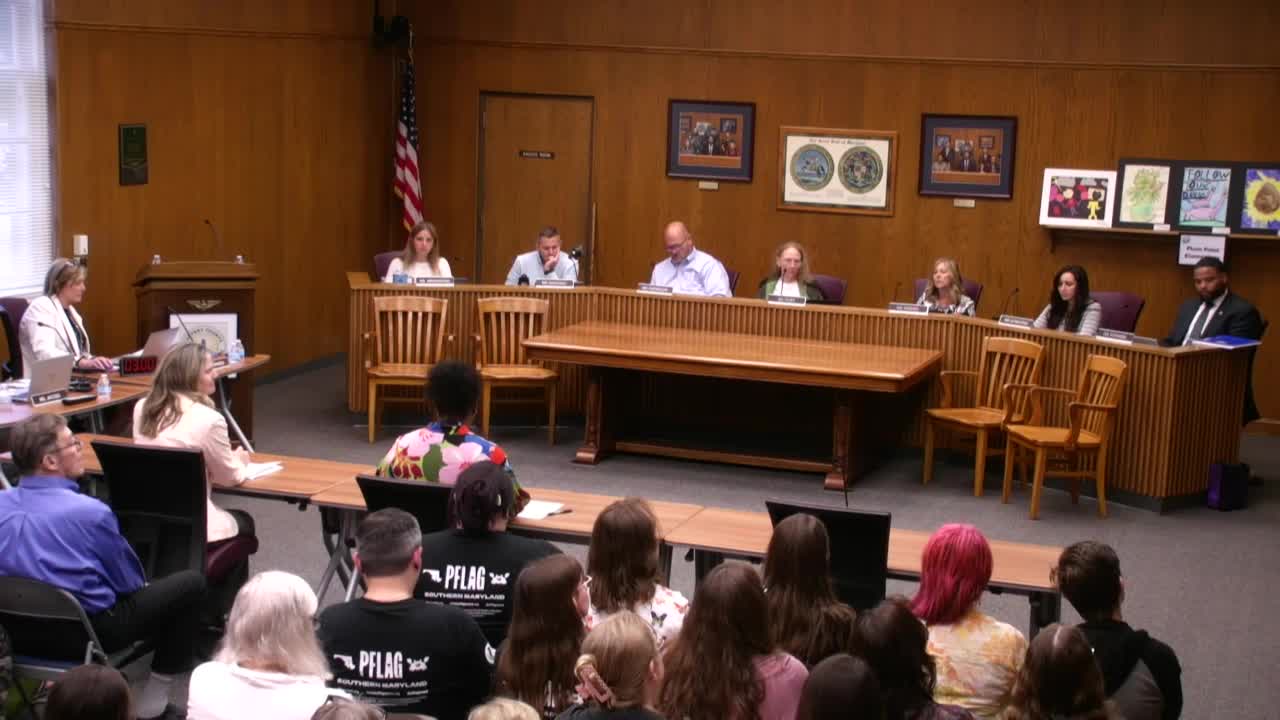
Staff presented three policy reviews on May 12 aimed at clarifying obligations and aligning district language with state guidance.
Cecilia Lewis, Director of Student Services, presented recommended edits to Policy 14-60 (Maryland Child Abuse and Neglect Law compliance). The proposed changes would (1) tighten the volunteer definition to: "any person at the request of the principal or designee who provides service for Calvert County Public School System without receiving monetary compensation," and (2) add Administrative Policy 8,123 (parent/caregiver/community involvement) to the related policy section. Lewis and Supervisor Molly Wanamaker described current practice for staff training and logging: staff receive annual training through the district's Safe Schools program and reports are logged internally in the Department of Student Services; external investigations are led by the Department of Social Services or law enforcement under existing memoranda of understanding (MOUs).
Board Member Melissa Goshorn asked for stronger language on volunteer training frequency and documentation—suggesting an assessment or a required acknowledgement certifying understanding. Lewis said volunteers are processed through Human Resources and committed to collaborating with HR to add language requiring volunteer acknowledgement; she described limitations on controlling external agencies' investigative procedures but agreed to pursue clearer internal follow-up language to "close the loop" on reported incidents.
On student behavior interventions (policy 32-15, presented by Lewis with Kendi Anderson, Director of Special Education, and Suzanne McGowan, Supervisor of Student Services), staff proposed adding a definition and policy language to explicitly incorporate "restorative approaches." The recommended definition describes restorative approaches as "preventive and proactive" methods that build relationships, set clear expectations, teach accountability for harm, and repair relationships. Staff cited alignment with Maryland Department of Education (MSDE) guidance and Maryland Code (cited in the presentation as "Maryland Code Annotated Educational Statute 7-36A1, 2019"). Board members asked for consistent language between the definition and the policy narrative and discussed ensuring those approaches address bystanders and the class community when incidents occur. Staff said restorative approaches will be used alongside other positive behavioral interventions and training for proactive, trauma-informed responses.
Scott McComb, Director of System and Instructional Performance, reviewed proposed clarifications to Policy 37-10 on enrollment processes. Changes clarify the policy's dual aims—(1) establishing enrollment processes and (2) identifying appropriate academic placement via transcript review—and add definitions for credits and transcripts. McComb detailed how the district evaluates incoming high-school credit claims (written assessments, interviews with content supervisors, portfolio reviews, MAP diagnostic assessments) and described the state requirement for home-instruction reviews; he emphasized that physical activity from private sports programs generally does not meet Maryland public-school physical-education standards.
Board members asked procedural and cross-policy questions: how student crisis responses are documented, how student conduct policies are aligned, and where parents and volunteer protocols should be codified. Staff said they will bring suggested language and procedures back for board review if the board approves the proposed policy edits. No final votes on these policy edits were recorded on May 12; staff fielded questions and offered to return with revised language incorporating requested clarifications.
The presentations included multiple references to state guidance and COMAR citations; staff said the changes are primarily clarifications intended to align CCPS practices with state requirements, not to change substantive duties.
Board members did request additional follow-ups: clearer volunteer-training and acknowledgement language in the mandatory-reporting policy, more explicit restorative-approach guidance that addresses classroom community and bystanders, and an exploration of where evacuation/other crisis procedures are specified across student-conduct and behavior-intervention procedures.
Staff recommended annual review language tied to COMAR deadlines; board members asked staff to circulate redlines and proposed procedures in advance of a future public vote. The board did not adopt final policy language on May 12.