Get Full Government Meeting Transcripts, Videos, & Alerts Forever!
Get email alerts on the Transportation Infrastructure topic
No spam. Unsubscribe anytime.
Council approves Tank Farm Road paving project; selects road‑diet alternative and directs safety refinements
Summary
Council authorized advertisement and likely award of the 2025 paving project (base bid includes Tank Farm Road and Sacramento Drive) and gave staff direction to advance a road‑diet option on Tank Farm east of the Marigold Center with additional safety measures. The Sacramento segment was approved earlier in the meeting.
The City Council authorized staff May 6 to advertise and pursue construction of the city’s 2025 paving project, including Tank Farm Road (Broad Street to the Orchid roundabout) and a Sacramento Drive repaving segment. Council gave staff clear direction to pursue a “road‑diet” striping alternative on Tank Farm Road between the Marigold Center and the Union Pacific railroad bridge (Alternative 1) and to explore additional safety enhancements such as pedestrian refuges and flex‑post buffers where feasible.
Project scope and cost: Public works staff described the project as a full pavement reconstruction for several arterial links. The full engineer’s estimate for the advertised base bid and two additive alternates was approximately $11.1 million; available funding at the time of the meeting was about $9.1 million. The base bid (funding‑priority scope) includes Tank Farm Road between Broad Street and the Orchid roundabout (excluding paving inside the roundabouts) and Sacramento Drive segments; additonal alternates could be awarded if bids and funding permit.
Why the road diet was proposed: Transportation staff said Tank Farm Road east of Broad currently functions as five lanes on its western portion (two through lanes each direction plus a center turn lane) and narrows to one lane each way east of the railroad bridge. Staff presented two alternatives: (1) a road diet that reduces the two‑lane section east of the Marigold Center to a single travel lane each direction with a wider center turn lane and striped buffer for bicycle lanes; or (2) retain the existing four‑lane section through the same area and make smaller safety improvements. Staff recommended Alternative 1 based on national research and the city’s Active Transportation Plan, noting the stretch is an ATP Tier‑1 corridor where protected bicycle facilities and improved pedestrian crossings are priorities.
Safety elements and trade‑offs: Staff highlighted collision history that included two severe pedestrian injury collisions in recent years near the corridor and frequent complaints about illegal high speeds. Alternative 1’s advantages include proven crash‑reduction potential, improved pedestrian safety at new marked crossings including a proposed crossing at Morning Glory, and speed feedback signs. Fire and emergency staff raised concerns about fixed vertical features (concrete curbs or large raised refuges) that could impede mass evacuation or emergency access; staff therefore recommended non‑vertical stripe buffers and flexibility to avoid vertical obstructions unless subsequent detailed analysis shows they are safe. Council directed staff to continue to test design options and to coordinate with the Fire Department on emergency access and evacuation timing; Fire Chief Todd Tuggle advised that any vertical obstruction could constrain vehicles attempting to expand traffic lanes during an evacuation.
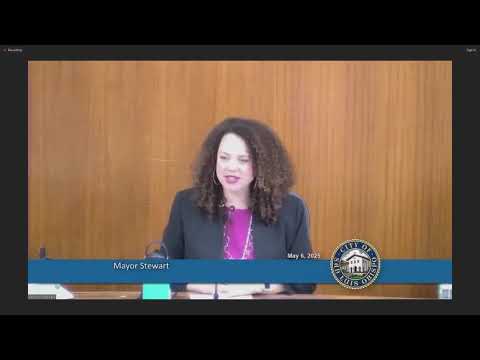
Sacramento Drive and other items: Before the Tank Farm deliberation the council separately approved the Sacramento Drive paving and safety measures (speed feedback signs, curve warning beacons and targeted pavement markings) as part of the base bid. That Sacramento vote passed 4–0 (Mayor Stewart briefly recused from that portion of the meeting for a locality conflict). Council then returned to the Tank Farm discussion and, after public comment and lengthy council deliberation, directed staff to finalize design for Alternative 1 and to advertise the project for bid.
Next steps and timeline: Staff said the project would be advertised in June, bids opened in July, and, if bids are responsive and within budget, construction could start in August or September with completion expected by January–February 2026. The city engineer was authorized to finalize plans consistent with council direction; the city manager was authorized to award a contract within available funding. Council also authorized staff to use contract change order authority within the approved project budget to address field conditions.
Ending: Council approved staff’s direction to implement the Tank Farm road‑diet striping plan with further work on pedestrian refuges and flexible physical protection for bicycle lanes where feasible, while prioritizing emergency‑response and evacuation planning.