Get Full Government Meeting Transcripts, Videos, & Alerts Forever!
Get email alerts on the Cannabis Regulation topic
No spam. Unsubscribe anytime.
SLO council introduces ordinance to clarify cannabis zoning, delays new storefront applications
Summary
City staff briefed council on the annual cannabis program update and introduced an ordinance to clarify land‑use and operational rules in municipal code section 17.86.80. Council agreed to introduce the ordinance and asked staff to further study event and on‑site consumption requests raised by retailers.
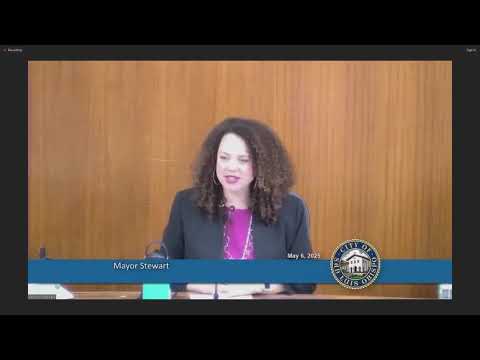
San Luis Obispo city staff presented the annual commercial cannabis program update on May 6 and introduced an ordinance to amend municipal code section 17.86.80 to clarify land‑use and operational requirements for commercial cannabis activity.
The update, given by Ivana Gomez, the city’s cannabis business coordinator, said the city currently has two active retail storefront operator permits — Megan’s Organic Market (280 Higuera) and SlowCal Roots (3535 South Higuera) — and a third retail permit that is conditionally awarded to Embark in 2024 but is inactive pending an appeal scheduled for council review July 1. Gomez said, “Because there is a 3 retail storefront permit limit in the city, the city cannot accept new retail storefront applications until that appeal is resolved.”
Gomez summarized proposed amendments described by staff as “cleanup” and clarifying changes, not policy shifts. She told council the amendments would (1) clarify how buffer distances apply to retail storefronts and to the city’s cannabis overlay zones (CBZ), (2) remove repetitive or inconsistent terminology such as “can overlay” in favor of the consistent “CBZ overlay,” (3) remove a specific federal Controlled Substances Act scheduling reference from the purpose statement to avoid repeated future code updates if federal classification changes, and (4) align microbusiness operational standards (hours, age access, signage) with retail storefront rules.
Why it matters: Gomez explained the buffer regime adopted in 2018 remains in force: retail storefronts must be 1,000 feet from schools and public parks, 600 feet from licensed day‑care centers, and 300 feet from residentially zoned areas only when those residential zones occur inside a CBZ overlay. Gomez said the CBZ overlay zones were intended to concentrate cannabis uses in areas already separated from sensitive uses by major barriers such as Broad Street or the railroad.
Retail operators in the audience asked the council to go further. Megan Souza, owner of Megan’s Organic Market, asked council to “direct staff to explore opportunities for cannabis events in the city of SLO,” citing examples such as educational or infused‑dinner events and noting such events would also require state temporary event permits from the Department of Cannabis Control (DCC). Austin Canela, of SlowCal Roots, asked council to study both temporary cannabis event rules and the possibility of on‑site consumption areas at licensed retailers, saying on‑site consumption would “open the door for tourism innovation from educational sessions to curated tasting experiences.”
Staff response and next steps: Gomez told council the requested changes are primarily clarifications and that staff did not recommend opening a new retail application period while the third permit remains under appeal. She also noted the city’s current fee and tax structure: cannabis tax revenue is collected monthly and is budgeted at about $1.1 million annually; permit fee revenue (renewals and transfer fees) is intended to cover program administration. Gomez said a new transfer‑of‑ownership fee adopted in October 2024 is approximately $14,000 and covers staff time for processing transfers. Councilmember Susan Francis asked how the city would proceed if it wanted to explore temporary events or on‑site consumption; Gomez and Director Timmy Tway said staff could prepare a high‑level memo describing other jurisdictions’ approaches and the work and resources a code change would require, and that a more extensive outreach and work‑plan commitment would be needed for program overhauls.
Council action: Councilmember Candy Marks moved to receive the update and introduce an ordinance amending section 17.86.80 to clarify land‑use and operational requirements for commercial cannabis activity; Councilmember Boswell seconded. The motion passed 5–0.
What remains open: Councilmembers and staff acknowledged retailers’ requests to explore events and on‑site consumption but said those would require further study and likely a future work‑plan item. Gomez said microbusiness retail sales had not been updated in a 2023 ordinance change and staff proposed aligning microbusiness retail hours and medical‑access rules with retail storefront requirements.
Ending: The council introduced the ordinance and directed staff to return with the ordinance language for subsequent public hearing and adoption steps; staff also agreed to prepare high‑level information on how other jurisdictions manage temporary cannabis events and on‑site consumption if the council wants to pursue that topic further.