Get Full Government Meeting Transcripts, Videos, & Alerts Forever!
Get email alerts on the Mexican Wolf Management topic
No spam. Unsubscribe anytime.
Cochise supervisors hear plan to pursue U.S.-only downlisting, seek more compensation and faster investigations
Summary
Cochise County supervisors on May 8 heard a detailed briefing on Mexican-wolf population growth, depredation impacts and management options, including a recommended push to pursue a U.S.-only downlisting and requests for higher federal compensation and faster local investigations.
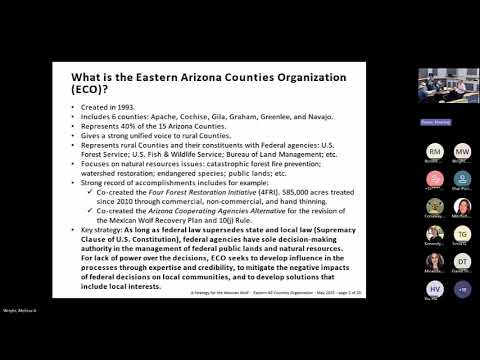
Cochise County supervisors on May 8 heard a detailed briefing on the Mexican wolf reintroduction program and its local effects, including population data, federal rules that govern management and options the county can pursue. The Eastern Arizona Counties Organization (ECO) told the board the U.S. wolf population could meet the recovery criteria for a U.S.-only downlisting within a few years, while ranchers and Cochise County law enforcement said delays in federal depredation investigations and limited field staffing are harming producers now.
The issue matters because population growth drives range expansion and livestock losses and because management options differ sharply depending on whether federal wildlife authorities move to downlist the U.S. population from “endangered” to “threatened,” or to delist the species entirely. ECO’s presenter, Pascal Berriault, said a path exists to downlist the U.S. population but that continued federal funding and program activity are needed to reach that goal without leaving local producers without tools or compensation.
Berriault, executive director of the Eastern Arizona Counties Organization, summarized data and legal triggers in the U.S. recovery plan. He said the federal minimum count at the end of 2024 was 286 Mexican wolves in the United States and that the population has grown roughly 11 percent in 2024 and about 14.3 percent on average since 2017. He said the recovery rule includes two key tests for a U.S.-only downlisting: a four-year U.S. average population of at least 320 wolves and successful incorporation of new genes into the wild population (22 successful incorporations under the plan). ECO’s count showed 21 successful gene incorporations on April 1, 2025; Berriault said one more successful incorporation would satisfy that requirement.
“Downlisting the U.S. population is coming on the horizon,” Berriault said, noting that Mexico’s population and genetic metrics lag far behind the U.S. numbers. He advised the board that a full delisting (removing protections under Section 9 of the Endangered Species Act) would require sustained population and genetic targets in both the U.S. and Mexico, and therefore is not a short-term option.
Berriault also described management tools and constraints in the recovery rule. He said ECO supported ending the release of “naïve” (human-habituated) wolves in favor of cross-fostering pups into wild dens, and that lethal removal by federal authorities remains an authorized, limited tool for highly predatory individuals. He argued that defunding the program without delisting would likely leave wolves protected but remove federal funding for mitigation (for example, cross-fostering, helicopter counts and transfers to Mexico), producing worse outcomes for producers.
Cochise County law enforcement and ranch patrol staff described current problems on the ground. Detective Cody Esfry of the Cochise County Sheriff’s Office Ranch Patrol said two wolves released in the Peloncillo/Chiricahua area have resulted, by his office’s tally, in six confirmed depredations over recent months and an additional incident reported the morning of the meeting. Esfry said USDA Wildlife Services investigators and Arizona Game and Fish staff who conduct official depredation confirmations are based in northern Arizona; that can create 24–48 hour delays before an authorized investigator can reach a scene, during which scavengers can remove forensic evidence.
Esfry said Ranch Patrol will respond quickly to preserve scenes and photograph evidence and to rule out criminal activity, but that local deputies are not certified as official wolf-depredation investigators under the current state and federal processes; without a USDA/APHIS inspection, livestock owners cannot receive certain compensations. The sheriff’s office has submitted letters to Washington and is coordinating with ranchers and stakeholders.
Presenters and county speakers also criticized a recent change in the USDA Wildlife Services standard of evidence for confirming wolf depredation; the revised standard emphasizes observed subcutaneous hemorrhage (deep bite marks) on carcasses. ECO and local advocates said in many Southwest cases a carcass is consumed or dragged away, leaving tracks and blood but no exposed subcutaneous hemorrhage, and that the stricter requirement can reclassify obvious events as only “probable” rather than “confirmed.” Berriault said ECO opposed removing hemorrhage from the standard but urged a limited exception when the scene strongly indicates wolf depredation.
Speakers discussed money and programs that currently support coexistence. Berriault said ECO and partners helped secure approximately $1.5 million for depredation compensation and conflict prevention since 2011 via Livestock Demonstration Grants; he said ECO has donated about $135,000 since 2020 to support Arizona Game and Fish “range rider” operations and related mitigation work. He also said federal grant funding for depredation compensation to the states runs at roughly $200,000 per year and that funding will be insufficient if wolf numbers and depredations continue to rise.
County participants proposed immediate and medium-term steps the board could pursue. These included drafting a county resolution to: request higher federal depredation compensation; ask U.S. Fish and Wildlife Service and USDA/APHIS to permit cooperative training or certification so local deputies or state personnel can conduct timely depredation investigations; press federal authorities to include an evidentiary exception for heavily-scavenged carcasses; and coordinate now with state and federal partners to prepare a 4(d) rule and other management measures that would accompany any U.S.-only downlisting. Several supervisors asked staff to draft a resolution and consult ranch patrol and the public before finalizing it.
No formal county vote took place at the work session. The board set a public meeting for May 13 at 5:30 p.m. in the same hearing room to collect public comment on a potential resolution about Mexican-wolf management and related county requests.
The meeting captured a common theme among presenters: litigation or rule changes at the federal level can be lengthy and uncertain, so the local strategy emphasized preparing now for lawful, administrable actions under the existing recovery plan while pressing for better compensation and faster on-the-ground investigation capacity.
The board said it will consult with Ranch Patrol and community stakeholders as staff prepare a draft resolution for consideration at a future meeting; the May 13 public hearing was announced as the next scheduled opportunity for county residents to offer comments.