Get Full Government Meeting Transcripts, Videos, & Alerts Forever!
Get email alerts on the Grants And Finance topic
No spam. Unsubscribe anytime.
Governing board approves FY26 alternative water supply grant list; district to enter agreements for construction funding
Summary
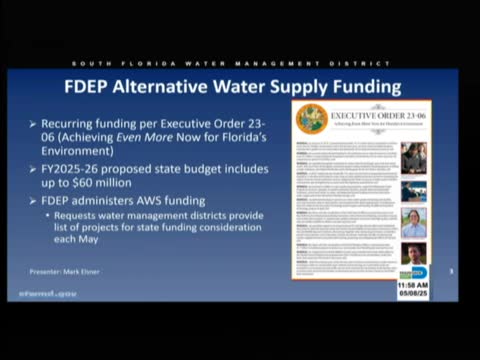
The board voted unanimously May 8 to adopt two resolutions approving a prioritized FY26 alternative water supply grant list and to authorize entering into construction agreements; staff said 36 applications requested roughly $1.5 billion in total project cost and that the tentative state budget included $60 million for the program.
The South Florida Water Management District on May 8 approved two resolutions to advance the district’s FY26 alternative water supply grant program and authorize staff to enter into agreements for selected construction projects.
Presentation and program details
Mark Ellsner, the district’s Water Supply Bureau chief, told the board the FY26 application round drew 36 applications requesting about $1.5 billion in total project costs; applications included alternative sources (brackish, reclaimed water, ASR) and water-conservation projects. Ellsner said the district’s preliminary, tentative budget had $60 million available for alternative water supply funding this year; the district will only fund construction costs under this program, not studies or design work. Staff also outlined consideration factors including regional benefits, consistency with regional water supply plans, permit compliance, the status of year-round irrigation ordinances and QBS readiness.
Public comments and nutrient concerns
Audubon Florida, represented by Caitlin Newcamp, thanked the district for the program but urged attention to nutrient-management risks when reclaimed water is used for irrigation, noting reclaimed water nutrient limits can be much higher than the water-quality goals for sensitive systems. A district/DEP representative said legislation (House Bill 1557, referenced in the meeting) requires assessment of reused water if it contributes to impairments and, where necessary, upgraded advanced wastewater treatment to address nutrient contributions within a set timeframe.
Board action
A motion to approve the prioritized list and a separate motion to authorize staff to enter agreements for the selected projects passed unanimously (both recorded as resolution numbers presented by staff: 20250511 and 20250512). Board roll calls recorded “yes” from all members present.
What to watch
Staff said they will prioritize projects that are shovel-ready for construction and projects that reduce reliance on traditional water sources. The district emphasized it will continue to coordinate with DEP and utilities to address nutrient management where reuse is proposed for irrigation.
Ending
Board members asked for continued attention to reclaimed-water nutrient levels while moving quickly to fund construction-ready projects; staff said they will return with updates as agreements are executed.