Get Full Government Meeting Transcripts, Videos, & Alerts Forever!
Get email alerts on the Water Supply And Drought topic
No spam. Unsubscribe anytime.
District reports low rainfall, Lake Okeechobee recovery progress and issues with estuary flows; Cape Coral faces Phase 4 restrictions
Summary
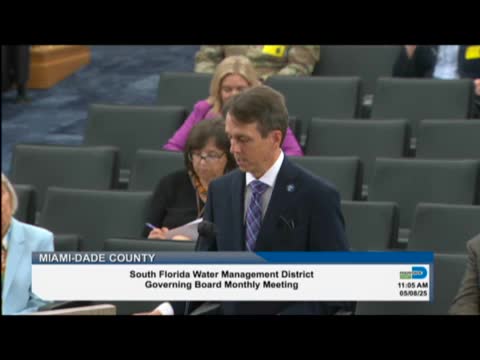
Board briefings on May 8 showed Lake Okeechobee at lower levels than in recent years but meeting recovery-day targets; staff described ongoing drought management, a recently issued Phase 4 irrigation restriction for Cape Coral, and continuing scrutiny of freshwater releases affecting estuary salinity and oyster recruitment.
District staff told the governing board on May 8 that the region has experienced an unusually dry dry season and described operational steps to protect water supplies and the environment.
Lake Okeechobee and dry-season status
Staff reported Lake Okeechobee at roughly 11.09 feet NGVD as of the meeting, tracking close to the district’s water-shortage management band. The district said inflows this water year were substantially below recent years — roughly 1.5 feet less than the prior year — but that operations had achieved multiple low-water days that count toward Lake Okeechobee recovery goals for submerged aquatic vegetation. Officials said about 22 days below 12.0 feet and 11 days below 11.5 feet had been recorded toward the regulatory benchmarks the Corps and district monitor for recovery operations.
Drought and water deliveries
Presenters warned that rainfall over the past dry season was well below average in much of the district and that evapotranspiration has been a large component of lake water loss. The U.S. Drought Monitor showed expanding dryness in the central district; staff said a modest rain event may arrive the week after the meeting but that they continued to prepare for the wet season and closely monitor forecasts.
Cape Coral restriction and water-supply measures
Bartlett said the district used an existing board authorization to issue a Phase 4 water-restriction order last Friday for Cape Coral and parts of Lee County. The order prohibits irrigation using certain groundwater (the mid-Hawthorn/aquifer source) and aims to stabilize aquifer levels and avoid irreversible compaction. Staff said initial monitoring shows stabilization but the situation will be watched daily; the district is coordinating with Cape Coral and Lee County on hook-ups to municipal supplies planned for June.
Estuary flows and oyster recruitment
The board heard competing public comments on estuary impacts. Matt DePaulis and other estuary stakeholders said the Caloosahatchee and Sanibel-area estuaries are on a “razor’s edge” for oyster spawning and that recommended lake releases and realized flows have not always matched, citing days when expected pulses of flow did not occur. District staff said minimum-flow metrics for the Caloosahatchee (an MFL of 457 cfs) and district recommendations (500 cfs recommendation) are part of operational discussions; staff acknowledged that the short-term daily flows can be lower than target on certain days while still working to meet duration components of the MFLs.
What it means
Staff emphasized that dry seasons can have ecological benefits for some wetland recovery processes but that the immediate challenge is balancing water supply needs for urban utilities, agriculture and environmental flows. Bartlett and technical staff described contingency work — pump availability, pre-positioned contracts and coordination with water utilities — in case Lake Okeechobee levels decline to trigger installation of forward pumps to maintain supplies.
Board response and next steps
Members asked when installation of pumps and other contingency steps would be triggered; staff said planning is in place and that discussions generally intensify around 10.8 feet NGVD, with other factors (crop timing, forecasts and precipitation) used to guide decisions. Staff said the district will continue weekly interagency evaluations of conditions and keep the board informed.
Ending
Board members and attendees described the situation as serious and urged continued monitoring and regional coordination; district staff said recovery metrics and the onset of the wet season will determine next operational steps.