Get Full Government Meeting Transcripts, Videos, & Alerts Forever!
Get email alerts on the City Budget topic
No spam. Unsubscribe anytime.
Houston controller details FY26 budget gap, urges residents to weigh in at May 21 public hearing
Summary
City Controller Chris Hollins laid out the city's fiscal picture, saying the proposed FY26 budget projects about $2.9 billion in general-fund revenue against roughly $3.0 billion in expenditures and urging residents to attend a May 21 public hearing and contact councilmembers as the council considers amendments in late May.
City Controller Chris Hollins on Tuesday explained the City of Houston's proposed fiscal year 2026 budget and urged residents to participate in upcoming hearings, saying the proposed plan leaves a structural shortfall the city must address.
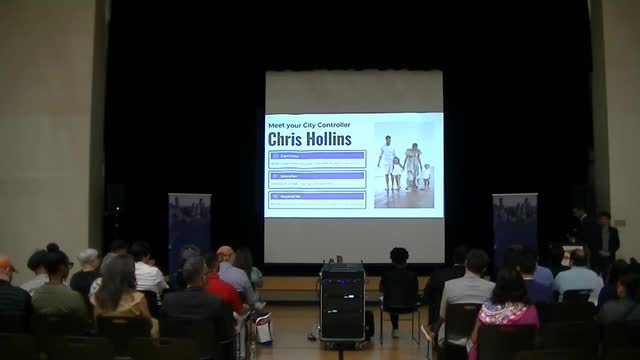
"As your city controller, I am your independently elected chief financial officer," Hollins said, describing his office's role overseeing investments, auditing operations and "certif[ying] the availability of funds." He told the Ripley House audience that the proposed FY26 budget totals about $7 billion overall, with roughly $3 billion in general-fund spending and $4 billion in enterprise funds.
Hollins emphasized the recurring nature of the city's structural shortfall and its drivers. He said the city's current fiscal-year shortfall was about $336 million, driven largely by personnel costs and a court ruling that required the city to increase annual spending for roads and drainage by about $100 million. Under the FY26 proposal he reviewed, he said the projected general-fund gap narrowed to about $107 million.
Why this matters: the general fund pays for core services'police, fire, parks, libraries and trash pickup'and is financed primarily with property and sales taxes. Hollins said police and fire payrolls and debt-service payments together account for the largest shares of the general fund. He urged residents to participate in the process so their priorities inform council deliberations.
Details and figures Hollins cited: - Proposed total FY26 budget: about $7 billion (approximately $3 billion general fund, $4 billion enterprise funds). - Current-year general-fund revenue (reported): $2.9 billion; expenditures: $3.2 billion; structural shortfall roughly $336 million. - Projected FY26 shortfall in the mayor's proposed budget: about $107 million. - City debt outstanding: about $15 billion; general-fund debt service is about $500 million annually. - Recent employee pay changes that affect costs: a 4.5% raise for police, a roughly $3,000 annualized raise for civilian employees (effective Nov. 1, 2024) and a 10% raise for firefighters plus $650 million in negotiated back pay that the city financed with a 27-year bond (Hollins said that bond averages roughly $45 million per year, and cost about $30 million in the first year). - Federal grants: Hollins said the city has about $2.6 billion in federal grants across multiple years, with roughly 99% of the housing department funded by federal grants. - Community centers: Hollins said the parks department budget includes about $11 million for community centers in the proposed budget, down from $12 million in the prior year (an approximate 8% decrease).
Hollins explained the difference between the city's general fund and enterprise funds, saying enterprise funds (water and sewer, airports, convention center, drainage) are financed by user fees or dedicated surcharges and cannot be repurposed to cover general-fund expenses without legal changes. He also noted that outside consulting work (for example, reports from Ernst & Young) differs from the formal audits his office conducts under auditing standards.
On a legal and structural matter that affects budgeting, Hollins described a court ruling that affirmed a 2018 voter-approved designation limiting how a portion of property-tax revenue may be spent on roads and drainage. He said the courts required the city to increase annual roads-and-drainage spending by about $100 million, contributing to the structural shortfall.
Audience questions covered possible legislative remedies and program-level concerns. Hollins said legislation in the Texas Legislature would, if passed, redirect some Harris County toll revenues (HCTRA) to Houston; he noted that the bill had passed the Senate and was then under consideration in the Texas House and that, if enacted, additional revenue could help close a portion of the gap. He cautioned, however, that the legislature's calendar means measures must pass by Memorial Day.
On how residents can engage, Hollins outlined near-term dates and actions: the mayor released the proposed budget the day before the town hall; the public hearing on the budget was scheduled for May 21; the mayor was expected to place the proposed budget on the city council agenda May 28, after which councilmembers could offer amendments and votes would follow in subsequent meetings. Hollins suggested specific, solution-oriented input when citizens testify and recommended contacting councilmembers directly.
On police and firefighter pay, Hollins said pay increases reflect both competitive pressures and negotiated agreements. He noted news reporting about the police contract'which he cited as a Chronicle estimate of roughly $865 million over five years'and said raises for public-safety workers account for a substantial portion of personnel costs but that personnel are a major component across all departments.
Hollins provided contact information for his office and said the controller's staff would follow up to answer questions they could not address during the session. "If I don't have the answer, I'll let you know that we'll follow up with you," he said.
The presentation included the controller's appeals to transparency and fiscal sustainability: prevent waste, fraud and abuse; increase transparency; improve city operations; and chart a path to fiscal sustainability so recurring services are matched with recurring revenue.
Ending: Hollins closed by urging residents to attend public hearings and to contact their councilmembers. He gave the controller's office email as controller@houstontx.gov and noted the office's social handles. He invited attendees to follow up through the office if their questions were not answered during the meeting.