Get Full Government Meeting Transcripts, Videos, & Alerts Forever!
Get email alerts on the Restoration topic
No spam. Unsubscribe anytime.
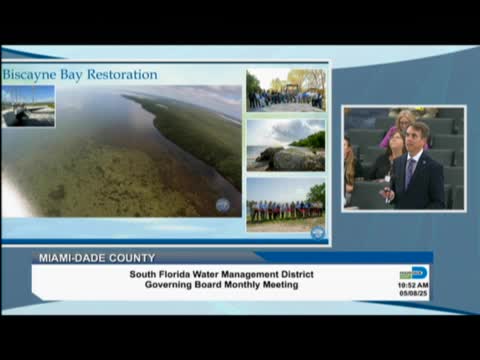
South Florida Water Management District spotlights Biscayne Bay, Everglades and Tamiami Trail restoration progress in Miami
Summary
At a Miami meeting May 8, South Florida Water Management District leaders outlined construction and habitat gains — including work on Cutler Wetlands, the L-31 flow way and Tamiami Trail bridges — and were urged by local groups to speed land purchases and avoid delays to Biscayne Bay Coastal Wetlands.
The South Florida Water Management District on May 8 told its governing board in Miami that several Everglades and Biscayne Bay restoration projects are moving into or through construction and that those efforts are already producing environmental and economic benefits.
Executive Director Drew Bartlett described ongoing construction at the Cutler Wetlands and the L-31 flow way, and said Army Corps of Engineers work on nearly 3.5 miles of bridge for Tamiami Trail is allowing planned water flow equalization through Everglades National Park. Bartlett said those actions, combined with a seepage wall and new culverts, are helping move fresh water south and rebalance salinity in Florida Bay and Biscayne Bay.
Bartlett said a recent economic study tied to Biscayne Bay restoration estimated a $64,000,000,000 economic impact and about 448,000 jobs in Miami-Dade County, and he described local benefits including new recreational access and a boat ramp for 3B. Bartlett said restoration work has begun to show improved salinity stability and water depths in Shark River Slough and other areas, and that restoration partners are “on track” to finish several features this year.
Why it matters: Board members and local advocates told the district that the projects have wide local consequences for coastal habitats, flood resilience and the regional economy, and they urged the district to preserve land and maintain momentum so the restoration footprint is not lost to development.
Local stakeholders used the meeting’s public comment period to press for faster action. Scott Polowitz of Friends of Biscayne Bay urged the district to begin purchasing land within the recommended Biscayne Bay Coastal Wetlands footprint “now before it is lost to development,” saying delayed land acquisition would make it harder to reduce pollution loads reaching Biscayne Bay. He called the project “vital” to lowering harmful runoff and protecting seagrass, mangrove and coastal wetlands.
Other projects and partners Bartlett highlighted include the Cutler Wetlands, the L-31 flow way, and the Corps-built L-31 rehydration works. Colonel Bowman of the U.S. Army Corps of Engineers attended and was thanked by multiple board members for Corps partnership on the Tamiami Trail and other tasks. Bartlett also noted continued work to install additional culverts and to manage flow into Taylor Slough and Florida Bay.
Board members described the work as the largest environmental restoration effort in history for the region, and several emphasized the need for continued coordination across federal, state and local agencies, including the Army Corps, U.S. Fish and Wildlife Service, Florida Department of Environmental Protection and county governments.
What remains unresolved: Bartlett told the board that the legislative session closed without passage of one water-district-related bill he referenced (Senate Bill 7002), and that appropriations work remained ongoing. He also said some federal or grant funding (he referenced Building Resilient Infrastructure and Communities grant awards) was reduced for construction on three structures; design funding remains in place, and the district will continue pursuing construction funding.
Ending: Board members and city and county officials attending the Miami meeting reiterated support for completing planned projects this year, citing resilience, water-quality and economic reasons. Local advocates said the district should accelerate land purchases for Biscayne Bay Coastal Wetlands and maintain a visible timetable so restoration gains are not delayed or lost.