Get Full Government Meeting Transcripts, Videos, & Alerts Forever!
Get email alerts on the Wildlife And Environment topic
No spam. Unsubscribe anytime.
Margate approves first reading to allow removal of nonnative invasive iguanas after residents cite property damage and safety concerns
Summary
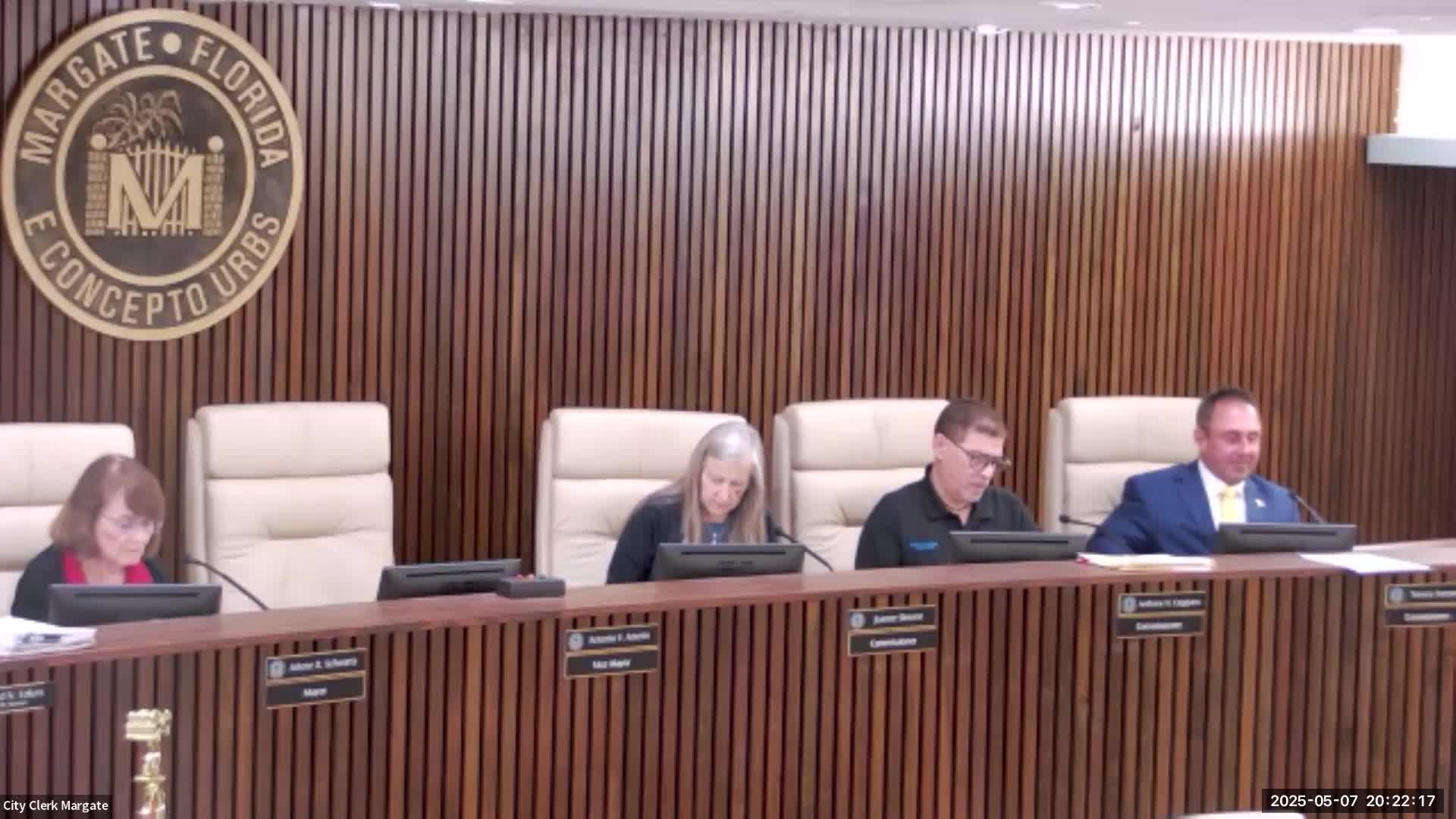
The Margate City Commission voted 4-1 on May 7 to approve first reading of an ordinance creating an exception to the city's anti‑cruelty rule so landowners may capture and humanely euthanize nonnative invasive iguanas and similar species; commissioners and residents debated who may perform removals and what methods are allowed.
The Margate City Commission on May 7 voted to approve first reading of an ordinance amending the city code to allow capture and humane euthanasia of nonnative invasive iguanas and related species on private property, with an amendment referencing the Florida Fish and Wildlife Commission list of nonnative invasive species.
The change alters the city's animal-cruelty prohibition to add an exception for nonnative invasive iguanas and other species identified by the Florida Fish and Wildlife Commission, and for 'certain nuisance animals' noted in the ordinance as amended. The vote on first reading was 4-1 (Commissioners Rosano, Casiano, Simone and Vice Mayor Serio voting yes; Mayor Arlene Schwartz voting no). The ordinance will return for a second reading.
Residents from Paradise Gardens and other neighborhoods urged the commission to act, saying iguanas have burrowed under seawalls, shredded landscaping and sickened pets. John Donahue, president of Paradise Gardens Section 4, said his community has seen expensive structural damage: "We had a person screaming that they're over my doors. . . . We had a woman here last time that had a bill of $14,000 for the destruction of her seawall," Donahue said. Other residents described repeated yard damage, deep holes that create trip hazards and lost crops and gardens.
Supporters told commissioners they had tried deterrence measures and private trappers but needed a local option. MJ Duff, addressing the commission for neighbors who had requested help, said: "They were all trapped. . . . These people are scared. They've all needed help by us." Michael Peek, a Paradise Gardens resident, urged a structured, police‑coordinated program to keep removal humane and safe: "Do something about it. . . . Organize it with the police department and . . . qualify certain people as good shooters, which we have. So it's done humanely. It can be done safely."
Commissioners debated two central questions: which species to include and who may perform removals. Commissioner Robert Simone moved to expand the draft to include other nuisance species raised at the meeting (Simone named Bufo frogs during discussion) and to tie the list of allowed nonnative species to the Florida Fish and Wildlife Commission (FWC) and accepted humane-euthanasia guidance. Commissioner Simone said, "If it is on his property and he gives somebody permission to be on his property, what difference does it make to you who he chooses to kill the [animal]?" The amendment was seconded and incorporated into the ordinance language on first reading.
Mayor Arlene Schwartz voted against first reading, citing concerns about public safety and the possibility that untrained people could discharge weapons. Several speakers, and some commissioners, described incidents of people firing from boats on the C-14 canal and worried about stray projectiles. Commissioner David Casiano urged limits and accountability for anyone removing animals other than the property owner. The city attorney noted the city cannot regulate firearms contrary to state law and recommended tying species lists to FWC designations to avoid substantive changes that would require re-advertising the ordinance.
Public commenters and some commissioners raised practical points that the commission asked staff to address before final adoption: whether licensed trappers exist locally and typical disposal practices (residents described double-bagging carcasses and placing them in regular garbage), the potential liability if removals are done on others' property, and prohibitions on minors operating BB guns (speakers referenced Florida rules that limit minors' use of certain projectile devices).
The ordinance text on first reading will permit humanely euthanizing nonnative invasive iguanas and other FWC-listed nonnative invasive species on private property; the commission also directed staff and the city attorney to prepare clearer language on permitted methods and any other safeguards to present at second reading.
The commission scheduled a second reading; staff said changes that are 'substantive' could require republication and an additional hearing. The city attorney and staff will provide draft language tying the allowed species to FWC and clarifying enforcement and method limits ahead of the next reading.
Votes and next steps: The ordinance passed on first reading 4-1 and will return for a second reading with revised language to clarify permitted species and operational safeguards.