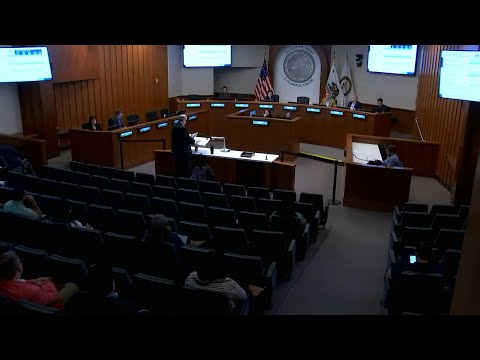
City manager outlines budget process, warns of rising insurance and limited capital picks
Loading...
Summary
City Manager Christian Clegg told the Bakersfield City Council on May 5 that the city will present a balanced fiscal year 2025–26 proposed budget after May workshops and a public hearing in June, but warned that rising insurance and workers' compensation costs are driving large increases in several internal service accounts.
City Manager Christian Clegg told the Bakersfield City Council on May 5 that the city will present a balanced fiscal year 2025–26 proposed budget after May workshops and a public hearing in June, but warned that rising insurance and workers' compensation costs are driving large increases in several internal service accounts.
Clegg told council members the budget team will bring a longer list of potential capital projects to the May 19 workshop and ask the council to choose a smaller subset for funding. He said revenues are “fairly flat” while costs are increasing, and staff has cut discretionary spending and shifted personnel between divisions to present a balanced proposal.
The nut of the presentation was that Bakersfield must manage constrained revenue growth while absorbing unavoidable cost increases. “We have a staff-identified way to bring forward to council a balanced budget,” Clegg said, describing a combination of operations reductions, reallocated positions and a narrower capital menu for council selection.
Clegg highlighted several specific points councilors pressed for. He said two budget positions moved from the city manager’s office into finance (the budget officer and budget analyst) and that the city continues to carry a $2,000,000 set-aside from prior years related to the jail bed issue, recommending it be carried forward. He also described an internal reallocation of a management assistant within the city manager’s office.
Risk management costs were a key driver of increases in the city manager’s presentation. Clegg said liability and workers’ compensation premiums rose substantially; in his remarks he cited a roughly $1,000,000 increase in liability insurance and a $3,000,000 increase in workers’ comp for the citywide risk allocation. He told council these actuarially driven insurance costs are difficult to control in the short term.
Clegg said the clerk’s office is operating with a flat budget and that visit Bakersfield, the city’s tourism/marketing function, has seen net benefits from closer alignment with communications, even though the amount of transient occupancy tax (TOT) allocated directly to Visit Bakersfield shows a slight reduction in the department table. He added that TOT overall is up.
Council members asked about growth and service levels as Bakersfield approaches being the state’s eighth-largest city. Council Member Gonzales cited recent state data showing 1.2% population growth in the prior year and asked for context on miles of streets, traffic signals and other infrastructure. Clegg and Gonzales exchanged figures pulled from past reports (e.g., 1,492 miles of streets in 2022 and about 447 traffic signals) and discussed staffing per 1,000 residents — a metric Clegg said has fallen from 5.4 to 4.84 over recent years as the city has grown.
Council members also asked for the timing of the proposed budget book and more line-item detail. Clegg and finance staff said the proposed budget book will be delivered in mid‑May ahead of the June public hearing, with additional layers of personnel and operations detail available in the formal book.
Less critical items discussed included routine administration matters: how public statements are handled at council meetings and that the clerk reported no public speaker cards had been submitted for this session. Clegg closed by reminding the council that staff will return May 19 with additional departments and capital decision points.
Looking forward, council members asked staff for comparative benchmarking of staffing and budgets against the city’s established comparable cities and for cost allocation work to more fully attribute support costs to service lines; finance staff said that work is planned post‑ERP implementation.