Get Full Government Meeting Transcripts, Videos, & Alerts Forever!
Get email alerts on the Urban Forestry topic
No spam. Unsubscribe anytime.
Wausau forester outlines emerald ash borer plan, planting grant and calls for closer coordination with engineering
Summary
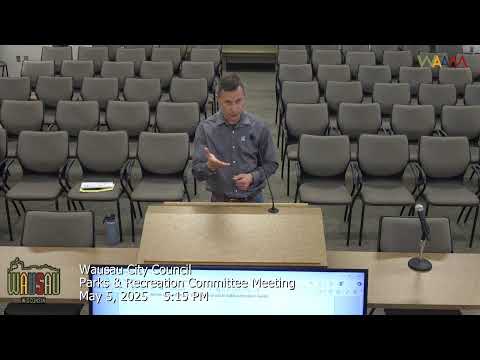
Wausau City Forester John Kehan told the Parks and Recreation Committee on May 5 that the city has removed 1,695 ash trees tracked since about 2019 and is managing a large emerald ash borer infestation with a mix of injections, removals and replacement plantings.
Wausau City Forester John Kehan told the Parks and Recreation Committee on May 5 that the city has removed 1,695 ash trees tracked since about 2019 and is managing a large emerald ash borer (EAB) infestation with a mix of injections, removals and replacement plantings.
Kehan, introduced by Parks staff member Polly, said the city is following an updated EAB management plan and is working to keep removals and replanting on a steady schedule while using injections on selected trees to control spread and buy time. “We’ve taken down 1,695 ash trees that we’ve tracked since roughly late 2019,” Kehan said. “We had a vision we had about 6,000 ash trees. We’ve really had closer to 7,000 in the city.”
The committee learned that injections have been used in recent years to preserve certain boulevard ash trees: Kehan reported injections of 873 in 2022, 948 in 2023 and 742 most recently. He said the city’s inventory includes roughly 3,317 ash trees remaining that are being monitored and that about 806 of those are not currently on the injection list because they are small, in poor condition or poorly sited.
Why it matters: The EAB infestation is driving a multi-year program of removals and replacements. Kehan said the city’s pace aims for a 12-year removal-and-replacement timeframe to allow flexibility if schedules slip and to avoid being driven solely by the insect’s spread.
Plan, removals and plantings Kehan said the public-right-of-way removals have recently been about 800–900 trees per year, while current replanting is about 525 trees per year — leaving an annual shortfall of roughly 350–400 trees. “You’re talking 900-ish removals a year, planting 540. You’re still 350, 400 short a year,” he said. The forester said the city prioritizes replacing boulevard ash trees removed at residences when residents request replacements and that residents may pay privately to have boulevard ash injected to preserve a particular tree.
The committee was told the city issued a bid for a grant-supported planting contract. Legacy Trees won the bid; the agreement calls for 300 trees per year for three years but, because of favorable pricing, Legacy Trees is planting a total of 415 under the contract (80 in spring and the remainder planned for fall). The planting work will focus on qualified neighborhoods, which cover about half of the city, and staff said they will try to distribute plantings across other areas to be equitable.
Street reconstruction and tree survival Kehan and Engineering Project Engineer TJ Niknish described how street reconstruction projects lead to many tree removals. Engineering produces full construction plans; forester review then targets ash trees, trees in poor condition, and trees located where excavation or utilities will compromise root stability. Niknish explained that the city’s curb design normally requires one foot of improved aggregate behind the back of curb to protect curb integrity and road base; that excavation footprint often removes the root area larger trees need to remain stable.
“We go one foot behind our curb with aggregate to help that stability of the curb,” Niknish said, noting the specification helps prevent frost heave and road deterioration. He added that the curb machine itself probably needs only about six inches behind the curb to operate, but the engineering standard calls for a deeper preparation for long-term pavement stability.
Committee members urged more collaborative, front‑end coordination. Alder Neal described the 600 block of Fulton Street, where he said 18 trees were removed and only one tree remained, and urged the committee and staff to seek less-transformative approaches on major projects. “Out of 18 trees on that block, if six were saved, we would have had some semblance of the character of that block maintained,” Alder Neal said.
Several members recommended reviving earlier cross‑department work with infrastructure and engineering so tree specialists and project designers review street designs together before construction. Niknish and Kehan agreed such discussions are done case‑by‑case now but said staff can provide project-level reports showing how many trees are on a project, how many are being removed and how many are being saved.
Pruning and staffing Kehan said block pruning has been largely deprioritized because staff time is consumed by EAB removals, injections and plantings; instead crews focus on pruning small trees to improve long-term structure and responding to resident requests for view clearance and hazard branches. Parks staff noted the city’s planting budget has been raised to accommodate more replanting in prior budget requests, but that budget increases have not materialized in recent cycles and that is one reason replacements lag removals.
Process improvements discussed - Engineering has begun installing root‑barrier material at tree sites and coordinating tree stakes for future plantings. Niknish said the city has used tree root barriers of about 14 feet at planned tree sites so roots are directed deeper rather than into sidewalks. - Staff proposed bringing in outside expertise as was done previously (a Milwaukee street‑tree program consultant visited years ago) and suggested the committee consider inviting tree‑program specialists to review local practices. - Members requested a report on specific blocks (for example, the 600 block of Fulton) explaining the disposition of trees removed there and whether removals were driven by disease, species, or construction necessity.
What the committee directed No formal policy change was adopted at this meeting. Committee members asked staff to restart cross‑department dialogue with Infrastructure/Facilities and to provide project‑level breakdowns of trees removed, saved and on the fence for future street reconstructions so the committee can review those cases earlier in the design process.
Votes at a glance - Approval of minutes, April 7, 2024: Motion by Alder Neal, seconded by Alder Lukens; passed unanimously. - Motion to adjourn: Motion by Alder Watson, seconded by Alder Lukens and Alder Neal; passed unanimously.
Ending Committee members scheduled the next meeting for Monday, June 2, 2025, at 5:15 p.m. in council chambers. Parks staff also said they may request a special meeting to address staffing and vendor changes related to River Life concessions for the summer season.