Get Full Government Meeting Transcripts, Videos, & Alerts Forever!
Get email alerts on the Transportation Grade Separation topic
No spam. Unsubscribe anytime.
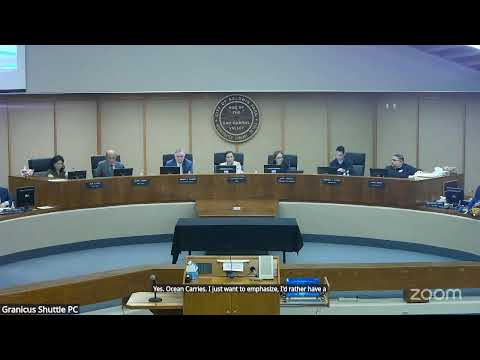
Council accepts Metro feasibility study for Ramona Boulevard grade separation, directs staff to seek partners and funding
Summary
The Baldwin Park City Council received and filed a final feasibility report from LA Metro assessing a grade separation at Ramona Boulevard and the Metrolink San Bernardino line, acknowledged a conceptual cost estimate and directed staff to pursue partnerships and funding; council voted 5-0 to proceed.
The Baldwin Park City Council voted to receive and file a technical feasibility report from Los Angeles County Metropolitan Transportation Authority (LA Metro) on a proposed grade separation where Ramona Boulevard crosses the Metrolink tracks and to direct city staff to pursue partnerships and funding for the next development steps.
The study, described by Charles Zhang, senior director with LA Metro's regional rail division, was presented as a Project Study Report Equivalent (PSRE) that evaluates conceptual alternatives and prepares the groundwork for engineering and grant applications. "This is a PSRE. We call it project study report equivalent, for any grade separation projects… this is the step 1," Zhang told the council.
Staff and Metro recommended the council acknowledge the project is technically feasible and to pursue environmental clearance, preliminary engineering and grant funding from county, state and federal sources. The presentation compared four alternatives (rail over roadway, rail under roadway, roadway over rail and roadway under rail) and found the preferred concept is to depress Ramona Boulevard under the rail corridor (the roadway-under-rail alternative) because it minimizes right-of-way impacts and constructability issues. The preferred footprint was described as roughly 2,000 linear feet with a single-span steel bridge over the tracks; conceptual bridge span lengths were noted as unusually long given the skew of the crossing.
Cost estimates presented to the council included a conceptual engineer's estimate of about $113 million (with a 30% contingency built into the conceptual estimate) for the preferred alternative; Metro staff also showed an eight-year escalation scenario that could raise the cost to about $167 million if the city delays moving forward. City staff read the study recommendations into the record and recommended the council: receive and file the PSRE; acknowledge technical feasibility and the escalated 8-year cost estimate; direct staff to pursue a project development partnership with LA Metro, Metrolink, Caltrans, San Gabriel Valley Council of Governments and others; and direct staff to pursue grant funding with support from elected officials.
During questions, council members pressed on right-of-way and access impacts for adjacent residents and businesses and whether the city could pursue negotiated acquisitions versus eminent domain. The city attorney confirmed land acquisition tools such as eminent domain are legally available where statutory standards are met; Metro staff urged negotiated, "friendly" acquisitions where possible. Council members also raised construction staging and traffic impacts during construction; Metro staff said construction staging details would be developed during preliminary engineering and noted construction approaches can substantially shorten traffic disruption when planned properly.
Motion and vote: Council member Emmanuel J. Estrada moved to receive and file the report and to adopt the staff recommendations; Council member Manuel Lozano seconded. The roll call vote was recorded as Yes from Ayala, Estrada, Lozano, Mayor Pro Tem Damien and Mayor Avila; the motion carried 5-0. The council's direction included moving next to environmental clearance and preliminary engineering and seeking partner commitments and grant funding.
Why it matters: A grade separation at Ramona Boulevard would remove a busy at-grade crossing on the San Bernardino Line that council and staff said constrains traffic flow, creates safety exposure at the crossing and limits downtown mobility. The agreement to pursue the next design and permitting steps places the project on a formal path that city staff and Metro said is necessary to apply for major state and federal grants; Metro estimated the full process from environmental clearance through construction could span multiple years (staff presented a rough eight-year from-start-to-finish timeline).