Get Full Government Meeting Transcripts, Videos, & Alerts Forever!
Get email alerts on the Development Agreements topic
No spam. Unsubscribe anytime.
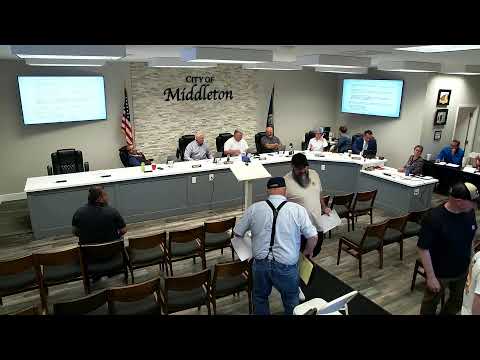
Council approves one-year administrative extension option for Sterling Lakes after bridge delays
Summary
Middleton City Council approved a modification to the Sterling Lakes development agreement allowing the developer an additional one-year administrative extension to submit the phase 1 final plat, after the developer said specialized bridge decking manufacturing delays threatened the original timeline.
Middleton City Council on Tuesday approved a first amendment to the development agreement for Sterling Lakes, allowing the developer an additional one-year administrative extension to submit the phase 1 final plat if the developer applies before the earlier extension expires.
The modification stems from delays the developer said were caused by manufacturing setbacks for specialized precast bridge decking needed for a bridge over Mill Slough. Derek Rush, representing Sterling Homes, told the council the decking required a “voided slab design” and that delivery of the precast slabs was delayed by the manufacturer. “This extension will ensure continued high quality execution without compromise,” Rush said.
The development agreement for Sterling Lakes was approved in September 2021 and originally allowed three years for the developer to submit phase 1 final plat materials, plus one administrative one-year extension if requested on time. Planning staff reported that construction drawing approval occurred in December 2022 and that the site has substantial infrastructure work already completed, including grading, water and sewer, joint trench, and temporary access for bridge foundation work. City Engineer Amy Woodruff recommended approval.
Rush said Sterling Homes contracted a bridge manufacturer in early 2024 and received final decking designs in October 2024. He said the manufacturer committed to producing 15 large precast slabs, but unforeseen issues delayed production; the first portion of the decking was installed the day before the council meeting. Rush said remaining work includes paving, parapet walls and railing. He told the council the developer expects to deliver homes in early 2026 and asked that the DA be amended only to permit an additional administrative extension, not to change density or layout.
Planning and Zoning held a public hearing on April 14 and recommended approval; staff said there were no outstanding agency comments. Miss Stewart, planning staff, told the council there are no staff-recommended conditions if council chooses to approve. A council member moved to approve the DA modification; the motion carried on a voice vote.
The amendment inserts language authorizing an additional one-year administrative extension to the DA if the developer timely requests it before the previous extension expires. Staff noted the council should include a written statement of factual findings in its final order.
Council members did not record a roll-call tally in the minutes; the motion was approved by voice vote.
The council did not change any other terms of the DA and did not set additional conditions. The developer’s presentation and the planning record are part of the project file.