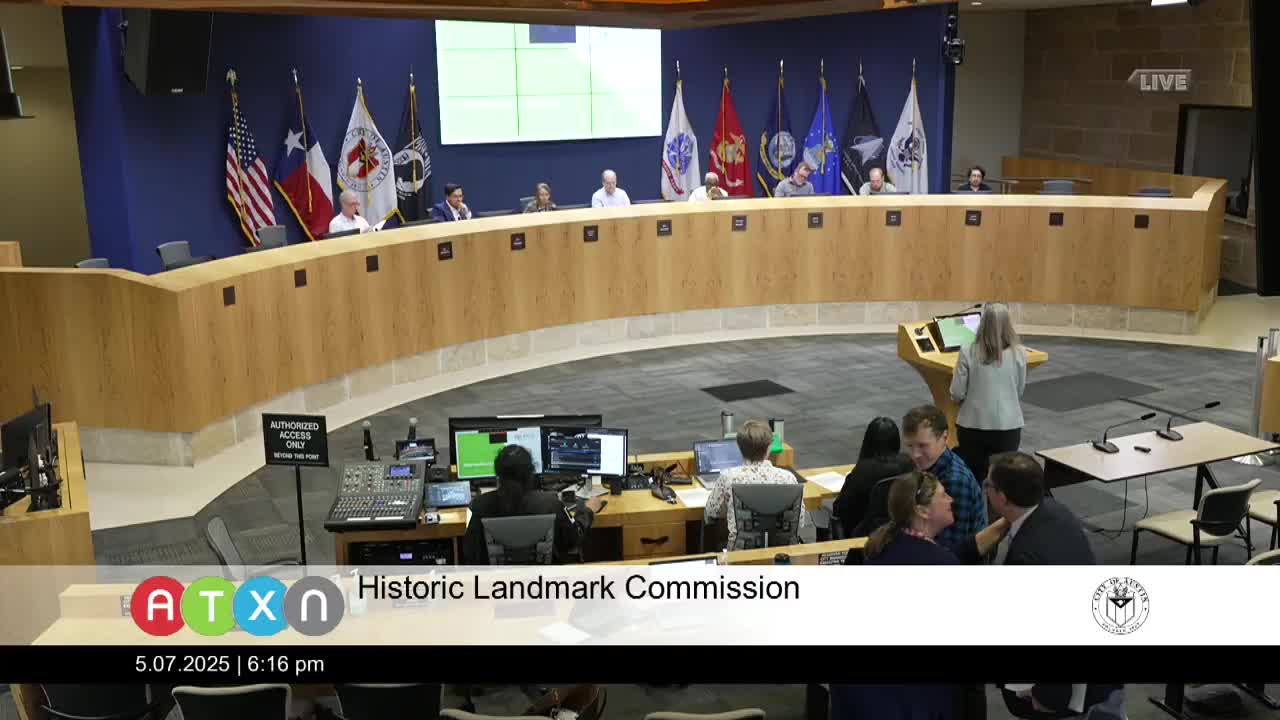
Raleigh Austin briefs Historic Landmark Commission on cultural trust investments, East Eleventh redevelopment and preservation goals
Loading...
Summary
Raleigh Austin officials told the Historic Landmark Commission on May 7 that the local government corporation is using seed funding and partnerships to preserve arts and culture, advance affordable creative workspace and support the East Eleventh Block 16/18 redevelopment while pursuing potential 2026 bond priorities.
Raleigh Austin officials briefed the City of Austin Historic Landmark Commission on May 7 about the organization's portfolio of cultural-preservation projects, including investments through a cultural trust, renovation and theater preservation projects and early-stage work on the East Eleventh Block 16/18 redevelopment.
Anne Gatling Haines, chief transactions officer at Raleigh Austin, told the commission the agency is a local government corporation and a 501(c)(3) that aims to “address affordability in Austin, including historic preservation.” She said the agency was created in late 2020, the board was seated in 2021, and Raleigh Austin began operating with initial funding intended to produce longer-term real estate investments that support arts, music and cultural organizations.
Why it matters: Raleigh Austin’s approach is aimed at combining small public seed funds with tax credits, philanthropic grants and development tools to secure longer-term, affordable space for arts organizations and creative workers that have been displaced by rising costs.
Key points from the briefing - Organization and board: Raleigh Austin is governed by a board that includes a representative nominated by the Historic Landmark Commission; Brad Patterson has served as that representative since 2021 and participates on the real-estate committee. - Funding and scale: Haines said the organization began with approximately $19,400,000 in city-dedicated seed funds for the cultural trust. In an RFP process Raleigh Austin received applications from 45 organizations representing roughly $350,000,000 in reported needs, illustrating a significant gap between available initial funds and citywide needs. - Portfolio and projects: Raleigh Austin has invested in an initial set of six cultural-trust projects focused on preserving existing venues (examples cited included the Hole In The Wall and Empire) and renovating performance spaces (the Millennium Theater and other venues). Several investments are structured as long-term leases or funding agreements with 20–40 year restrictive covenants. - East Eleventh Block 16/18: The agency described the two acres that compose Blocks 16 and 18 along East Eleventh Street as being in an exclusive negotiating agreement with a development team selected by the Urban Renewal Board; Raleigh Austin staff said construction is not expected for roughly 18 months to two years while the developer completes design and financing work. The project will aim to incorporate cultural anchors such as the Victory Grill and nearby institutions. - Strategy and future steps: Raleigh Austin staff said the agency leverages financing tools such as historic tax credits and new market tax credits, philanthropic partners and city investments. Haines said the agency is considering additional investments for a potential 2026 bond program and emphasized priorities including legacy-business preservation and affordable creative workspace.
Quotations - Anne Gatling Haines, Chief Transactions Officer, Raleigh Austin: “We are here to address affordability in Austin, including historic preservation.” - Brad Patterson, Raleigh Austin board member and the commission’s representative: “I am really proud of what the organization has already accomplished and what we have coming in the pipeline.”
Context and timeline Raleigh Austin officials said the East Eleventh Block 16/18 project will proceed through the exclusive negotiating phase and that visible construction activity is not expected for roughly 18 months to two years. Staff also described a long pipeline of projects that will require additional capital, partnerships and possible future bond funding to scale preservation and affordable workspace outcomes.