Get Full Government Meeting Transcripts, Videos, & Alerts Forever!
Get email alerts on the Green Infrastructure Stormwater topic
No spam. Unsubscribe anytime.
DEP backs notice requirement, opposes fixed "greened acres" target for MS4 areas at council hearing
Summary
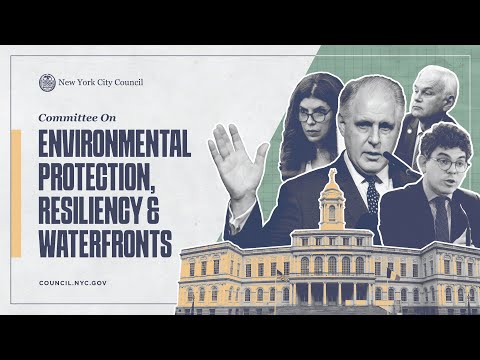
Deputy Commissioner Licata of the New York City Department of Environmental Protection testified before the Council committee on environmental protection about DEP’s green infrastructure program, saying the agency supports a proposed local‑notification bill with edits but opposes a separate mandate requiring 2,400 "greened acres" in MS4 areas by 2035.
Deputy Commissioner Licata of the New York City Department of Environmental Protection testified before the City Council committee on environmental protection about the agency’s expanding green infrastructure program and two bills on the committee’s agenda. Licata described DEP’s maintenance routines, funding sources and large-scale projects — and told the Council the Department “generally support[s]” Intro. 1253 (a 30‑day local-notification requirement for bioretention installations in the public right of way) while urging edits, but opposed Intro. 1254, which would require DEP to install 2,400 greened acres in MS4 areas by 2035.
Why it matters: Councilmembers and community advocates pressed DEP on whether fixed acreage targets, notification rules and federal funding changes will help neighborhoods facing frequent street flooding. The hearing highlighted tensions between state consent-order CSO priorities, citywide stormwater goals, and the limits of green infrastructure in some neighborhoods (for example, high groundwater areas in Southeast Queens).
Licata gave a detailed account of DEP’s work and key figures for the Council. She said the agency has retrofitted over 250 parks, playgrounds and NYCHA properties with green infrastructure, and noted the city now has roughly 16,000 green infrastructure assets. On private‑land programs, she testified that a capital-funded grant program invested approximately $13,000,000 across 32 sites (mostly green roofs) and that DEP has funded about $9,500,000 of private green infrastructure that now manages an estimated 11,000,000 gallons of stormwater per year. Licata also described the Unified Stormwater Rule that took effect in early 2022 and requires on‑site management for sites that disturb 20,000 square feet or add 5,000 square feet of impervious surface.
Licata emphasized maintenance needs and tradeoffs: “We strive to keep our rain gardens healthy and performing by visiting them every 4 to 6 weeks,” she said, and added that more litter control diverts staff time from soil enhancement, pruning and planting. She gave a rough per‑feature cost for bioswales and rain gardens: “It’s somewhere between 15 and 20,000.”
On the bills, Licata said DEP and the Department of Design and Construction already coordinate community outreach and that DDC is willing to supplement those plans; DEP therefore “generally support[s]” Intro. 1253 but asked for further conversations and edits. On Intro. 1254 she argued the greened‑acre metric is a poor sole measure for progress in MS4 areas because the original greened‑acre definition was designed to measure CSO volume reduction in combined‑sewer areas, not flood reduction or pollutant treatment in MS4 areas. She warned the metric could force installations where they would be ineffective and noted physical constraints and capacity: after more than a decade of installing GI in combined‑sewer areas DEP has “just reached 2,800 greened acres,” while the bill would require nearly the same acreage in the smaller MS4 portion of the city over the next 10 years.
Councilmembers used the hearing to press DEP on local coordination and data. Councilmember Holden and others raised examples from constituents of utility and roadway contractors paving over tree strips and street green areas; Licata and Parks representatives said they would pursue utility coordination and follow up. Councilmember Ressler and others pressed DEP for timeframes and capital funding for the agency’s list of 86 high‑risk flood locations; DEP staff reiterated the scale of the challenge, said about $28,000,000 of MS4 projects are upcoming and that a 30‑year build‑out estimate for comprehensive upgrades depends substantially on funding.
Parks and other agency officials described their roles. Matt Drury, chief of citywide legislative affairs for New York City Parks, and Marit Larson, assistant commissioner for natural resources and planning at Parks, described routine enforcement and outreach on street trees and explained ways Parks partners with DEP on blue‑belt and park‑based GI projects. Melissa (assistant commissioner, DEP green infrastructure programs) described schoolyard projects and partnerships with the Trust for Public Land and the School Construction Authority.
Public and stakeholder testimony largely supported nature‑based solutions but opposed the greened‑acre mandate. Em Ruby of Riverkeeper told the committee she and her organization “oppose Intro. 1254” and warned that a greened‑acre target in MS4 areas could divert funds from CSO work in combined‑sewer areas and would “result in widely dispersed and poorly planned green infrastructure assets.” Paul Gallais (Columbia Climate School) and representatives of the League of Conservation Voters and the SWIM Coalition urged prioritized funding, community co‑design and workforce investments; SWIM asked the Council to earmark the city’s $303,000,000 rental payment from the New York City Water Board to replace federal BRIC funds lost to the city’s cloudburst projects.
Discussion vs. decision: the hearing was informational; no vote was taken. DEP’s formal positions on the bills are on the record: support for a notification requirement (Intro. 1253) with edits and operational caveats; opposition to a fixed 2,400‑greened‑acre mandate in MS4 areas (Intro. 1254), with technical and capacity justifications.
What to watch next: DEP requested continued dialogue with the Council and DDC about how to amend Intro. 1253; multiple witnesses and advocates asked the Council to rework Intro. 1254 into a metrics and planning approach that captures flood reduction, water‑quality treatment and site suitability rather than a single acreage target.
Sources and evidence: Council testimony from Deputy Commissioner Licata, Parks officials Marit Larson and Matt Drury, public testimony from Em Ruby (Riverkeeper), Paul Gallais (Columbia Climate School), Alia Sumrow (NYLCV), Michelle Lutke (SWIM Coalition), and exchanges recorded in the committee transcript.