Get Full Government Meeting Transcripts, Videos, & Alerts Forever!
Get email alerts on the Energy Policy topic
No spam. Unsubscribe anytime.
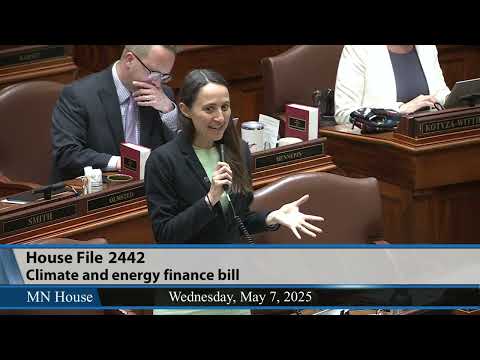
House passes energy "lights-on" budget bill after floor debate on data centers, RDA and nuclear
Summary
House File 2442, an act relating to energy and funding for energy and renewable development account programs, passed the Minnesota House on third reading after extended floor debate on the state’s energy priorities.
House File 2442, an act relating to energy and funding for energy and renewable development account programs, passed the Minnesota House on third reading after extended floor debate on the state’s energy priorities.
Representative Jessica Acum, a Hennepin County representative and co-chair of the House Energy Committee, opened debate by describing HF2442 as a “lights-on” budget bill that preserves several recent advances in Minnesota’s renewable-energy transition and adheres to committee targets. She said the committee could not include every policy request this session but said the bill protects prior gains and keeps state government operating.
The debate moved to substantive policy differences. Representative Loren Swazinski (Lyon) framed HF2442 as a compromise that should move to conference, arguing the bill missed opportunities such as broader net-metering reform and lifting the moratorium on new nuclear construction. “This bill is a lights on Bill,” Swazinski said, urging members to vote to send it to conference so the policy can evolve.
Several DFL members and committee participants pushed in the other direction. Representative Amira Jones (Hennepin) highlighted energy-efficiency investments and federal programs such as Energy Star, calling efficiency “the cheapest and cleanest kilowatt hour” and saying independent reviews find $1 returned to the state economy for every $1 spent on efficiency programs. Jones described the bill as continuing Minnesota’s long history of efficiency investments and urged a green vote.
Representative Kendra Quam raised support for small modular nuclear power and hydrogen production as technologies she believes Minnesota should embrace. Representative Solomon Murphy (Otter Tail), a vice chair in the committee, voiced concerns about utility-scale solar siting and potential agricultural impacts, citing industry processing rules and reporting that many solar projects are being placed on prime farm land.
Representative Talia Hollins (Ramsey) urged the House to use proceeds from the Renewable Development Account, a fund established in 1994 as part of a compromise tied to on‑site nuclear fuel storage at Prairie Island. Hollins said the RDA, funded by Xcel Energy ratepayer payments, has directed more than $200 million to wind, solar, biomass and storage projects and itemized several RDA investments (examples she cited include $4,750,000 to Granite Falls hydroelectric, $2,000,000 for community energy transition grants, $10,000,000 to the University of Minnesota Morris for a green ammonia pilot, and $5,500,000 to a Mountain Iron solar manufacturing project).
Committee co-chairs and other members thanked staff and emphasized the expectation that unresolved issues will be addressed in conference committee. Representative Acum asked colleagues for a green vote to advance the bill and to continue negotiations in conference.
There were no amendments at the desk. On roll call, 112 members voted yes and 21 voted no; the clerk recorded Representative Fogelman voting no remotely by name. The House agreed to the bill’s title, and the bill passed.
Votes at a glance: House action on three measures reported on the floor that day included: - House File 2442 (energy, FY and Renewable Development Account programs): third reading passed, 112–21; title agreed to. - House File 2115 (human services): House refused to concur in Senate amendments; motion carried and the speaker appointed a House conference committee (members named on the record). - House File 2434 (human services): House refused to concur in Senate amendments; motion carried and the speaker appointed a House conference committee (members named on the record).
Procedural follow-up: The speaker announced House appointments to the two conference committees. For House File 2115 the House appointees were Representatives Schumacher, Gander, Noor and Frederick. For House File 2434 the House appointees were Representatives Schumacher, Gilman, Jacob, Knorr, Keeler and Curran.
Context: HF2442 was presented on the floor as primarily a budget and program-continuity measure for energy-related accounts overseen by the Department of Commerce and the Public Utilities Commission, including the Renewable Development Account. Floor debate emphasized competing priorities — continued investment in energy efficiency and renewables, protection of ratepayers, and potential future policy work on data centers, net metering, nuclear and hydrogen. Conference committee negotiations were expected to address outstanding policy differences.