Get Full Government Meeting Transcripts, Videos, & Alerts Forever!
Get email alerts on the Parking topic
No spam. Unsubscribe anytime.
Council set to hold public hearing May 14 on off‑street parking code rewrite after multi‑year review
Summary
Planning staff presented a citywide rewrite of off‑street parking and loading rules May 7 and the council scheduled a public hearing for May 14 to consider the proposed changes.
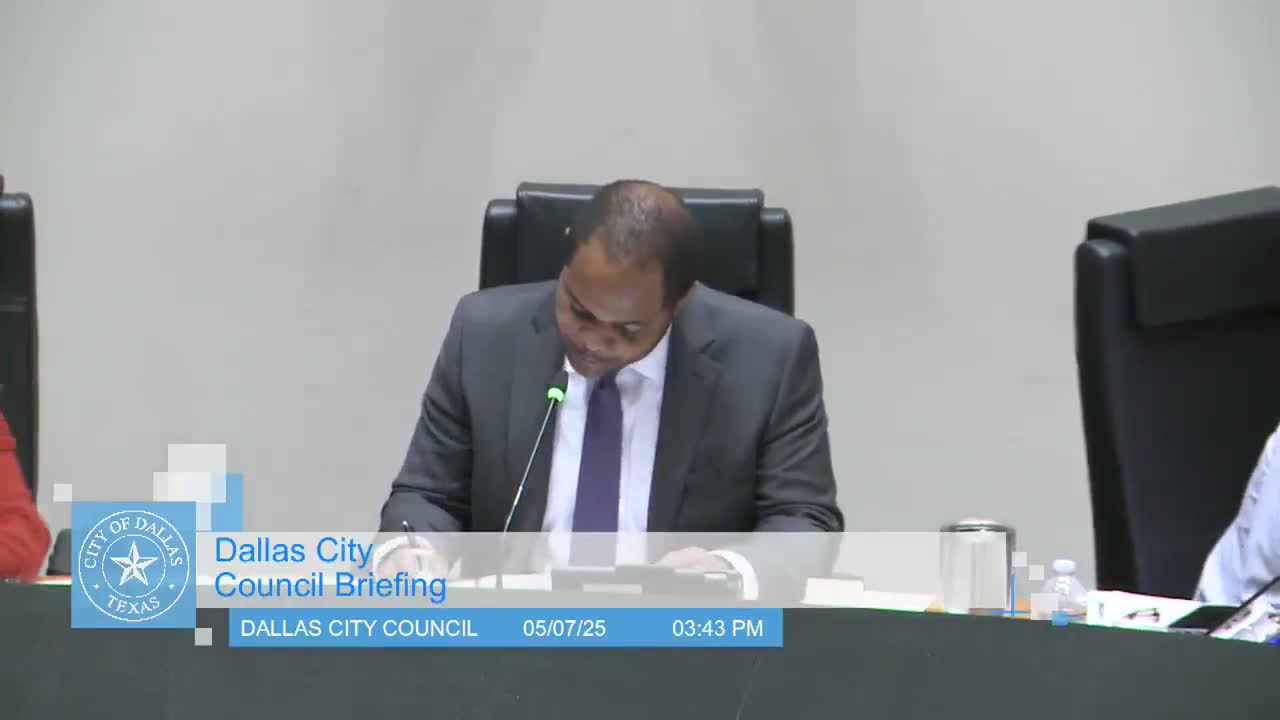
The Dallas City Council received a lengthy briefing on May 7 about a proposed development‑code amendment to off‑street parking and loading requirements. Staff described the item as the culmination of several years of work and recommended that council hold a public hearing on May 14.
What staff proposed: Planning staff presented a citywide rewrite of off‑street parking and loading rules that would reduce the number of rigid, one‑size‑fits‑all parking minimums, introduce context‑sensitive rules for transit‑oriented areas, clarify loading and bicycle parking standards, and simplify administrative reductions.
Key recommended changes discussed in the briefing: - Transit and downtown: City Plan Commission (CPC) recommended ‘‘no required parking’’ for areas it identifies as TODs (defined by CPC as roughly within a half mile of light‑rail or streetcar stations) and for downtown. Staff mapped existing station buffers and estimated the half‑mile area at roughly 8 percent of the city. - Residential: CPC recommended simplified residential ratios (single‑family detached/attached and duplex: one parking space per unit) and a multifamily baseline of 0.5 spaces per dwelling unit for many developments. The Economic Development Committee (EDC) amended that approach with a tiered structure: developments with 200 or more units would provide one parking space per unit, 21–199 units would be at 0.5 per unit, and 20 or fewer units would require no parking. - Ancillary uses and historic buildings: CPC recommended exemptions or reduced requirements for some historic buildings and for small restaurants and retail. EDC revised the small‑restaurant language to treat the first 2,500 square feet of certain uses as exempt from minimum parking, easing the requirement for small businesses. - Loading and vehicle‑service uses: CPC added clearer loading rules and required that vehicle‑related uses keep serviced or displayed vehicles on site rather than using nearby public property. - Design and bike parking: CPC included modest design standards (pedestrian paths, tree protection, curb‑cut limits) and clarified short‑ and long‑term bicycle parking expectations; EDC recommended removing curb‑cut width limits now and addressing design comprehensively in the broader zoning reform.
How councilmembers reacted: Council members expressed a mix of support and concern. Supporters, including Chair Chad West, said the code is outdated, places a high cost on housing and small projects, and that the draft changes would remove needless barriers for small businesses and for multifamily and affordable housing projects. Council member Zarin Gracie and others urged caution, highlighting the importance of anticipating spillover effects on neighborhood street parking and asking that the city ensure strong curb‑management and neighborhood permit tools are in place before wide reductions. Several council members asked staff to do further outreach to neighborhood groups, disability advocates and senior‑affairs stakeholders and to produce data showing anticipated effects by district.
Process and next steps: Planning staff reminded council that the draft only changes the base code; plan‑district (PD) provisions would continue to govern areas that already have customized parking rules (PDs cover an estimated 18 percent of the city). Staff said CPC met six times and Zoning Ordinance Advisory Committee (ZOAC) met more than two dozen times on the subject; EDC reviewed the item and recommended changes earlier in the week. The council scheduled a public hearing for May 14; staff said the code rewrite will also be part of the larger comprehensive zoning reform.
Why it matters: Off‑street parking rules affect development cost, housing affordability and how public space is used. Staff told council the rewrite is intended to lower development cost, encourage transit‑oriented development and avoid requiring parking where market and transit accessibility make it unnecessary. Critics warned of unresolved neighborhood impacts if the city removes minimums without stronger curb‑management and enforcement tools.
Public comment: Speakers at today’s meeting urged both caution and action. Supporters — including practitioners who worked on parking reform in other Texas cities — said minimums raise housing costs and that other cities have successfully reduced parking mandates without harming accessibility. Opponents stressed the need for careful district‑level outreach and asked staff to address handicapped parking, parking enforcement, and impacts on seniors and people with disabilities.
Next steps: The council will hold a public hearing on May 14. If council moves forward, staff said plan‑districts with bespoke parking rules would remain in force unless council votes to amend them by separate action. The planning department also committed to incorporate the parking work into the pending comprehensive zoning reform and to supply additional district‑level impact analyses if requested.