Get Full Government Meeting Transcripts, Videos, & Alerts Forever!
Get email alerts on the Living Wage Plan topic
No spam. Unsubscribe anytime.
Austin Public Health outlines options, cost estimates to apply city living wage to social‑service contracts
Summary
APH presented a multiyear implementation plan and survey results showing variable impacts of applying the city living wage ($21.63) to social‑service contracts; staff estimated a range of costs and offered narrower and broader implementation scenarios for council consideration.
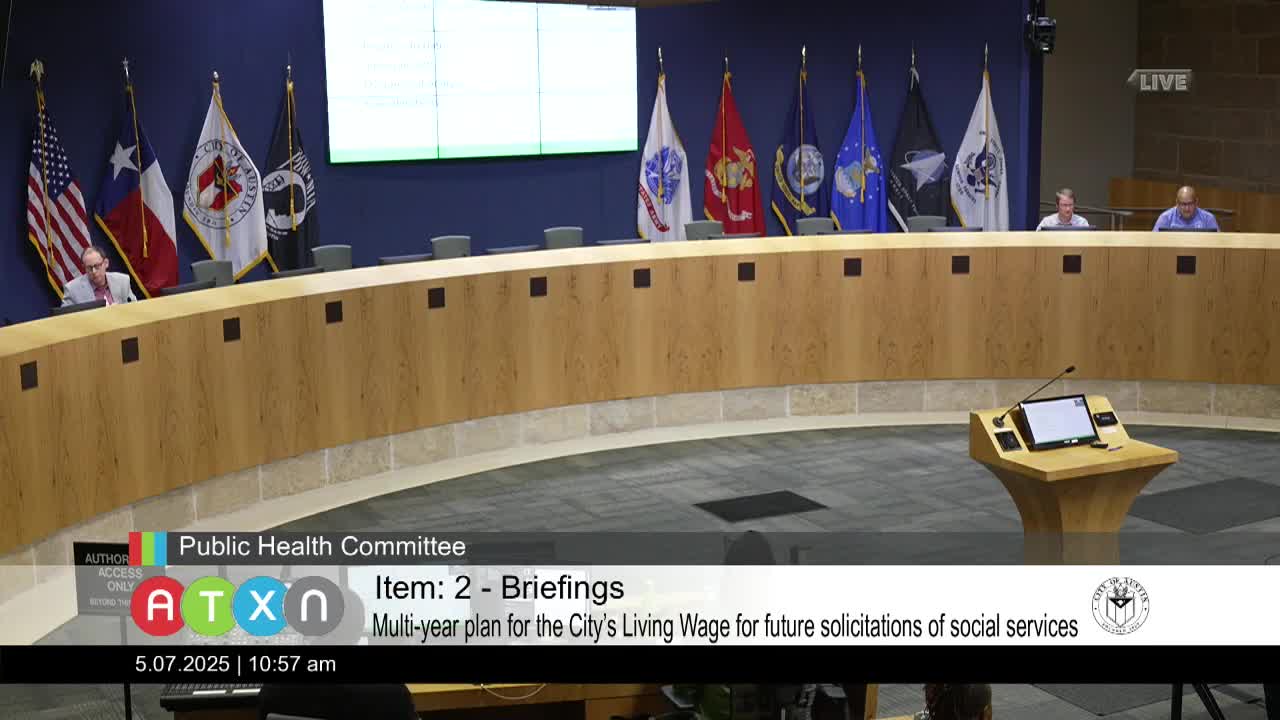
At the May 15 Public Health Committee meeting, Austin Public Health staff briefed councilmembers on a multiyear plan to apply the city living wage to future social‑service solicitations and shared results from a vendor survey and preliminary cost analyses.
Laura La Fuente, assistant director of Austin Public Health, said the guidance from the budget process directed APH to develop an “implementable multi year plan for applying the city's living wage for all future solicitations for social services.” La Fuente told the committee that APH convened discussions with Travis County and Central Health; Travis County indicated it would be unable to update contract living‑wage requirements, and Central Health staff noted funding relationships differ by provider.
APH released a public survey in December–January to assess vendor capacity and impacts. La Fuente summarized survey findings: 56% of respondents reported that 0–10% of their full‑ and part‑time employees working on city‑funded programs currently make less than $21.63; about 17% reported that more than half of their staff fall below the living wage. Respondents’ estimates of required additional funding to raise covered workers to $21.63 ranged from about $22,000 to $305,000 per contract; APH reported an average estimate of about $182,000 per contract. Based on 54 survey responses, staff presented a ballpark FY26 impact estimate of roughly $9,900,000 but cautioned that the sample is not a comprehensive inventory of contracts.
La Fuente outlined two narrower options for implementation: (1) apply the city living‑wage requirement only to social‑service contracts in which the city contracts for goods or services to a third party where the city is responsible for service delivery (APH and select EMS contracts), an approach APH estimated would require about $530,000 for current APH/EMS contracts pending department‑wide review; or (2) adopt an across‑the‑board 3% annual cost‑of‑living increase for all social‑service agreements, which APH staff estimated at about $2,300,000 on top of an existing ~$77,000,000 social‑services portfolio.
Staff also flagged implementation challenges: ongoing funding sustainability for annual cost‑of‑living increases, salary compression and market‑rate effects, administrative burden for smaller nonprofits, and potential reductions in programmatic services if funding remains level.
Committee members asked clarifying questions. A councilmember asked whether the “54 respondents” correspond directly to the count of contracts; La Fuente said the number reflects survey respondents and that more work is needed to map responses to the full contract inventory (she noted APH has about 37 relevant contracts and that other departments must be queried to complete the list).
Why it matters: Applying the living wage to contracted social‑service work affects providers’ labor costs and could require additional city funding or changes to contract scope. Staff framed the briefing as preparatory information for policy decisions in the budget cycle; no binding policy decision was made at the hearing.